THE SHROOMVERSE JOURNAL ✳ 22 MIN READ
DMT Trip Simulation: How Close Can It Really Get?
DMT trip simulation: how close can videos and VR get? Explore common visual motifs, timelines, entity archetypes, safety warnings, and realism limits.
On this page 10 sections
A DMT trip simulation can make your screen bloom into jeweled tunnels, impossible temples, grinning jesters, and rooms that seem to fold through themselves. With headphones and a dark room, the best examples can feel surprisingly absorbing. But can a video actually reproduce one of the most intense psychedelic states people report?
Not really, and that distinction matters. A simulation can imitate recurring visual motifs, accelerating motion, spatial distortion, and dramatic sound. It can't reproduce the changes in identity, emotion, time, bodily awareness, or apparent reality associated with N,N-dimethyltryptamine (DMT). You're watching a representation, not entering a pharmacologically altered state.
This review explains what these simulations portray, how their familiar POV imagery relates to published reports, and where artistic license takes over. It also covers typical timelines, entity encounters, intensity levels, accessibility risks, and a practical realism checklist. It does not explain how to obtain, prepare, dose, or consume DMT. In the United States, DMT is generally classified as a Schedule I controlled substance, apart from narrow legal and research contexts.
This assessment draws on clinical research, survey data, documented experience reports, and visual-media analysis, not the claim that any animation can serve as a risk-free practice run for a breakthrough.
Key Takeaways
- A DMT trip simulation artistically recreates visual motifs like tunnels and fractals but cannot replicate the full psychedelic experience or altered states of identity and emotion.
- These simulations serve curiosity, harm reduction education, and artistic exploration but should not replace professional advice or preparation for actual DMT use.
- Different formats (POV videos, VR, AI-generated visuals, and audio sound baths) offer varying immersion levels, but each has limitations in realism and safety.
- Typical DMT trip visuals include recursive geometric patterns, entity archetypes like jesters or machine elves, and intense spatial distortions, but simulations often exaggerate or simplify these features.
- Simulations should include clear safety warnings due to potential risks like motion sickness, anxiety, or photosensitive seizures, especially in VR or flashing imagery.
- Evaluate DMT trip simulations critically, recognizing they provide interpretive art rather than exact pharmacological representation, and use them responsibly as visual and conceptual tools rather than experiential guides.
What a DMT Trip Simulation Is (and What It Can't Replicate)
A DMT simulation is an artistic attempt to translate reported psychedelic effects into ordinary media. Usually, it combines computer-generated geometry, first-person camera movement, layered textures, faces, symbolic figures, and spatial audio. The result may resemble certain features of an experience without reproducing its overall state.
That limitation isn't a technical failure. A screen remains a flat, bounded object you know you can pause. During an intense psychedelic state, users may report losing normal awareness of the room, body, time, or even personal identity. Scenes can appear autonomous and more convincing than imagination, not merely projected in front of the viewer.
A simulation also can't predict what any individual would experience. Expectations, mental health, environment, memory, culture, and pharmacology all affect psychedelic experiences. Some people report elaborate spaces and entities; others describe abstract imagery, terror, bodily sensations, fragmented impressions, or little imagery at all.
Reality check: A convincing video is best treated as interpretive psychedelic art, not a diagnostic tool, dose guide, or guaranteed preview.
Why People Search for DMT Simulations: Curiosity, Harm Reduction, Preparation, and Art
Curiosity is the obvious draw. You may have heard Joe Rogan mention "machine elves," encountered Alex Grey-style visionary art, or watched a clip titled DMT Breakthrough 4K and wondered whether the imagery has any basis in reported experiences.
Others arrive with harm-reduction intentions. They want to understand why experiences can become overwhelming or why users describe ego dissolution and encounters with apparently intelligent beings. That context can correct the breezy myth that DMT is simply "a colorful 10-minute trip." Still, watching videos isn't sufficient preparation for pharmacological, psychiatric, legal, or situational risk.
Simulations also function as art. Creators such as Julius Horsthuis explore fractal architecture without claiming literal neurological accuracy. For sober viewers, that work can be enjoyed like surreal animation or visual music.
If you're using simulations to decide whether DMT is safe for you, stop there. A video can't assess medication interactions, cardiovascular concerns, bipolar-spectrum vulnerability, psychosis risk, or the hazards of an uncontrolled setting. Those questions belong with a qualified clinician, not YouTube's recommendation algorithm.
Simulation Formats: POV Videos, 4K Compilations, VR, AI Visuals, and Sound Baths
Different formats create different illusions, and each has a tell:
| Format | What it does well | Main limitation |
|---|---|---|
| POV video | Creates forward motion and visual overlays | Keeps you outside the scene as an observer |
| 4K compilation | Shows crisp fractals and saturated detail | Resolution is mistaken for experiential accuracy |
| VR headset | Adds scale, depth, and head tracking | Can trigger nausea and remains obviously interactive media |
| AI-generated video | Produces fluid transformations and uncanny figures | Often melts objects randomly without coherent progression |
| Audio sound bath | Suggests rising intensity through drones and spatial effects | Can't represent visual or identity changes |
VR comes closest to surrounding your visual field, especially on devices such as the Meta Quest 3 or Apple Vision Pro. Yet interactivity can make it less faithful: selecting menus and adjusting your headset reinforces your ordinary identity.
AI video excels at unstable faces and dreamlike transitions. Unfortunately, extra fingers and morphing furniture aren't automatically "DMT-like." Audio-only pieces are gentler for some viewers, but labels such as "DMT frequency" have no established ability to reproduce DMT pharmacology.
DMT Trip Timeline: Onset, Peak, Breakthrough, and Comedown
An accurate simulation needs a timeline, not just a 20-minute fireworks reel. In research involving inhaled DMT, effects can begin within seconds and escalate so quickly that users have little time to orient themselves. The most intense period is generally brief, followed by a comparatively rapid return toward baseline. Residual brightness, emotional intensity, or visual movement may persist afterward.
A simplified portrayal looks like this:
- Onset: abrupt bodily sensations, ringing or humming, visual overlays, and accelerating geometry.
- Peak: immersive imagery, major spatial distortion, reduced awareness of the environment, and possibly entity encounters.
- "Breakthrough": a nonclinical user term for apparent entry into a self-contained reality, often accompanied by loss of normal body or identity awareness.
- Comedown: the room and body re-emerge; patterns weaken, although emotion and confusion may remain.
The whole acute inhaled experience is commonly described in minutes rather than hours, often largely resolving within roughly 15–30 minutes. Some accounts cite effects lasting up to around 45 minutes. Route, amount, individual biology, and study conditions make a single stopwatch figure misleading.
Fast Onset vs Ayahuasca: Inhaled DMT Compared With Ayahuasca and Pharmahuasca
Inhaled DMT and ayahuasca shouldn't share one timeline. When DMT is smoked or vaporized, its rise can be startlingly fast because it reaches circulation quickly and is rapidly metabolized. That "rocket launch" transition is why simulations often jump from a recognizable room to total immersion in seconds.
Orally consumed DMT is normally broken down by monoamine oxidase. Ayahuasca combines DMT-containing plant material with plants containing monoamine oxidase inhibitors (MAOIs), making oral activity possible. Its onset is slower and its effects can continue for several hours, often with nausea, vomiting, emotional material, and ceremonial context. Pharmahuasca uses a pharmaceutical MAOI with DMT rather than a traditional plant brew; it isn't interchangeable with ayahuasca culturally or medically.
| Feature | Inhaled DMT | Ayahuasca/pharmahuasca |
|---|---|---|
| Onset | Seconds | Commonly tens of minutes |
| Acute duration | Usually brief | Commonly several hours |
| Character | Rapid, compressed, disorienting | Longer narrative and emotional arc |
| Key concern | Sudden impairment | MAOI interactions plus prolonged impairment |
MAOIs can interact dangerously with some medications and substances. A slow-motion simulation set to jungle sounds doesn't communicate that risk, or represent Indigenous Amazonian traditions simply because it adds a vine graphic.
Common Visuals in DMT Trip Simulations
Viewers recognize DMT-inspired media through a familiar visual vocabulary: symmetry, recursive patterns, luminous surfaces, eyes, masks, transforming faces, tunnels, and ornate rooms that feel larger inside than outside. Depth can become unstable. A wall may appear infinitely far away while geometric overlays cling to nearby objects.
At lighter portrayed intensities, the normal room remains visible beneath patterns. At stronger levels, the simulation replaces it with a complete environment. That distinction reflects reports in which hallucinated imagery may first blend with surroundings and later seem to constitute an alternate reality.
Culture shapes the vocabulary too. Simulations frequently borrow from Mesoamerican stonework, Hindu and Buddhist iconography, Islamic geometry, biomechanical science fiction, and circus imagery. Similar reports don't prove that users are accessing the culture that produced a motif. Memory, expectation, online storytelling, and visual pattern recognition offer less mystical (if less cinematic) explanations.
The Geometric "Chrysanthemum," Fractals, Tunnels, and Hyperspace Architecture
The chrysanthemum is psychedelic shorthand for a dense, flower-like geometric field that opens, rotates, or breaks apart during onset. In simulations, it often acts like a doorway: petals multiply, the center expands, and the camera shoots through.
Fractals provide the next layer. Shapes repeat at different scales, making each surface appear endlessly detailed. Tunnels or wormholes then supply movement, while "hyperspace architecture" turns patterns into vaulted chambers, lattices, temples, or machinery that seems to violate ordinary perspective.
These motifs work because they suggest three reported qualities at once:
- Recursion: detail appears nested inside detail.
- Impossible depth: near and far stop behaving normally.
- Continuous transformation: objects become other objects without an obvious edit.
But simulations often overuse the forward-flying tunnel because it's easy to animate and instantly legible. Actual reports are more varied. A person might encounter a static room, rapidly changing tableaux, darkness, bodily dissolution, or imagery with no clear sense of traveling anywhere.
Color, Motion, and "HD Realism" Claims: Why 4K Doesn't Equal Accuracy
"4K" tells you pixel resolution, not phenomenological fidelity. A razor-sharp 3840-by-2160 render may look gorgeous on an OLED display while missing the unstable depth, emotional force, peripheral saturation, and apparent meaningfulness described by users.
Color is similarly tricky. Simulations favor neon magenta, cyan, gold, electric green, and impossible iridescence. Reports often mention extreme brightness or colors that seem unfamiliar, but an RGB display can only emit colors within its hardware gamut. Turning saturation to 100 is an artistic workaround, not evidence that the creator has bottled hyperspace.
Motion matters more than polish. Better pieces allow geometry to reorganize with internal logic: a face becomes a room, the room becomes a lattice, and that lattice gains impossible dimensionality. Cheap "psychedelic" filters merely make edges wobble and hues cycle.
If the description promises "100% accurate DMT visuals in 8K," keep your skepticism handy. No resolution can encode ego loss, altered time, bodily intensity, fear, awe, or the conviction that a scene possesses independent reality.
Entities and "the DMT Realm": Motifs, Meanings, and Interpretations
Entity encounters are among the most discussed (and disputed) features of DMT reports. People have described beings that seem intelligent, autonomous, welcoming, comic, clinical, indifferent, or threatening. Some interpret them as spirits or inhabitants of another realm. Others see internally generated agents produced when perception, memory, social cognition, and expectation operate under unusual neurochemical conditions.
Research can document what participants report and measure associated brain activity. It can't currently verify metaphysical claims. Surveys have found that entity encounters can feel more real than ordinary experience and sometimes produce lasting changes in worldview. That tells you the event can be psychologically powerful; it doesn't establish an external being's existence.
The phrase "DMT realm" is hence descriptive, not a scientific location. It refers to the apparently coherent worlds users recount. A balanced simulation leaves interpretive room instead of presenting aliens, deities, or spirits as settled fact.
Common Entity Archetypes: Jesters, Guides, and Machine Elves
Three archetypes dominate online portrayals:
- Jesters or clowns grin, tease, gesture, perform tricks, or become menacing. Carnival music and checkerboard patterns often accompany them.
- Guides appear benevolent and may seem to reassure, teach, heal, or escort the experiencer.
- Machine elves, a term popularized by Terence McKenna, are usually rendered as small, hyperactive, technological beings constructing objects or communicating through visual symbols.
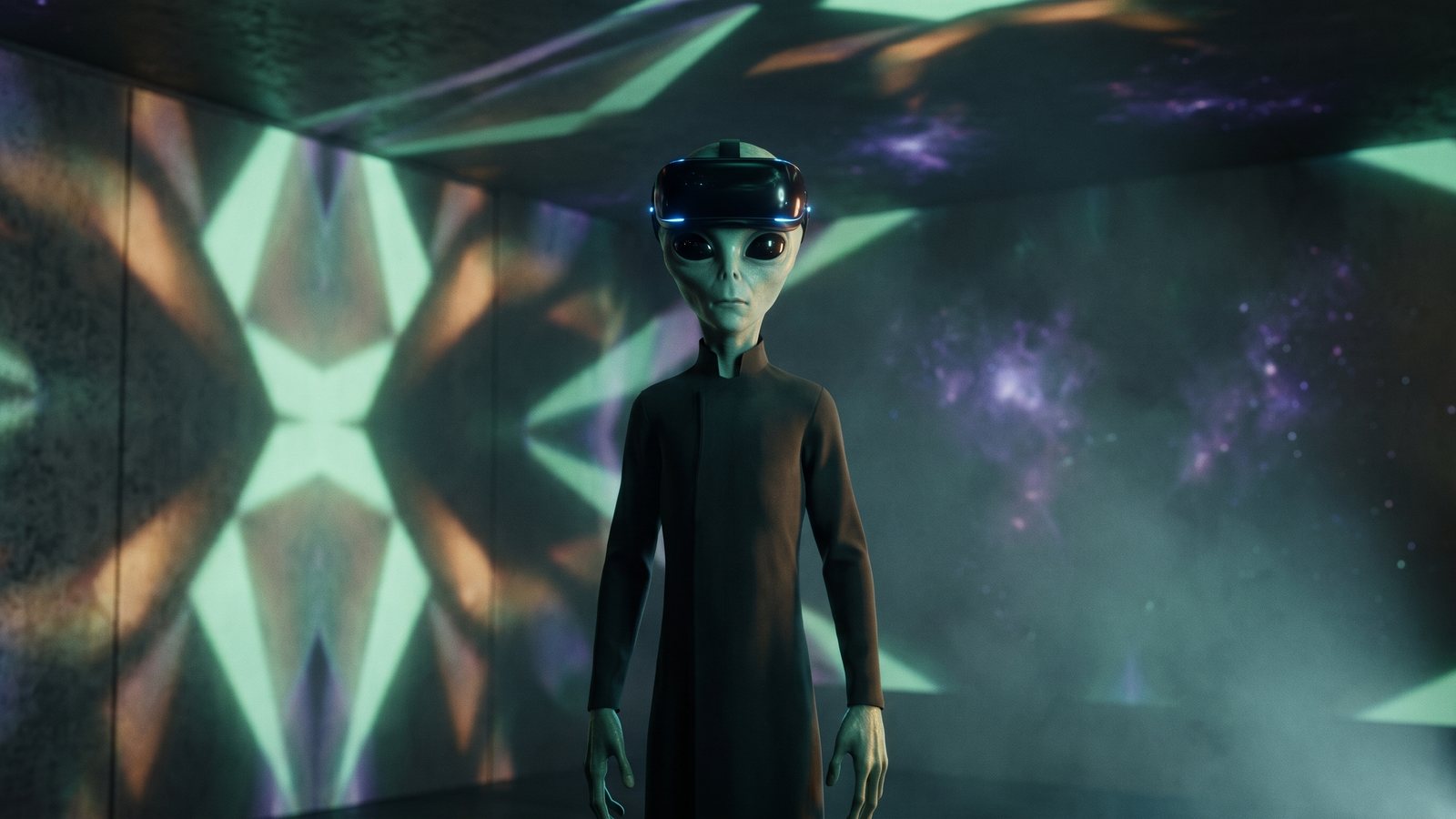
Other reports include insectoid figures, faceless presences, ancestors, godlike forms, surgeons, aliens, or threatening animals. Simulations tend to literalize these descriptions as animated characters standing in rooms. The reported experience may be stranger: a presence could be felt without being clearly seen, communicate without speech, occupy the architecture, or seem inseparable from the viewer.
Beware of feedback loops. Once a famous archetype saturates podcasts, Reddit, and video thumbnails, future users and artists may recognize or reproduce it more readily. Shared motifs are intriguing, but exposure, common brain mechanisms, and cultural suggestion remain plausible contributors.
Levels of Intensity: From Light Visuals to Full Breakthrough
Simulations commonly arrange intensity into levels, but their "dose" labels deserve caution. Visual media can portray increasing immersion; it cannot reliably map imagery to a particular number of milligrams. Potency, delivery efficiency, technique, individual sensitivity, other substances, and context all complicate that relationship.
A more responsible scale describes effects, not dosing:
| Portrayed level | What remains recognizable | Typical simulation choices |
|---|---|---|
| Light | Room, body, and ordinary identity | Surface patterns, brighter color, breathing edges |
| Moderate | Environment remains but distorts heavily | Overlays, facial changes, layered geometry |
| Immersive | External surroundings fade | Tunnels, enclosed spaces, strong audio escalation |
| Breakthrough portrayal | Ordinary scene disappears | Autonomous realm, entities, altered identity and time |
Even this scale is approximate. Intensity isn't a tidy staircase, and elaborate imagery doesn't automatically equal greater danger or meaning. A visually sparse experience can still involve panic, dissociation, or profound loss of self.
Don't treat a labeled simulation as a calibration chart. "This video looks manageable" says nothing useful about how your body or mind would respond to a controlled substance.
"Waiting Room" vs "Breakthrough": How to Tell What a Simulation Is Portraying
The waiting room is another community term rather than a validated clinical stage. It usually describes a highly altered, enclosed, patterned space in which the person feels near, but not fully through, a threshold. Artists depict it as a domed chamber, endlessly tiled lobby, rotating circus tent, or mechanical antechamber. Normal surroundings may be gone, yet the viewer retains some sense of being an observer who is "waiting."
A breakthrough portrayal usually goes further. Look for:
- Complete replacement of the starting environment
- Reduced or absent representation of the viewer's body
- A new world that appears self-contained
- Entities interacting directly with the POV
- Distorted time, death/rebirth symbolism, or dissolution of identity
- A return sequence in which the original room slowly reconstructs itself
The difference isn't simply more fractals. It's a shift in the implied relationship between viewer and scene. In a waiting-room video, you watch a bizarre environment. In a breakthrough simulation, the filmmaker tries to suggest that ordinary reality (and the "you" observing it) has temporarily stopped being the main frame of reference.
Safety, Risks, and Accessibility Warnings for DMT Simulation Videos
A video can be drug-free and still be unpleasant or unsafe for some viewers. Rapid flashes, high-contrast geometry, spiraling movement, aggressive bass, and full-field VR can provoke headaches, nausea, dizziness, panic, or (more rarely) photosensitive seizures.
Before pressing play:
- Read the description and comments for strobe or jump-scare warnings.
- Use a small screen rather than VR for your first viewing.
- Lower brightness and volume; keep room lighting on.
- Stay seated, particularly if you're prone to vertigo.
- Stop immediately if you develop visual discomfort, nausea, dread, confusion, or a headache.
Don't watch while driving, walking near traffic, operating equipment, or caring for a child. That sounds comically obvious until autoplay serves a flashing tunnel at exactly the wrong moment.
Creators should provide clear flashing-image, motion, loud-audio, and disturbing-content warnings. "May melt your ego" is not an accessibility notice.
Epilepsy, Photosensitivity, and Motion Sickness
Photosensitive epilepsy can be triggered by flashing or rapidly alternating patterns, particularly when high contrast fills much of the visual field. Not every person with epilepsy is photosensitive, and people without a diagnosis can still experience discomfort. Guidance from the Epilepsy Foundation on photosensitivity is more useful than relying on a creator's casual "watch at your own risk" disclaimer.
Motion sickness has a different mechanism. Your eyes report high-speed movement while your inner ear says you're sitting still. VR headsets magnify that conflict through wide fields of view and head tracking.
Reduce exposure by choosing slower footage, disabling fullscreen mode, sitting farther away, and taking frequent breaks. In VR, use comfort settings such as snap turning and stationary boundaries. If symptoms begin, don't "push through" for authenticity. Remove the headset, look at a stable object, breathe normally, and rest.
Anyone with a seizure disorder should follow individualized medical advice. Online content warnings are inconsistent and can miss short, intense flash sequences.
Mental Health Considerations: Anxiety Triggers, Panic Spirals, and Integration
Dark rooms, headphones, threatening faces, death imagery, and disorienting POV motion can trigger anxiety even when you know the scene is fictional. Once your heart speeds up, normal bodily sensations may feel like proof that something is wrong. That loop (image, fear, bodily arousal, more fear) can become a panic spiral.
You have permission to stop. Pause the video, turn on lights, place both feet on the floor, name objects in the room, and slow your exhale. A familiar voice or ordinary task can help re-establish context. If distress persists, seek appropriate professional support.
People dealing with psychosis, mania, severe dissociation, trauma-related symptoms, or intense health anxiety may reasonably choose to avoid immersive psychedelic media. That isn't being uptight; it's knowing your nervous system.
"Integration" simply means making sense of a powerful experience afterward. For a disturbing simulation, this may involve journaling, talking with a therapist, or deciding not to watch similar material again. Persistent hallucinations, paranoia, inability to sleep, or thoughts of self-harm require prompt clinical help, not another sound bath.
How Accurate Are DMT Trip Simulations? A Checklist to Judge Realism
Accuracy depends on what a creator claims to reproduce. As visionary artwork, an extravagant alien carnival may succeed beautifully. As a literal reconstruction of DMT phenomenology, it should be judged against recurring reports, credible research, and honest acknowledgment of variation.
Use this quick checklist:
- Does the piece distinguish inhaled DMT from ayahuasca?
- Is onset rapid without making the entire video uniformly frantic?
- Do open-eye overlays differ from full environmental replacement?
- Does space distort, rather than merely changing color?
- Is there a progression from onset to peak and return?
- Are entities presented as one possible motif rather than guaranteed visitors?
- Does the creator avoid exact dose-to-visual promises?
- Are accessibility warnings specific and visible?
- Does the description admit that emotion, identity, and bodily effects can't be recreated onscreen?
The strongest answer to "How accurate is it?" is often: accurate in selected motifs, inaccurate as a complete experience. That may sound less exciting than "the closest thing to DMT," but it's far more credible.
Signs of Higher-Quality Simulations: Coherent Progression, Perceptual Distortion, and Audio Design
Higher-quality simulations usually have structure. They begin with recognizable perception, intensify rapidly, cross into a distinct visual mode, hold a peak, then decompress. Even surreal transitions possess visual logic. Patterns wrap around objects, depth becomes ambiguous, and architecture transforms continuously rather than appearing as unrelated clips.
Audio carries more weight than viewers expect. A rising tone, deep vibration, accelerated clicking, spatial whispers, or sudden silence can communicate onset and disembodiment more effectively than another rainbow fractal. Good sound design supports the visual arc without claiming that one "sacred frequency" chemically activates DMT.
Look for restraint, too. A skilled creator knows when to let one impossible room linger. Constant novelty can flatten the impact, like a horror film composed entirely of jump scares.
Useful production notes are another positive sign. Artists who identify software such as Blender, TouchDesigner, Unreal Engine, or Stable Diffusion-based workflows help you separate creative process from scientific evidence. Responsible descriptions also credit inspiration, label AI-generated material, and provide safety warnings.
Common Inaccuracies: Over-Literal Aliens, Nonstop Chaos, and Mislabeled "LSD-Style" Visuals
The most obvious inaccuracy is the rubber alien who walks into frame, waves, and begins speaking English. Entity reports can be vivid, but they're often difficult to translate into ordinary character animation. Literal treatment turns ineffable presences into low-budget game NPCs.
Nonstop chaos is another giveaway. DMT accounts may involve overwhelming speed, yet they can also contain coherent rooms, stable beings, stillness, intimacy, dread, or a sense of receiving concentrated information. Random glitch edits capture confusion while losing structure.
Then there's the generic "psychedelic" filter: breathing walls, rainbow trails, melting clocks, and oily color shifts. Those effects are more closely associated in popular culture with LSD-like or broad hallucinogenic imagery. They may occur in some form across substances, but labeling every wobble a DMT breakthrough is sloppy.
Other warning signs include:
- A four-hour inhaled-DMT timeline
- Guaranteed entity encounters
- Precise visual predictions based on dose
- Claims that VR safely reproduces ego death
- Indigenous symbols used as decorative proof of authenticity
- Medical or spiritual certainty unsupported by evidence
Pretty? Maybe. Documentary evidence? Nope.
Frequently Asked Questions About DMT Trip Simulations
These short answers address the questions that usually appear beneath simulation videos, often between "What software made this?" and one commenter announcing they personally met the purple jester in 2017.
Scientific knowledge remains incomplete. DMT research has expanded, including controlled human studies using neuroimaging and extended intravenous administration models, but researchers still can't reconstruct a private experience frame by frame. Experience reports are valuable evidence about phenomenology (what something feels like), not automatic proof of a shared external realm.
For broader health information, consult evidence-based resources such as the National Institute on Drug Abuse overview of hallucinogens and peer-reviewed research rather than treating video comments as medical guidance.
Is it possible to simulate a DMT breakthrough without DMT?
You can simulate selected sensory motifs, but not verify or reproduce a DMT breakthrough in full. VR can surround your field of view. Generative video can produce endlessly transforming geometry. Spatial audio can create the feeling of motion or presence. Meditation, breathwork, sensory deprivation, dreams, and other non-drug states may also produce unusual subjective experiences for some people.
None is pharmacologically equivalent to DMT, and "natural" doesn't mean risk-free. Intensive breathwork, sleep deprivation, and flashing-light devices can carry physical or psychological risks of their own.
A useful distinction is representation versus induction. A flight simulator represents instruments and motion well enough to teach procedures; it doesn't place your body at 35,000 feet. Likewise, psychedelic media can help you discuss motifs and artistic interpretations, but it can't prove how you would react to abrupt ego dissolution, fear, or altered bodily awareness.
If your goal is curiosity, enjoy the work as art. If your goal is preparation for drug use, a screen is an inadequate safety plan.
Why do some simulations feel "too real" or cause anxiety?
Your visual and balance systems respond to cues even when your reasoning mind knows they're fictional. Fullscreen tunnels create optic flow, the same broad pattern your brain uses to infer self-motion. Loud bass adds bodily vibration. Faces automatically recruit social and threat-detection systems, while repetition can narrow attention until the screen seems to dominate awareness.
Expectation amplifies the effect. A title promising "THE REAL BREAKTHROUGH" primes you to scan for unusual sensations. If you notice dizziness or a racing heart, anxiety can reinterpret those ordinary responses as loss of control.
To reset, shrink the window, mute the audio, switch on a lamp, and look at something stable with clear edges. Remind yourself aloud: "This is a video, and I can stop it." Slightly corny? Sure. Effective grounding rarely wins awards for dialogue.
If a simulation produces recurring panic, derealization, disturbed sleep, or intrusive imagery, avoid further exposure and speak with a mental-health professional. Entertainment shouldn't become an endurance test.
Are DMT entities real? What researchers and experienced users report
Experienced users sometimes describe entities as more real than everyday people and report apparently reciprocal communication, recognition across sessions, or lasting spiritual conviction. Clinical and survey researchers take those reports seriously as subjective data. Researchers have also documented associations between DMT experiences and profound changes in meaning, mood, and metaphysical belief.
But no accepted experiment has established that DMT entities exist independently of the experiencer. Neurological explanations include altered predictive processing, intensified pattern detection, disrupted self-modeling, and the brain's tendency to infer agency. Cultural exposure may shape what those mechanisms produce. Spiritual explanations interpret the beings as autonomous consciousnesses, guides, or inhabitants of another domain. Current evidence doesn't settle that debate.
The intellectually honest position is neither ridicule nor certainty. You can acknowledge that an encounter felt utterly real to someone without converting conviction into proof.
Conclusion
Ultimately, a DMT trip simulation is most valuable when it stays honest about its boundaries. Use it to explore visual art, recurring motifs, and questions about perception, not as a promise of what DMT will show you or evidence that taking it is safe. Choose content with clear warnings, keep your viewing setup comfortable, and step away if your mind or body says enough. Curiosity is welcome; you don't have to surrender your skepticism at the door.



