
THE SHROOMVERSE JOURNAL ✳ 8 MIN READ
Blue Meanies mushroom: why the name can point to two different species
Topic: Mushroom names and species
Published Updated
Listen: the 3-minute version
AI-narrated summary of this article
Short answer, checked 4 October 2026
Blue Meanies mushroom is not a single, settled identity. iNaturalist lists “Blue Meanies” as the common name for Panaeolus cyanescens. Separately, a 2025 study’s sample table has a strain called “Blue Meanies” that it assigns to Psilocybe cubensis. Both are documented, and neither cancels the other. A reliable sentence names the source and the material, then the species. The sources we checked do not say where the name came from.
On this page 8 sections
“Blue Meanies” looks like a plain name for a plain mushroom. It is not. A common name used for one species can also appear as the label on material that a laboratory assigned to another, and treating every appearance as equivalent carries errors into photographs, articles, comparison tables and safety advice.
This guide sets out what two records actually show, what they do not show, and how to write about the name without overreaching. It is a naming reference, not an identification key: it cannot tell you what an unknown mushroom is. For the wider picture, start with what are magic mushrooms.
Not for identifying a mushroom
Nothing here can identify a wild or unlabelled mushroom, and a name on a label is not proof of what is inside. If anyone has eaten a wild mushroom, do not wait for symptoms: call the Ontario Poison Centre (1 800 268 9017, toll-free) or your local emergency number. See also our safety guide.
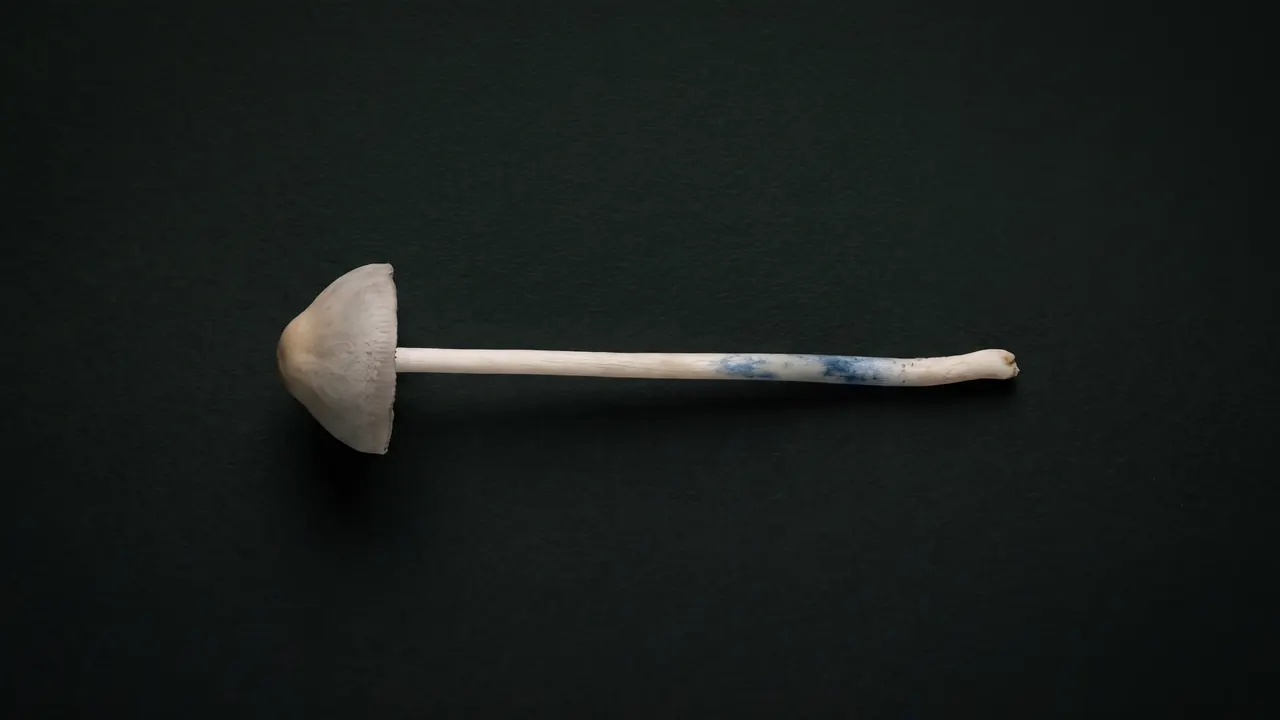
What does “Blue Meanies” mean as a mushroom name?
We found two documented uses. They are different kinds of evidence, and the table keeps them apart.
| Use | Where it is documented | What it does not show |
|---|---|---|
| Common name for Panaeolus cyanescens | iNaturalist’s taxon record for Panaeolus cyanescens lists “Blue Meanies” as its common name (iNaturalist taxon record) | A record of name usage, not authentication of any particular mushroom |
| Label for study material assigned to Psilocybe cubensis | Table 1 of Cohen et al. (2025) lists a strain called “Blue Meanies” with ITS classification Psilocybe cubensis, GenBank accession PV069794 (Cohen et al., 2025) | The assignment concerns that one sample, not every use of the phrase |
Together these are enough to show why a blanket “Blue Meanies means this species” statement is too broad. They are not evidence that the two uses share a history, or that the mushrooms are interchangeable.
How does the 2025 study use the name Blue Meanies?
The paper is a chemical comparison of 42 strains of psilocybin-producing fungi. Its Table 1 has a “Strain” column, the genus and species the authors listed, a separate “ITS species classification” from DNA sequencing, and a GenBank accession for each strain (Cohen et al., 2025).
In that table, row 16 gives the genus Psilocybe, the species cubensis, the strain name “Blue Meanies”, an ITS classification of Psilocybe cubensis and accession PV069794. The GenBank entry itself names the isolate “Blue Meanies” under the organism Psilocybe cubensis and was submitted in February 2025 (GenBank PV069794).
Two details matter here. First, the paper explains that species names from morphology “may be unreliable”, which is why all 42 samples were cross-checked by ITS sequencing (Cohen et al., 2025). Second, the ten Panaeolus strains in the same table carry other labels (such as “Australia”, “Goliath” and “Vietnam”), and none is called Blue Meanies. In the text we read, the phrase appears only in that one table row, with no explanation of where the label came from.

The same table shows how labels and classifications can part ways. A strain labelled “Mexicana” is listed under Psilocybe tampanensis, and several strains listed as natalensis were classified by ITS as Psilocybe cubensis (Cohen et al., 2025). A label is something someone chose, which is not the same as a finding about the organism. The assignment in the study applies to that sample, and we do not claim more than that.
What does iNaturalist record for Blue Meanies?
On iNaturalist, Panaeolus cyanescens is the taxon whose common name is “Blue Meanies”. A search of iNaturalist taxa for the phrase returned that one species (iNaturalist search), while Psilocybe cyanescens carries a different common name there, “Wavy Cap” (iNaturalist search).
That is a record of how a naming platform labels a species. It does not authenticate any mushroom in a photograph, and it does not tell you who first used the name or why.
Are Panaeolus cyanescens and Psilocybe cyanescens the same mushroom?
No. They are different scientific names in different genera, and both are listed as accepted species: Panaeolus cyanescens Sacc. and Psilocybe cyanescens Wakef. in the GBIF name backbone (GBIF: Panaeolus cyanescens; GBIF: Psilocybe cyanescens). Because both genera begin with “P”, abbreviating them to “P. cyanescens” makes a confusing topic worse. Write the genus out wherever the distinction matters. Our reference on Psilocybe cyanescens naming covers the other half of that pair.
There is also a separate, purely nomenclatural link. Species Fungorum gives the current name Panaeolus cyanescens Sacc. (Syll. Fung. 5: 1123, 1887) and lists two synonyms: Agaricus cyanescens Berk. & Broome (1871) and Copelandia cyanescens (Sacc.) Singer (1951) (Species Fungorum). A documented scientific synonym is a different kind of connection from a shared common name. For that species record, see Panaeolus cyanescens and Copelandia.
How can you tell which meaning an article intends?
Read the article’s scientific name and its source. Then ask three questions:
- Does it cite the 2025 sample table? Then the relevant connection is to that study’s cubensis-assigned sample.
- Does it cite a reference that uses the phrase as the common name of Panaeolus cyanescens? Then it should say so explicitly.
- Does it supply neither? Then its meaning stays unresolved, and it should say that.
Do not use appearance to repair an undocumented label. A photograph may lack a reliable specimen identity, and a stock image may illustrate only the general topic. The honest fix is to get the record or state the uncertainty, not to guess from a cap, a stem or a colour. Blue bruising is not a naming key either: the chemistry is explained in why do magic mushrooms turn blue.
How can a sentence about Blue Meanies be written accurately?
An evidence-based sentence keeps the source’s scope. For example: “In this study, the sample labelled Blue Meanies was assigned to Psilocybe cubensis.” Or: “Blue Meanies is a common name listed for Panaeolus cyanescens.” Neither claims to define every use of the phrase.
For any publication, check captions, titles, navigation labels and comparison tables as well as the body text, because an accurate paragraph does not fix an unqualified label elsewhere. Our guide to magic mushroom names, species and strains explains how to keep scientific names, common names and culture labels in separate fields, and what can be compared between cubensis names covers the strain side.
What is not known about the Blue Meanies name?
The sources we checked do not establish one naming event that accounts for every use of the phrase. We therefore give no discoverer, no date and no shared lineage. That is a limit of the evidence we found, not proof that the history cannot be documented.
Nor does the phrase define a dependable chemical or subjective profile. The first question is always which material the name describes. Once identity is documented, any claim about potency or effects still needs its own evidence: see what lab studies of potency do and do not establish.
Common questions
Are Blue Meanies and Blue Meanie separate varieties?
Singular and plural wording alone cannot establish a biological distinction or an alias. Preserve the source’s spelling and check what material it describes.
Is “Blue Meanies” a species name?
No. It is not a scientific name. iNaturalist lists it as the common name of Panaeolus cyanescens, and a 2025 study uses it as a strain label for material assigned to Psilocybe cubensis.
Does Copelandia mean cubensis?
No such equivalence follows from the names. Species Fungorum lists Copelandia cyanescens as a synonym of Panaeolus cyanescens, which is a different species from Psilocybe cubensis.
Should this name have a single directory entry?
It should lead to a disambiguation page like this one, showing the distinct documented uses. It should not silently redirect readers to one species.
Can a photo show which Blue Meanies a mushroom is?
No. A photo without a documented specimen identity cannot settle it, and this site gives no identification guidance for wild mushrooms. For anything eaten by mistake, call a poison centre.
Does the name say anything about strength or effects?
No. The sources we checked do not tie the phrase to a dependable chemical profile or to any effect. See our safety guide for general information.
Shroomverse sells mushroom products. This article is general information about mushroom names and taxonomy. It is not medical, legal or identification advice, and it does not recommend any product.
SOURCES
- Comprehensive analysis of 42 psilocybin-producing fungal strains reveals metabolite diversity and species-specific clusters (Cohen J, Sulimani L, Procaccia S, et al., Scientific Reports 15, article 13822, 2025), Springer Nature (peer-reviewed, open access); full text read via PubMed Central PMC12015540 and Europe PMC. Accessed . Table 1, row 16: genus Psilocybe, species cubensis, strain “Blue Meanies”, ITS classification Psilocybe cubensis, accession PV069794; the text on morphological versus ITS identification; the ten Panaeolus strains with other labels; the “Mexicana” and natalensis rows.
- GenBank record PV069794: Psilocybe cubensis isolate Blue Meanies, ITS and partial LSU sequence, NCBI GenBank (record read through the NCBI Entrez service). Accessed . The isolate name “Blue Meanies” under the organism Psilocybe cubensis; submitted by the study’s first author in February 2025.
- iNaturalist taxon record: Panaeolus cyanescens (taxon 179100), iNaturalist (taxon API). Accessed . Panaeolus cyanescens with “Blue Meanies” as its listed common name: a record of name usage, not authentication.
- iNaturalist taxon search for “Blue Meanies”, iNaturalist (taxon API). Accessed . The search returned one taxon, Panaeolus cyanescens.
- iNaturalist taxon search for Psilocybe cyanescens, iNaturalist (taxon API). Accessed . Psilocybe cyanescens is a separate taxon with a different common name (“Wavy Cap”).
- Species Fungorum: Panaeolus cyanescens synonymy, Species Fungorum (CABI, Royal Botanic Gardens Kew, Landcare Research). Accessed . Current name Panaeolus cyanescens Sacc. (Syll. Fung. 5: 1123, 1887); synonyms Agaricus cyanescens Berk. & Broome (1871) and Copelandia cyanescens (Sacc.) Singer (1951).
- GBIF species match: Panaeolus cyanescens, Global Biodiversity Information Facility (backbone taxonomy API). Accessed . Panaeolus cyanescens Sacc. as an accepted species.
- GBIF species match: Psilocybe cyanescens, Global Biodiversity Information Facility (backbone taxonomy API). Accessed . Psilocybe cyanescens Wakef. as a separate accepted species in a different genus.
- Wild Mushroom Ingestion & Response, Ontario Poison Centre. Accessed . Advice to call the Ontario Poison Centre (1 800 268 9017, toll-free) after eating wild mushrooms instead of waiting for symptoms.
CHANGES
- : Published. Sources opened and checked on this date. Two links in the original draft (Index Fungorum and an iNaturalist guide page) could not be opened and are not cited.
- : Added a link to the documentary Blue Meanie: one nickname, two mushrooms.



