SHROOMVERSE FILMS · TRANSCRIPT
Blue Meanie: one nickname, two mushrooms
“Blue Meanie” is one nickname for two completely different mushrooms: a slender, blue-staining dung species first collected in Sri Lanka in 1868, and a Psilocybe cubensis line that borrowed the name. We trace the names, the records and what lab chemistry and DNA do and don’t show for each.
Key claims are labelled on screen by their evidence: documented, limited evidence, anecdotal or unknown.
It’s an educational film. It isn’t about our products, and there’s no growing, sourcing or dosing advice in it. Some scenes are AI-generated illustrations, and the narration is a synthetic voice.
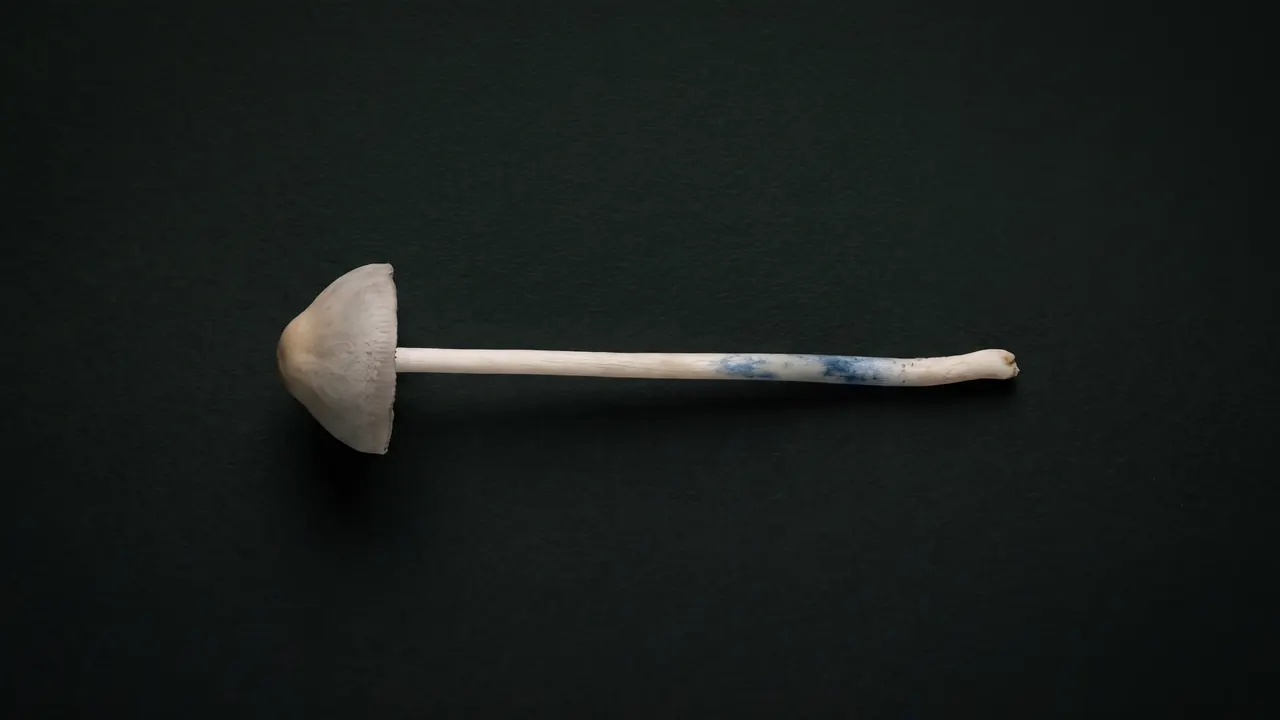
Key facts
- The type specimen of Panaeolus cyanescens was collected at Peradeniya, Ceylon (now Sri Lanka), in September 1868 and is kept in the Kew Fungarium (Kew holotype K-M000905213, via GBIF).
- Its accepted name is Panaeolus cyanescens Sacc. (1887). The earlier Agaricus cyanescens Berk. & Broome (1871) is illegitimate, and Copelandia cyanescens (1951) is a former name (Index Fungorum).
- In South Africa, a 2021 study calls the same species “Natal Blue Meanie” (Nkadimeng et al. 2021).
- GBIF holds about 1,700 records of Panaeolus cyanescens, with the largest counts from the United States, Mexico and Australia. They show where people record it, not population sizes (GBIF, October 2026).
- The second “Blue Meanie” is a cultivated line of Psilocybe cubensis. In a 2023 genetic study, the one sample sold under that name fell into the Golden Teacher group: genetically ordinary cultivated cubensis (McTaggart et al. 2023).
- The two Blue Meanies are not close relatives, but a 2018 study found evidence that Panaeolus cyanescens acquired its psilocybin genes from Psilocybe by horizontal gene transfer (Reynolds et al. 2018).
Restated from the film’s narration. Each fact links the source it rests on; the full list is under the transcript.
FULL TRANSCRIPT
Cold open
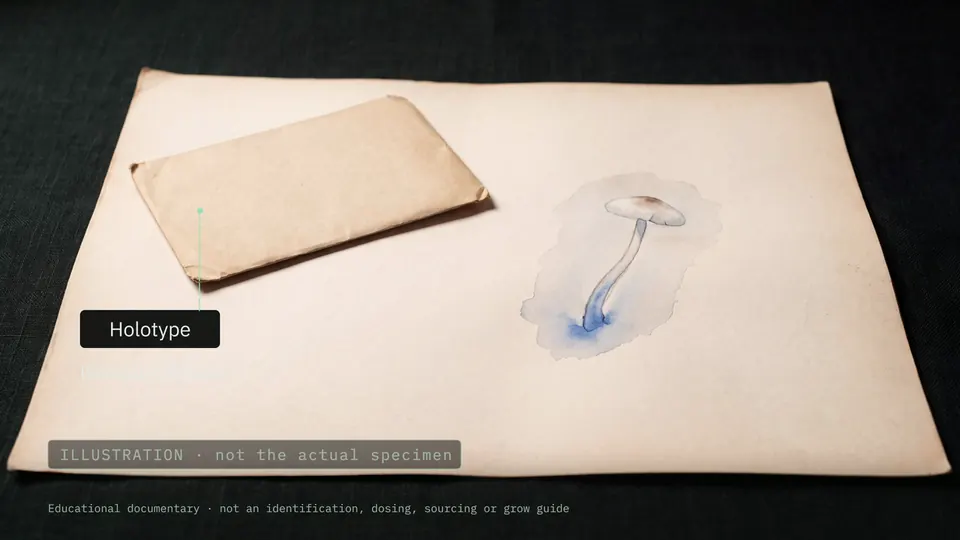
In the fungarium of the Royal Botanic Gardens, Kew, there's a sheet of paper with a specimen envelope attached. This is an educational documentary. Psilocybin is a controlled substance in most countries. The handwriting reads Peradeniya, September 1868. Beside it, a small painting of a pale mushroom, its stem painted blue. It's the holotype of Panaeolus cyanescens: the specimen the species name is anchored to.
Today that species carries a nickname: Blue Meanie. So does a cultivated line of a completely different mushroom, Psilocybe cubensis. So when someone says Blue Meanie, which mushroom do they mean?
I · One nickname, two mushrooms
Start with the name. In Australia and New Zealand, Panaeolus cyanescens is known locally as "blue meanies." That's according to John W. Allen's 1999 guide to the region's psychoactive mushrooms. Allen gives two explanations. First, the mushroom's reputation, and the intense blue it turns where it's bruised. Second, a link to the Beatles' 1968 animated film Yellow Submarine, whose villains are the music-hating Blue Meanies.
That's one author's explanation. We couldn't find anyone who documented the moment the name was first used. The name turns up elsewhere too. In South Africa, a 2021 study says the same species is commonly known as "Natal Blue Meanie." Then it jumped species. By August 2004, on a large mushroom forum, one user was already asking: do you mean the cubensis strain, or the Copelandia?
Copelandia cyanescens is a former name of Panaeolus cyanescens. A year later, one buyer reported spores sold as a Blue Meanie cubensis. A reply called it a misnomer, a name given by some spore vendor years before. The same reply named a third species as the "real" Blue Meanie. At least two mushrooms, and no paper trail showing how the second one got it.
II · A name with a history
Before the nickname, there was a scientific name. And it has its own tangled story. Peradeniya was in Ceylon, today's Sri Lanka. The Peradeniya specimen became the type of a species published by Berkeley and Broome in 1871, as Agaricus cyanescens. There was a problem. Another botanist, Montagne, had already used that exact name in 1856. Today's databases mark the 1871 name as illegitimate.
The name that stands is Panaeolus cyanescens, published by Saccardo in 1887. In 1951, the species was moved into a genus called Copelandia. But Copelandia itself is now treated as illegitimate, and its species folded back into Panaeolus. Then, in 2026, a genome-scale study backed an earlier proposal. Panaeolus, it concluded, belongs in a family separate from its old one, under an older name: Galeropsidaceae.
The old Copelandia group survives as a subgenus, with a new name, Bresadolomyces, and this species as its type. Three genera and a change of family in a century and a half. The mushroom itself never changed. Names change. The specimen in the envelope doesn't. That's why science keeps it.
III · A mushroom that follows cattle
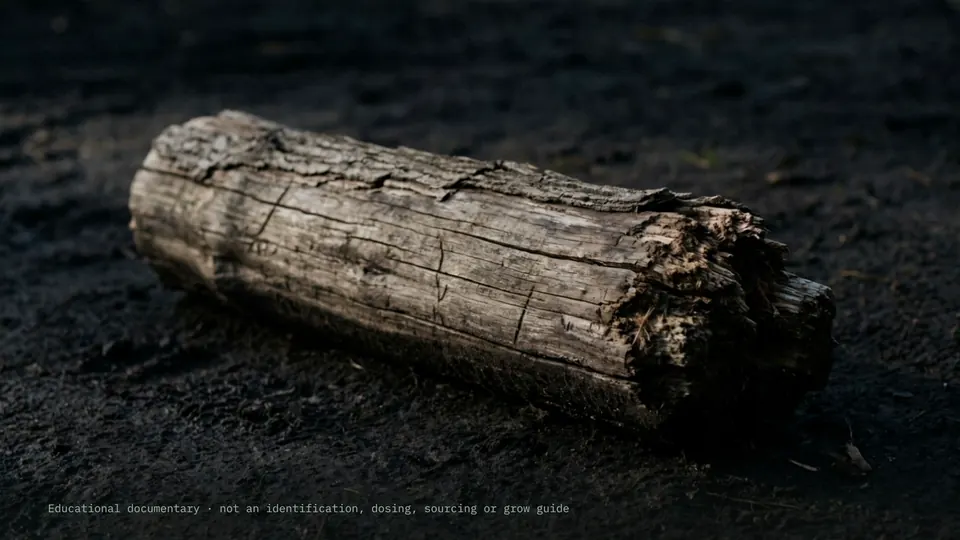
So what is this mushroom? A slender, grey-white species whose flesh stains blue on exposure to air. Under a microscope, it has its own signatures. Golden-brown cells called metuloids on the gills, and lemon-shaped to rounded spores. Cubensis spores are closer to hexagonal. It grows mainly on dung, across the tropics of both hemispheres. A 2023 review notes it has also been reported on other material, including wood.
In 2025, mycologists in Argentina published the first description of the species there, and linked its distribution to livestock. The global biodiversity database GBIF holds about seventeen hundred records of it. The largest counts come from the United States, Mexico and Australia. Those are records, not populations. They show where people look and photograph, as much as where the mushroom grows.
IV · Seventy collections
What's actually inside it? In 1992, a chemist put the problem plainly: published analytical data on this species were few. His name was T. Stijve, and he worked in quality assurance, in Vevey, Switzerland. He analysed seventy collections, from Queensland, from Thailand, and three batches from Hawaii. Every one contained psilocin, along with serotonin and urea. Between psilocin and psilocybin, psilocin was the main one.
Psilocybin was another story. The Hawaiian collections had it. The Australian and Thai ones had almost none. Same species. Different places. Different chemistry. Even within one mushroom, it varied. Psilocin was spread about evenly between cap and stem. The stem held about three times more psilocybin than the cap. And in every group, there was more urea, on average, than psilocin.
Forensic chemists in Japan, testing mushrooms circulating there, found Copelandia tilted toward psilocin too. They called cubensis "psilocybin-rich" and Copelandia "psilocin-rich." Close chemical cousins. But each of these two species leans a different way.
V · The other Blue Meanie
Now the second Blue Meanie. Psilocybe cubensis. A different genus, now in a different family, with an orange-grey cap and differently shaped spores. In 2023, a large genetic study of cultivated cubensis included one sample sold as Blue Meanie. It fell into a genetic group the researchers named after another cultivar, Golden Teacher. Genetically, it looks like ordinary cultivated cubensis. Nothing in that result connects it to Panaeolus.
A culture labelled Blue Meanies in a second lab came back the same way: cubensis, by its DNA barcode. Its chemistry has barely been measured. One 2024 study tested just three mushrooms. That's not enough to say anything general about a variety. Online, you'll find confident origin stories for this cubensis. We couldn't verify any of them. Forum posts from as early as 2004 already blamed a spore vendor for the name.
VI · When labels lie
A label is a claim. DNA is a test. In 2021, a genome team sequenced spore samples sold under many different names. One was labelled Panaeolus copelandia. Its DNA barcode matched Psilocybe cubensis, plus a common mould. The authors called it "likely a mislabeled sample." In 2025, another lab found the opposite case: Panaeolus cyanescens hiding under another name. Three cultures labelled as a different Panaeolus species turned out to be this one.
A label can be wrong in either direction. A study of cubensis cultivars needed an outsider for comparison. It used Panaeolus cyanescens. Its DNA barcode wasn't even close. Two Blue Meanies. Two species DNA tells apart easily. And labels that sometimes mix them up anyway.
VII · Borrowed chemistry
Here's the strangest part. Psilocybin is made by a small cluster of genes. On the family tree, Panaeolus and Psilocybe sit in different families. The 2026 study estimates that Panaeolus's family branched off from its closest relatives about eighty-seven million years ago. So how did Panaeolus cyanescens get the genes? In 2018, researchers found evidence that it acquired them sideways, from Psilocybe, through horizontal gene transfer.
A 2024 study went further. Its gene tree places this species' psilocybin gene right beside Psilocybe cubensis. The authors' reading: a transfer involving the ancestor of cubensis, roughly sixteen million years ago. Why would genes like these spread? The 2018 team suggested psilocybin may have given an advantage in dung and decaying wood, exactly where these mushrooms live. So the two mushrooms that share the name Blue Meanie aren't close relatives. But the genes that let one of them make psilocybin may have come from the other's ancestors. Separate families. Shared chemistry.
Final thought
Go back to that envelope. Peradeniya, September 1868. Someone collected a small mushroom. Someone painted a pale mushroom, its stem stained blue. And the specimen was filed under a name that would later have to be replaced. Later came a nickname, linked by one author to a 1968 cartoon. Then, by 2004, the same nickname was being used for a second mushroom.
Names drift. Labels get swapped. Specimens stay where they are. If you want to know what a mushroom is, don't ask what it's called. Ask what's in the envelope.
KEY SOURCES
- Royal Botanic Gardens, Kew, Fungarium, holotype K-M000905213 (Peradeniya, Sept. 1868), via GBIF
- Index Fungorum, records for Panaeolus cyanescens Sacc. 1887, Agaricus cyanescens Berk. & Broome 1871, Agaricus cyanescens Mont. 1856, Copelandia cyanescens (Sacc.) Singer 1951
- He M-Q et al. 2026, “Systematic study of Panaeolus (Agaricales, Galeropsidaceae) sensu lato…”, IMA Fungus 17
- Stijve T. 1992, “Psilocin, psilocybin, serotonin and urea in Panaeolus cyanescens from various origin”, Persoonia 15(1):117–121
- Strauss D et al. 2023, “Global species diversity and distribution of the psychedelic fungal genus Panaeolus”, Heliyon 9:e16338
- Batista AJ et al. 2025, “Psilocybe cubensis and Panaeolus cyanescens… in NE Argentina”, Bol. Soc. Argent. Bot. 60(1)
- GBIF.org (3 October 2026), occurrence search, Panaeolus cyanescens
- Allen JW. 1999, Magic Mushrooms of Australia and New Zealand: the “blue meanies” name and its suggested origins
- Nkadimeng SM et al. 2021, J. Inflamm. Res. 14:3729–3738 (“Natal Blue Meanie”)
- Tsujikawa K et al. 2003, “Morphological and chemical analysis of magic mushrooms in Japan”, Forensic Sci. Int. 138:85–90
- McTaggart AR et al. 2023, Current Biology 33:5147–5159 (cultivar genomics; Table S1)
- Cohen J et al. 2025, “Comprehensive analysis of 42 psilocybin-producing fungal strains…”, Sci. Rep. 15:13822
- McKernan K et al. 2021, “A whole genome atlas of 81 Psilocybe genomes…”, F1000Research 10:961 (v2)
- Sharchaton A et al. 2026, J. Fungi 12(7):486 (P. cyanescens as DNA control)
- Goff R et al. 2024, Anal. Chim. Acta 1288:342161
- Reynolds HT et al. 2018, “Horizontal gene cluster transfer increased hallucinogenic mushroom diversity”, Evol. Lett. 2:88–101
- Bradshaw AJ et al. 2024, “Phylogenomics of the psychoactive mushroom genus Psilocybe…”, PNAS 121:e2311245121
- Forum record: two archived public forum threads, dated 1 Aug 2004 and 24 Jul 2005 (the forum is not named or linked)
Keep exploring.
- All Shroomverse films
- DMT: The Molecule Beyond Reality: documentary and full transcript
- Tidal Wave: documentary and full transcript
- Penis Envy: The Mushroom Behind the Myth: documentary and full transcript
- Amazonian: what the name can and can’t tell us: documentary and full transcript
- Albino Penis Envy: no pigment, so why is it blue?: documentary and full transcript
- Blue Meanies mushroom: why the name can point to two different species
- Panaeolus cyanescens: the Copelandia name and what “Blue Meanies” does not settle
- What are magic mushrooms? A plain-English guide
- Psychedelic Toronto: a history
- Toronto help lines