THE SHROOMVERSE JOURNAL ✳ 20 MIN READ
The history of magic mushrooms: from Mesoamerica and María Sabina to Life magazine and today
Topic: Mushrooms: history and science
Published Updated
Listen: the 3-minute version
AI-narrated summary of this article
Short answer, checked 4 October 2026
Peoples in Mexico used psilocybin mushrooms in ceremony before the Spanish conquest. Friars recorded the practice; colonial authorities banned it. A 1955 Mazatec velada led by María Sabina reached the world in Life magazine on 13 May 1957. Albert Hofmann’s team reported psilocybin in 1958. US and UN controls followed in 1970–71, and trials returned in the 2000s.
On this page 13 sections
Much of the history of magic mushrooms runs through Mesoamerica. The people who knew these mushrooms best left carved stones, painted books and living ceremonies. Spanish friars left descriptions, many of them hostile, and scholarly inquiry then went quiet for centuries. In 1957 a New York banker left a magazine story that changed one Mazatec town.
This guide follows the history of psychedelic mushrooms from stone and paint to the Spanish colonial record, María Sabina’s 1955 velada and the 13 May 1957 issue of Life, then through the chemists, the 1960s, the bans and twenty years of new research. We checked each source we cite and flag the few we read only in part or second-hand. Where the evidence is thin, we say so. For the same dates on one page, alongside the science and the law, see our psilocybin timeline.
How we label the evidence
Established: backed by primary documents or several independent sources. Preliminary: one study or one reading, not yet confirmed. Unresolved: scholars disagree, or the record is missing. Limited evidence: we found only secondary sources.
Where the history of magic mushrooms begins: Mesoamerica
Where did magic mushrooms originate, and what were they used for?
Mexico is unusually rich in these fungi. A 2024 scholarly bibliography of Indigenous mushroom practices counts at least 20 confirmed Psilocybe species there and more than 200 Indigenous-language names for psychoactive mushrooms (Spiers et al., 2024).
The same review names Nahua, Totonac, Mazatec, Mixe, Zapotec and Chatino communities among the peoples who have used them in healing and ceremony. Where and when that use began, nobody can say: the review calls its full extent hard to measure. The evidence from before 1500 is objects and images, and each one has to be interpreted.
Mushroom stones
Stone sculptures shaped like mushrooms have been found in Mexico, Guatemala, Honduras and El Salvador (Carod-Artal, 2015). In 1961 the archaeologist Stephan de Borhegyi described nine miniature mushroom stones buried with nine miniature grinding stones at Kaminaljuyú, Guatemala, dated to about 1000–500 BC. He argued the pairing made it more likely that sacred mushrooms were ground for ceremonies (Borhegyi, 1961).
His son and widow later wrote that archaeologists of his day resisted the idea (Spiers et al., 2024). The dates get garbled too: one 2015 review gives “3000 BC” in English and “3,000 years” in Spanish (Carod-Artal, 2015). Evidence: unresolved. The stones are real; what they meant is still argued.
Painted books
Few Mesoamerican painted books, or codices, survived Spanish destruction (Spiers et al., 2024). In one Mixtec book, Yuta Tnoho (also called Codex Vindobonensis Mexicanus I), a team led by the Mixtec researcher Faustino Hernández Santiago reads pages 24 and 25 as a mushroom ritual tied to the first sunrise (Hernández Santiago et al., 2017). Evidence: preliminary. This is a scholarly reading that depends on interpreting images, not proof.
What were magic mushrooms originally called?
In Nahuatl, the language of the Aztecs, Sahagún records nanacatl as the name of the little black mushrooms at a merchants’ feast (see below), and Oaxacan words for mushrooms, Nanacates and Nanacatitos, derive from a Nahuatl name (Haro-Luna et al., 2025). The sacred kind was teonanácatl, usually translated “flesh of the gods” (Spiers et al., 2024). Wasson’s 1957 version was “God’s flesh” (Life, 1957).
Other languages have their own names. María Sabina called them “saint children” (Spiers et al., 2024). In a Zapotec community in Oaxaca, older residents told researchers they were not “drunken mushrooms”, the Spanish label Sahagún used, but “holy mushrooms” (Haro-Luna et al., 2025).
What the Spanish colonial record says
The oldest surviving written descriptions come from Spanish missionaries of the 1500s, above all the Franciscan friar Bernardino de Sahagún and the Dominican friar Diego Durán. They worked with Indigenous elders, writers and artists, but they served a church that was destroying the cultures they recorded. Read them critically (Spiers et al., 2024).
Sahagún’s General History of the Things of New Spain describes a merchants’ feast. The first food, eaten before dawn, was “honguillos negros” (little black mushrooms) called nanacatl, eaten with honey, and cacao was drunk. Some guests danced, sang or wept; some saw themselves dying, others saw riches. Afterwards they talked over their visions (Sahagún, Book IX, chapter 8).
In his book on the natural world, Sahagún describes small mushrooms called teonanácatl that grow under the grass in fields. They taste bad, hurt the throat and intoxicate, and “los que los comen ven visiones”: those who eat them see visions (Sahagún, Book XI, chapter 7). We read the 1829–30 Spanish edition, not the Nahuatl text or English translations.
Durán’s history of the Mexica puts mushrooms at royal feasts. After the sacrifices at Moctezuma’s coronation, he writes, the guests ate raw mushrooms, saw visions and had revelations of the future. One of Moctezuma’s yearly feasts, when everyone ate mushrooms, was the “fiesta de las revelaciones”, the feast of revelations (Durán, chapter 54; Carod-Artal, 2015). He credits the visions to the devil, so read him critically.
Colonial authorities deemed sacred mushrooms idolatrous and prohibited them from the 1500s. A 2024 review says Inquisition documents refer to people accused of eating them, the last reference being a 1726 letter that it takes from another review we did not open (Spiers et al., 2024). That references kept appearing suggests the practice survived in secret. Evidence: limited, and second-hand.
Who discovered magic mushrooms?
Short answer: no outsider did. Indigenous peoples in Mexico knew these mushrooms for centuries before any European wrote about them. What outsiders found in the 20th century was that the practice, long assumed lost, was still alive.
For a time, scholars doubted it had ever involved mushrooms. In 1915 the botanist William Safford argued that teonanácatl was really peyote, and that Spanish observers had mistaken dried cactus for mushrooms (Safford, 1915). Later work showed he was wrong (Spiers et al., 2024).
In 1919 Blas Pablo Reko wrote that teonanácatl was a mushroom still used in Oaxaca’s Sierra Juárez. In 1936 the ethnologist Robert Weitlaner heard about mushroom rituals in the Mazatec town of Huautla de Jiménez. In 1938 a small team that included his daughter, Irmgard Weitlaner-Johnson, became the first non-Indigenous outsiders known to witness a Mazatec mushroom ceremony and write about it (Spiers et al., 2024).
The American biologist Richard Evans Schultes, who crossed paths with that team in Huautla, published “The identification of teonanacatl, a narcotic basidiomycete of the Aztecs” in February 1939 (Schultes, 1939). A fuller paper followed in 1940 (Schultes, 1940). Evidence: established. By 1940 the mushroom answer was on the scholarly record.
María Sabina and the Mazatec velada
María Sabina was a Mazatec sabia, or wise woman, from Huautla de Jiménez in Oaxaca. She grew up in a home and community that used the mushrooms, and she died in 1985 (Spiers et al., 2024). In the life story she told the Mazatec writer Álvaro Estrada, she said: “the mushrooms are saints; they give me wisdom” (quoted in Seale-Feldman, 2026).
A velada is a night vigil. In June 1955 she led one attended by R. Gordon Wasson, a J.P. Morgan banker and amateur mycologist, and the photographer Allan Richardson (Spiers et al., 2024; Life, 1957). Wasson dated it to the night of 29–30 June. He described about 20 people in a lower room, an altar with Christian images, mushrooms counted in pairs, and the last candle put out before midnight (Life, 1957).
In the dark, she and her daughter chanted and spoke through the night. Wasson understood the vigil as a consultation: people brought illness, a stolen donkey or worry about a relative far away (Life, 1957). Mazatec ceremony blends Catholic and older practice, and still does (Carod-Artal, 2015).
What the visits cost her and her community
Life gave her a pseudonym, “Eva Mendez”, never named Huautla, and called the local language “Mixeteco” (Life, 1957). It was not enough. The publicity led people to find the town anyway, and ceremonial use was displaced as recreational use spread (Haro-Luna et al., 2025).
By the mid-1960s Huautla had become a countercultural pilgrimage destination for people in search of “magic mushrooms”, and María Sabina was stigmatized in her own community for the changes that followed (Spiers et al., 2024). A 2026 review adds that Wasson published his accounts without her consent, that his publications revealed who and where she was, and that she was ostracized (Magar et al., 2026).
Mazatec researchers have since written about the exploitation she and her people suffered, and calls for reparations have followed (Spiers et al., 2024). Other hardships appear in many retellings; we left out any we could not check against a source we could open. Evidence: limited. The harms above come from three scholarly papers, and we did not open a primary account.
The 1957 Life article: “Seeking the Magic Mushroom”
Wasson’s story ran in Life on 13 May 1957 (volume 42, number 19) under the title “Seeking the Magic Mushroom”. It was part three of the magazine’s “Great Adventures” series, and the contents page lists it at page 100. The full issue is on the Internet Archive.
It introduced Wasson as a J.P. Morgan vice-president and his wife, Valentina P. Wasson, as a New York pediatrician. It ran the French mycologist Roger Heim’s watercolours of seven hallucinogenic mushrooms and admitted that no one yet knew which chemical caused the visions (Life, 1957).
One line has aged badly. Wasson called himself and Richardson “the first white men in recorded history to eat the divine mushrooms” (Life, 1957). Whoever ate first, he was not the first outsider at the table: a team had witnessed a Mazatec ceremony in 1938 and written about it. Spiers and colleagues conclude he was less of a pioneer than he often claimed (Spiers et al., 2024). Evidence: contested claim.
Six days later, Valentina Wasson described her own experience in This Week magazine. But it was Life, with its huge readership, that brought the mushrooms to mass attention in the West (Spiers et al., 2024).
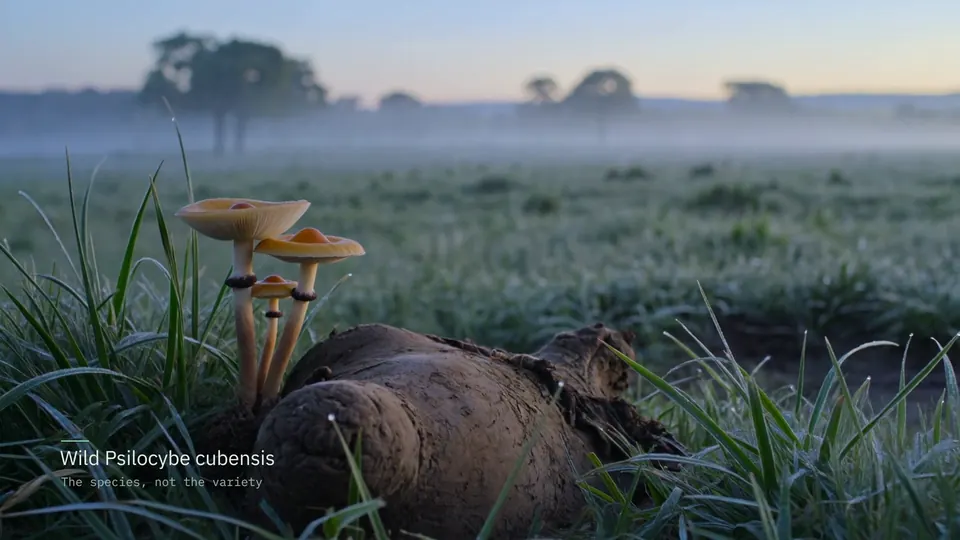
The last of Heim’s paintings has a modern echo. Life captioned it Stropharia cubensis and said it was first found in Cuba in June 1904 (Life, 1957). Today the species is Psilocybe cubensis (GBIF). One cultivated strain of it carries a name we trace in the true story behind the Penis Envy strain name.
Who discovered psilocybin? Albert Hofmann, 1958
Heim grew Psilocybe mexicana in his Paris laboratory from cultures brought back from Mexico (Life, 1957). He gave dried material to Albert Hofmann, the Swiss chemist who had discovered LSD (Spiers et al., 2024).
The papers are easy to date. In March 1958, Hofmann, Heim and two colleagues reported psilocybin in the journal Experientia (Hofmann et al., 1958). The same month, a paper led by Heim in the French Academy of Sciences’ Comptes rendus reported both psilocybin and psilocin (Heim et al., 1958).
By November 1958 Hofmann’s team had worked out psilocybin’s structure and made it in the laboratory, the nearest answer to “when was psilocybin invented?” (Hofmann et al., 1958). In 1959 came a short note on identifying psilocin (Hofmann and Troxler, 1959) and a full account of both compounds in Helvetica Chimica Acta (Hofmann et al., 1959). That is why some reviews give 1959 for psilocin. Evidence: established.
Psilocin is also the compound the mushroom makes at the start of its bruising reaction, explained in why magic mushrooms turn blue (Lenz et al., 2020). In 1962 Hofmann himself was among the researchers who came to Huautla, visiting with Wasson and Irmgard Weitlaner-Johnson (Spiers et al., 2024).
The 1960s research era
Psilocybin reached laboratories just as a new word arrived. A 2026 article credits the psychiatrist Humphry Osmond with coining “psychedelic”, meaning mind-manifesting, in 1957 (Seale-Feldman, 2026). Evidence: limited; we could not check the date against Osmond’s own writing. Osmond had left England in 1951 for a post in Saskatchewan, where he spent a decade experimenting with hallucinogens (Lett and Dyck, 2023).
At Harvard, psilocybin work by Timothy Leary and Richard Alpert ended in controversy: on 27 May 1963 the university announced that Alpert’s appointment had been terminated for giving a hallucinogenic drug to an undergraduate (Harvard Crimson, 1963). Toronto had its own research and street scene in these years, told in surprising stories of psychedelic Toronto and in the history of Rochdale College, its free university.
When did magic mushrooms become illegal?
Governments began scheduling the compounds in the early 1970s. The dates differ by country, and the international treaty covers the chemicals rather than the mushrooms.
Federal scheduling in the United States, 1970
The US Controlled Substances Act, Title II of a law approved on 27 October 1970, listed psilocybin and psilocyn in Schedule I, for drugs the law says have a high potential for abuse and no currently accepted medical use. The schedules took effect at once; most of the rest, including offences and penalties, on 1 May 1971 (Public Law 91-513, sections 202 and 704). Both are still in Schedule I (21 CFR 1308.11).
A 1965 law had already let the Secretary of Health, Education, and Welfare designate drugs with a potential for abuse because of their “hallucinogenic effect” (Public Law 89-74). We did not trace whether psilocybin was ever designated, so earlier US controls are unconfirmed here. Evidence: established for the 1970 and 1971 dates.
The 1971 UN Convention on Psychotropic Substances
The key treaty was signed in Vienna on 21 February 1971. The Convention on Psychotropic Substances put psilocybine and psilocine (its spellings) in Schedule I. For those substances, Article 7 requires parties to prohibit all use “except for scientific and very limited medical purposes” (UNODC text). It came into force on 16 August 1976 and has 184 parties (UN Treaty Collection).
The treaty left room for Indigenous practice. Article 32(4) lets a country with wild plants containing Schedule I substances, used by “small, clearly determined groups in magical or religious rites”, make a reservation (UNODC text). Mexico did so when it joined on 20 February 1975 (UN Treaty Collection).
One more subtlety: the treaty lists the compounds, not the mushrooms. In 2010 the International Narcotics Control Board said no plants are controlled under the 1971 Convention, naming magic mushrooms, and recommended that governments consider national controls (INCB, 2010).
When did magic mushrooms become illegal in Canada?
Later than you might think. The Le Dain Commission’s Final Report of 1973 said psilocybin was “not included in any Canadian schedules” (Le Dain, 1973, p. 75). It added that magic mushrooms had been eaten in Canada by “only a few exceptional experimenters” (Le Dain, 1973, appendix, p. 357).
Psilocybin and psilocin are usually said to have been added to Canada’s restricted drugs in 1974. Evidence: limited. Secondary sources agree, but we could not open the 1974 regulation itself. The inquiry’s 1969 hearings are told in the Le Dain Commission in Toronto.
Canada joined the 1971 Convention on 10 September 1988. Its reservation covered peyote, not mushrooms (UN Treaty Collection). The Controlled Drugs and Substances Act, passed in 1996 and in force since 14 May 1997, lists psilocin and psilocybin in Schedule III (Justice Laws). Health Canada says the production, sale and possession of magic mushrooms are illegal in Canada (Health Canada).
The modern research revival, 2006 to 2026
A 2006 double-blind study gave psilocybin to 36 hallucinogen-naive adults who took part in religious or spiritual activities, in a supportive setting and with an active comparison drug. Two months later, volunteers rated the experience as having substantial personal meaning and spiritual significance (Griffiths et al., 2006). Evidence: preliminary, from a small, selected sample.
A larger test began in 2019. A phase 2 trial of a synthetic psilocybin, with sites in 10 countries including the Centre for Addiction and Mental Health (CAMH) in Toronto, enrolled 233 adults with treatment-resistant depression (ClinicalTrials.gov; Goodwin et al., 2022).
At three weeks, the highest dose lowered depression scores by 6.6 points more than a very low comparison dose, on a scale that runs to 60. The benefit did not hold on the trial’s 12-week measure of sustained response, 77% of participants had adverse events such as headache, nausea and dizziness, and suicidal thoughts, behaviour or self-injury occurred in every dose group (Goodwin et al., 2022).
Two phase 3 trials followed. Their sponsor, Compass Pathways, reported differences of 3.6 points (June 2025) and 3.8 points (February 2026) on the same scale (Compass, 2025; Compass, 2026). These are company-reported results. In August 2026 it was filing with the US Food and Drug Administration in stages (Compass, August 2026).
Not every trial is positive. A German trial published in 2026 missed its main measure, and its authors call it inconclusive (Mertens et al., 2026). Reviewers have also warned that effects may be overestimated, because trial volunteers can often tell whether they received a psychedelic (Muthukumaraswamy et al., 2021). Evidence: preliminary. Psilocybin is still an investigational drug, not a proven treatment.
In Canada, Health Canada’s page says there are no approved therapeutic products containing psilocybin in Canada or elsewhere (Health Canada). Since 1 October 2026, new federal Controlled Substances Regulations, which consolidate earlier rules, list psilocybin as a restricted drug (Canada Gazette, 2025).
Canada’s place in the history of magic mushrooms
Canada’s part is small but real: Osmond’s years in Saskatchewan, a federal inquiry in 1973 that found few Canadians had tried magic mushrooms, and a Toronto trial site in 2019. Follow the city’s side in psychedelic Toronto.
Magic mushroom history: a timeline
- About 1000–500 BC (Borhegyi’s dating)Miniature mushroom stones buried at Kaminaljuyú, GuatemalaEvidence Unresolved: meaning debated
- 1500sSahagún and Durán describe mushroom feasts; a 2024 review says colonial authorities prohibited the mushrooms as idolatrousEvidence Established (the feasts); limited evidence (the ban)
- 1726Latest Inquisition-era reference to mushroom eating reported by one review: a letterEvidence Limited evidence (second-hand)
- 1915Safford argues teonanácatl was peyoteEvidence Established (later rejected)
- 1938First outsiders known to witness and write about a Mazatec mushroom ceremonyEvidence Limited evidence (one review)
- February 1939Schultes publishes his identification of teonanácatl as a mushroomEvidence Established
- 29–30 June 1955María Sabina’s velada with Wasson and Richardson in Huautla de JiménezEvidence Established
- 13 May 1957Life publishes “Seeking the Magic Mushroom”Evidence Established
- 1957A 2026 article credits Humphry Osmond with coining “psychedelic”Evidence Limited evidence
- March 1958Hofmann and colleagues report psilocybin; psilocin is reported the same monthEvidence Established
- 1962Hofmann visits Huautla with WassonEvidence Limited evidence (one review)
- 27 May 1963Harvard announces Alpert’s dismissalEvidence Established
- Mid-1960sHuautla becomes a countercultural pilgrimage destinationEvidence Limited evidence (scholarly reviews)
- 27 October 1970US Controlled Substances Act enacted; psilocybin and psilocyn listed in Schedule IEvidence Established
- 21 February 1971UN Convention on Psychotropic Substances signed in ViennaEvidence Established
- 1 May 1971Most of the US Act, including its offence provisions, takes effectEvidence Established
- 1973Le Dain report: psilocybin not on any Canadian scheduleEvidence Established
- 1974Canada restricts psilocybin and psilocinEvidence Limited evidence
- 20 February 1975Mexico joins the Convention with a reservation for Indigenous ritesEvidence Established
- 16 August 1976The Convention comes into forceEvidence Established
- 10 September 1988Canada joins the ConventionEvidence Established
- 14 May 1997Canada’s Controlled Drugs and Substances Act comes into forceEvidence Established
- 2006Double-blind psilocybin study of 36 hallucinogen-naive adults who took part in religious or spiritual activitiesEvidence Preliminary findings
- 2022Phase 2 depression trial, with a Toronto site, is publishedEvidence Preliminary findings
- 2025–2026Company-reported phase 3 results; US filing under wayEvidence Preliminary
- 1 October 2026New federal regulations, consolidating earlier ones, list psilocybin as a restricted drugEvidence Established
What is still unresolved
Some parts of the history of magic mushrooms are still open questions:
- How old Mesoamerican mushroom use is, what mushroom stones were for, and whether codex images show psilocybin mushrooms.
- The exact date Canada first restricted psilocybin. Secondary sources say 1974.
- Whether psilocybin was federally controlled in the United States before 1970.
- Whether psilocybin works as a medicine. Phase 3 results are company-reported, and Health Canada says no psilocybin product is approved in Canada or elsewhere.
- Several details of María Sabina’s later life that circulate in retellings but that we could not check.
Our documentary Penis Envy: The Mushroom Behind the Myth takes the same evidence-first approach. It is on our films page and on YouTube.
Common questions
Who discovered magic mushrooms?
No outsider did. Indigenous peoples in what is now Mexico used them in ceremony for centuries. Outsiders rediscovered the living practice in the 1930s: by one review’s account a team was the first outsider to witness and write up a Mazatec ceremony, in 1938, and Richard Evans Schultes identified teonanácatl as a mushroom in 1939.
What were magic mushrooms originally called?
In Nahuatl, the Aztec language, the sacred mushrooms were teonanácatl, usually translated “flesh of the gods”. Nanacatl was the Nahuatl word Sahagún recorded for mushrooms at a merchants’ feast. Mazatec and Zapotec speakers have their own names; María Sabina called them “saint children”.
Who was María Sabina?
A Mazatec sabia, or wise woman, from Huautla de Jiménez in Oaxaca, who died in 1985. She led the 1955 velada that R. Gordon Wasson described in Life. The publicity brought outsiders to her town, and scholars report she was stigmatized and ostracized in her community.
When was “Seeking the Magic Mushroom” published?
On 13 May 1957, in Life magazine, volume 42, number 19, as part three of its “Great Adventures” series. The author was R. Gordon Wasson. The full issue can be read on the Internet Archive.
Who discovered psilocybin?
The Swiss chemist Albert Hofmann and colleagues, working with the French mycologist Roger Heim. They reported psilocybin in March 1958, psilocin was reported the same month, and they described psilocybin’s structure and synthesis in November 1958.
When did magic mushrooms become illegal in Canada?
Psilocybin was not on any Canadian schedule in 1973. Secondary sources say it was restricted in 1974, which we could not confirm at the source. Since 1997 psilocin and psilocybin have been in Schedule III of the Controlled Drugs and Substances Act.
Shroomverse sells mushroom products. This article is general information about history. It is not medical, legal or purchasing advice, and it does not encourage anyone to use drugs.
SOURCES
- Seeking the Magic Mushroom (R. Gordon Wasson), Life, vol. 42, no. 19, 13 May 1957, Time Inc., via the Internet Archive. Accessed .
- Indigenous psilocybin mushroom practices: An annotated bibliography (Spiers et al.), Journal of Psychedelic Studies 8(1), 2024. Accessed .
- Indigenous Knowledge Systems & Psychedelic Science: Towards Ethical and Reciprocal Collaboration (Magar et al.), Journal of Psychopharmacology 40(1):179–188, 2026. Accessed .
- Current use of holy mushrooms of the genus Psilocybe in a Zapotec community in Oaxaca, Mexico (Haro-Luna et al.), IMA Fungus 16:e148070, 2025. Accessed .
- Secular Mysticism: Entanglements of Science and Religion in Psychedelic Medicine (Seale-Feldman), Culture, Medicine and Psychiatry 50:30, 2026. Accessed . Source of the María Sabina quotation, which it takes from Álvaro Estrada’s account; we did not open Estrada’s book.
- Tune in, Turn on: Religious Music and Spiritual Power in the History of Psychedelic Therapy (Lett and Dyck), Social History of Medicine 36(1):62–79, 2023. Accessed .
- Miniature Mushroom Stones from Guatemala (Borhegyi), American Antiquity 26(4):498–504, 1961. Accessed . Abstract read.
- Hallucinogenic drugs in pre-Columbian Mesoamerican cultures (Carod-Artal), Neurología (English edition) 30(1):42–49, 2015. Accessed .
- Pictographic representation of the first dawn and its association with entheogenic mushrooms in a 16th century Mixtec Mesoamerican Codex (Hernández Santiago et al.), Scientia Fungorum 46, 2017. Accessed . Abstract read.
- Historia general de las cosas de Nueva España, vol. 2 (Sahagún; Bustamante edition), Mexico, 1829, via the Internet Archive. Accessed . Book IX, chapter 8.
- Historia general de las cosas de Nueva España, vol. 3 (Sahagún; Bustamante edition), Mexico, title page dated 1830 (Internet Archive record: 1829), via the Internet Archive. Accessed . Book XI, chapter 7.
- Historia de las Indias de Nueva España y islas de Tierra Firme, vol. 1 (Durán), Mexico, 1867, via the Internet Archive. Accessed . Chapter 54, on Moctezuma’s coronation.
- An Aztec Narcotic (Safford), Journal of Heredity 6(7):291–311, 1915. Accessed . Bibliographic record checked.
- Plantae Mexicanae II: The Identification of Teonanacatl, a Narcotic Basidiomycete of the Aztecs (Schultes), Botanical Museum Leaflets, Harvard University 7(3):37–56, 1939. Accessed . Bibliographic record checked.
- Teonanacatl: The Narcotic Mushroom of the Aztecs (Schultes), American Anthropologist 42(3):429–443, 1940. Accessed . Bibliographic record checked.
- Psilocybin, ein psychotroper Wirkstoff aus dem mexikanischen Rauschpilz Psilocybe mexicana Heim (Hofmann, Heim, Brack, Kobel), Experientia 14(3):107–109, March 1958. Accessed . Bibliographic record checked.
- Determinism of carpophore and slerote formation in culture of Psilocybe mexicana Heim, a hallucinogenic agaric of Mexico and demonstration of psilocybine and psicoline (Heim, Brack, Kobel, Hofmann, Cailleux), Comptes rendus de l’Académie des sciences 246:1346–1351, March 1958 (PubMed record). Accessed . Title as indexed by PubMed (an English rendering of the French original); the record itself spells “slerote” and “psicoline”.
- Konstitutionsaufklärung und Synthese von Psilocybin (Hofmann et al.), Experientia 14(11):397–399, November 1958. Accessed . Bibliographic record checked.
- Identifizierung von Psilocin (Hofmann and Troxler), Experientia 15(3):101–102, 1959. Accessed . Bibliographic record checked.
- Psilocybin und Psilocin, zwei psychotrope Wirkstoffe aus mexikanischen Rauschpilzen (Hofmann et al.), Helvetica Chimica Acta 42:1557–1572, 1959. Accessed . Bibliographic record checked.
- Injury-Triggered Blueing Reactions of Psilocybe “Magic” Mushrooms (Lenz et al.), Angewandte Chemie International Edition, 2020. Accessed .
- Psilocybe cubensis (Earle) Singer: name record and Earle’s 1904 Cuban type specimen, GBIF. Accessed .
- Psilocybin, Senate Race Highlight Harvard Year, The Harvard Crimson, 9 July 1963. Accessed .
- Public Law 91-513 (Comprehensive Drug Abuse Prevention and Control Act of 1970), 84 Stat. 1236, US Government Publishing Office. Accessed . Sections 202 and 704 read.
- Public Law 89-74 (Drug Abuse Control Amendments of 1965), 79 Stat. 226, US Government Publishing Office. Accessed . Section 3 read; cited only for the “hallucinogenic effect” designation power.
- 21 CFR 1308.11, Schedule I, Legal Information Institute, Cornell Law School. Accessed .
- Convention on Psychotropic Substances, 1971: status, reservations and declarations, United Nations Treaty Collection. Accessed .
- Convention on Psychotropic Substances, 1971 (text and schedules), United Nations Office on Drugs and Crime. Accessed .
- Report of the International Narcotics Control Board for 2010, paragraphs 284–287, International Narcotics Control Board. Accessed .
- Final Report of the Commission of Inquiry into the Non-Medical Use of Drugs (1973), part 2, Government of Canada Publications. Accessed . Quotation on printed page 75.
- Final Report of the Commission of Inquiry into the Non-Medical Use of Drugs (1973), appendices, Government of Canada Publications. Accessed . Quotation on printed page 357.
- Controlled Drugs and Substances Act, S.C. 1996, c. 19, Justice Laws Website. Accessed .
- Psilocybin and psilocin (magic mushrooms) (page modified 20 October 2026), Health Canada. Accessed .
- Controlled Substances Regulations, SOR/2025-242, Canada Gazette, Part II, 17 December 2025. Accessed .
- Psilocybin can occasion mystical-type experiences having substantial and sustained personal meaning and spiritual significance (Griffiths et al.), Psychopharmacology 187:268–283, 2006. Accessed .
- Single-Dose Psilocybin for a Treatment-Resistant Episode of Major Depression (Goodwin et al.), New England Journal of Medicine 387:1637–1648, 2022. Accessed .
- NCT03775200: The Safety and Efficacy of Psilocybin in Participants With Treatment Resistant Depression, ClinicalTrials.gov. Accessed .
- Form 8-K, 23 June 2025 (COMP005 results), Compass Pathways, SEC EDGAR. Accessed . Company-reported.
- Form 8-K, 17 February 2026 (COMP006 results), Compass Pathways, SEC EDGAR. Accessed . Company-reported.
- Second-quarter 2026 results release, 5 August 2026, Compass Pathways, SEC EDGAR. Accessed . Company statement on the US filing.
- Efficacy and Safety of Psilocybin in Treatment-Resistant Major Depression: The EPISODE Randomized Clinical Trial (Mertens et al.), JAMA Psychiatry 83(5):448–460, 2026. Accessed .
- Blinding and expectancy confounds in psychedelic randomized controlled trials (Muthukumaraswamy, Forsyth and Lumley), Expert Review of Clinical Pharmacology 14(9):1133–1152, 2021. Accessed .
CHANGES
- : Added links to the DMT Library.
- : First published. Every source opened and checked on this date; the claims sheet is kept with our editorial notes.
- : Re-read Health Canada’s psilocybin page, updated on 20 October 2026, and corrected its date here. The statements this article cites from it are unchanged.



