
THE SHROOMVERSE JOURNAL ✳ 14 MIN READ
What is jurema? Mimosa tenuiflora, the jurema tradition and its chemistry
Topic: DMT
Published Updated
Short answer, checked 24 October 2026
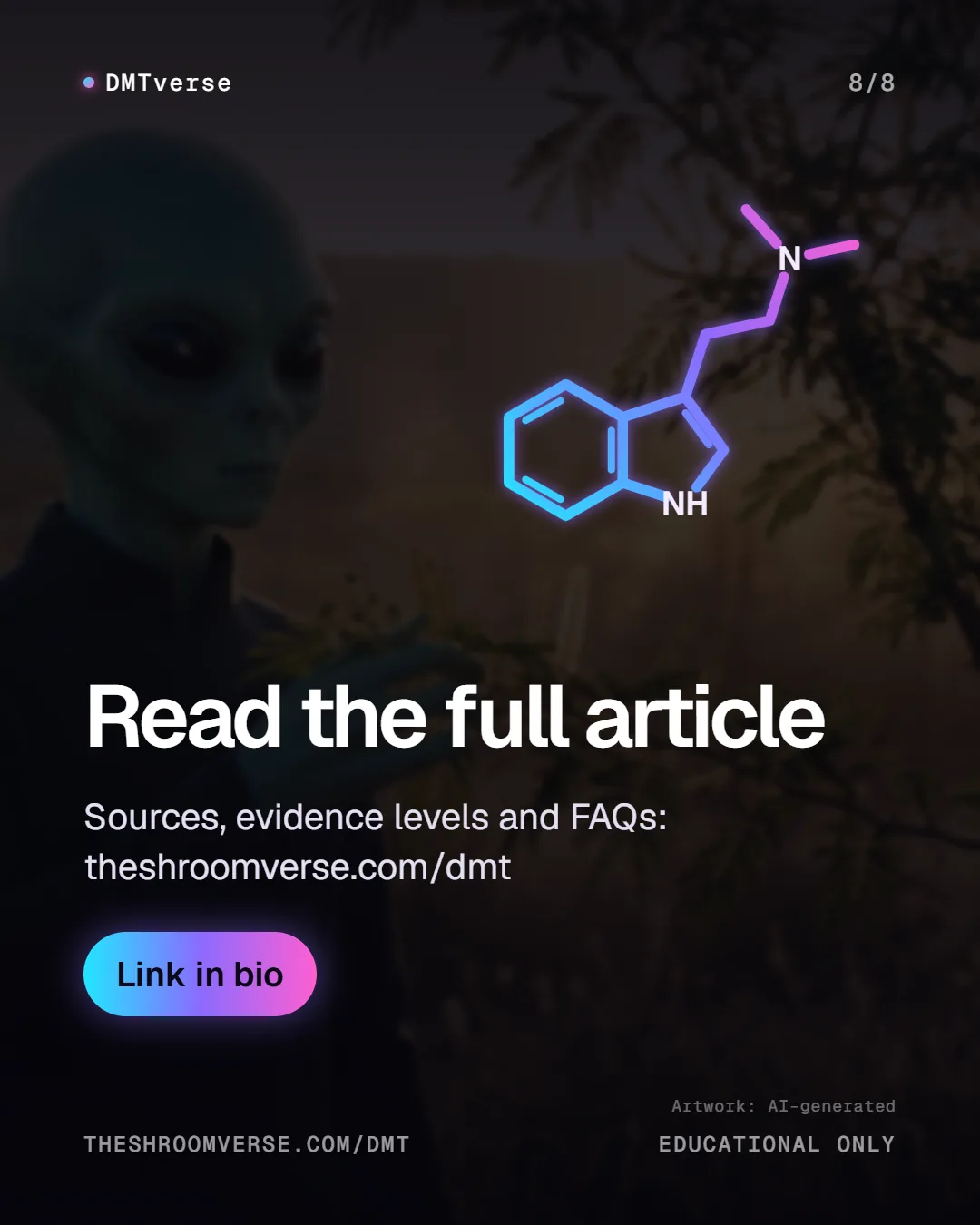
Jurema is the Brazilian name for Mimosa tenuiflora (also published as Mimosa hostilis), a thorny shrub or tree whose bark is used in a sacred drink of Indigenous and Afro-Brazilian religion in northeastern Brazil. Analyses of the bark report DMT, plus tannins and a compound called yuremamine. Unlike ayahuasca, the drink has no vine supplying MAO inhibitors, and why it is active anyway is still debated. In Canada, DMT is in Schedule III of the Controlled Drugs and Substances Act; the plant is not named.
THE SHORT VERSION · SWIPE

On this page 10 sections
Jurema is a plant, a drink and, for some communities, a sacred presence. The word mostly refers to *Mimosa tenuiflora*, a spiny legume of dry northeastern Brazil, and to the ceremonial drink made from it. This guide covers the botany, the recorded tradition, the chemistry and the open questions.
Education only, not guidance
This article gives no amounts, preparation, extraction, sourcing or instructions, and describes ritual only as researchers recorded it. Evidence labels used below: established (shown in peer-reviewed or primary sources and not seriously disputed), preliminary (early, small or indirect) and unresolved (an open question).
What is jurema? The plant and its names
Botanically, jurema preta (black jurema) is *Mimosa tenuiflora* (Willd.) Poir., in the pea family, Fabaceae. Plants of the World Online, run by the Royal Botanic Gardens, Kew, accepts the name, first published in 1810, and describes a scrambling shrub or tree. Its native range runs from southern Mexico to Venezuela and northeastern Brazil, and it has been introduced to Java, Malaya, New Guinea and Sumatra. Kew records its use as animal food, as medicine, for fuel and for social purposes (POWO). Evidence: established.
Kew lists eight synonyms. Two matter for readers: *Mimosa hostilis* Benth. (1875), the name much older literature and many websites still use, and *Acacia jurema* Mart. (1828), which carries the Brazilian common name into botany (POWO). So “Mimosa hostilis” and “Mimosa tenuiflora” are the same species. In Brazil, the plant is most strongly associated with the Caatinga, the country’s semi-arid northeastern biome (Amariz et al., 2022). Evidence: established.
“Jurema” is also a looser folk name. A 2008 review lists at least 19 species called jurema in Brazil, and notes that some of them, chiefly those called jurema branca (white jurema), do not contain tryptamine alkaloids at all (Souza et al., 2008). Elsewhere the same tree has other names: in Mexico its bark is known as tepescohuite, a traditional skin remedy (Rivera-Arce et al., 2007). Evidence: established.
The jurema tradition in northeastern Brazil
According to a 2008 review by Brazilian ethnobotanists, *Mimosa* species called jurema were used in religious practice by Indigenous peoples of northeastern Brazil long before Portuguese colonisation, and after colonisation they were also taken up by Afro-Brazilians. The drink has several names. The Truká of Assunção Island (Cabrobó, Pernambuco) and the Kambiwá call it jurema wine; the Pankararu of Brejo dos Padres call it ajucá; the Atikum of Serra do Umã and the Kambiwá call it anjucá (Souza et al., 2008). Evidence: established for these groups, as recorded in the anthropological work the review cites.
The same review describes the ritual setting rather than a recipe. Tobacco and candles appear in practically all the Indigenous rituals that involve jurema, which today take place in a festival called the Toré, where people honour religious entities, including mythical ancestors, and sing traditional songs. Among the Kariri-Xocó, the trees in the forest from which the plant is taken should be seen or touched only by people initiated by the community’s elders (Souza et al., 2008). A 2005 paper confirms the drink is still used for medico-religious purposes (Vepsäläinen et al., 2005).
The tradition was once written off. A 1999 review notes that jurema use had been described as extinct in Brazil in a 1980 book, and points to later fieldwork showing it continued among the Kariri-Xocó (Ott, 1999). Evidence: established.
Afro-Brazilian jurema is less documented, by design: the 2008 review says little is published because its use is usually a well-kept secret, and that these religions are found in several Brazilian states. It also records Afro-Brazilian use of the plant to treat infections and inflammation (Souza et al., 2008). Evidence: established that the practices exist; details are kept private by the communities themselves.
What did chemical analyses find in jurema?
The headline finding is DMT, but some of the earliest work is known only through later reviews. The table lists each finding with the source we read; where we could not read the original, the source column names the review that reports it (Souza et al., 2008; Ott, 1999).
| Year | Study | Material | What was reported | Source we read |
|---|---|---|---|---|
| 1946 | Gonçalves de Lima | Material linked to the Pankararu jurema drink | An alkaloid named nigerine; later suggested to be impure DMT | Souza et al. 2008; Ott 1999 |
| 1959 | Pachter, Zacharias and Ribeiro | Roots (as Mimosa hostilis) | DMT isolated | Ott 1999; paper title on Crossref |
| 1961 | Melo and Bandeira | Root bark | DMT | Souza et al. 2008 |
| 1990 | Meckes-Lozoya and colleagues | Bark (Mexican tepescohuite) | DMT and 5-hydroxytryptamine; β-carbolines also reported | Souza et al. 2008 |
| 2005 | Vepsäläinen and colleagues | Stem bark | Yuremamine, a new compound class (structure revised in 2015) | Abstract |
| 2012 | Gaujac and colleagues | Inner bark, 24 local samples | DMT in every sample, at widely varying levels | Abstract |
| 2014 | Gardner and colleagues | Leaves and seeds | N-methyltryptamine, DMT and 2-methyltetrahydro-β-carboline | 2022 review of the genus |
| 2024 | de Sousa and colleagues | Root bark | Thirteen compounds: eight proanthocyanidins (tannins), three alkaloids, a flavonol and a dihydrochalcone | Abstract |
DMT was apparently first detected by Gonçalves de Lima’s team after a visit to the Pankararu village of Brejo dos Padres, under the name nigerine (Souza et al., 2008). Ott’s 1999 review credits Pachter, Zacharias and Ribeiro (1959) with isolating DMT from the roots (Ott, 1999). Evidence: established as history; we did not read the 1946 or 1959 papers.
Modern work confirms DMT with current instruments. A 2012 study analysed 24 locally obtained samples of inner bark and found DMT in all of them, at levels that varied widely between samples (Gaujac et al., 2012); a 2022 study identified and quantified it in the bark by NMR and GC-MS (Amariz et al., 2022). The 2014 work found N-methyltryptamine, DMT and a simple β-carboline in leaves and seeds (Rizwan et al., 2022). Evidence: established that DMT is present; the amount varies.
DMT is not the whole story. The bark is rich in tannins, alongside saponins, steroids, chalcones and unusual flavonoids (Souza et al., 2008). A 2024 analysis of root bark annotated 13 compounds, most of them tannins (de Sousa et al., 2024). Yuremamine, isolated from stem bark in 2005, was described as a new class of plant indoles (Vepsäläinen et al., 2005); in 2015 chemists who synthesised it revised its structure to a flavonoid-linked indole (Calvert and Sperry, 2015). Evidence: established.
Is jurema active without an MAO inhibitor?
This is the puzzle that draws pharmacologists to jurema. Swallowed on its own, DMT is nearly inactive, because the enzyme monoamine oxidase A breaks it down on first pass through the gut and liver; in ayahuasca, β-carbolines from the vine block that enzyme (Egger et al., 2024). Jurema, as traditionally described, contains no such vine. See why DMT breaks down so fast. Evidence: established for DMT.
The 2008 review sets out the competing explanations. One is that the plant supplies its own MAO-inhibiting compounds: β-carbolines were reported in it by Meckes-Lozoya and colleagues in 1990. Another, from Ott (2002), is that the drink is visionary on its own and that inactive preparations were simply too weak. The review’s own conclusion is cautious: there is no firm evidence yet that the drink is hallucinogenic by itself, and its effects may vary with the different ingredients different cultures add (Souza et al., 2008). Evidence: unresolved.
Animal work has added a twist without settling it. In a 2022 mouse study, a standardised bark extract, which contained DMT and yuremamine, had an antidepressant-like effect in behavioural tests whether or not harmine (a β-carboline) was added, and blocking 5-HT2A/2C serotonin receptors prevented that effect (Duarte-Filho et al., 2022). That is mice, not psychedelic effects in people. Evidence: preliminary.
What about the “yuremamine hypothesis”, the online idea that yuremamine explains jurema’s activity? In the papers we read, yuremamine was isolated, characterised and re-assigned (Vepsäläinen et al., 2005; Calvert and Sperry, 2015), but none tested whether it changes how DMT acts in the body. It is a hypothesis, not a finding. Evidence: unresolved.
Jurema vs ayahuasca: how do they differ?
Both are South American sacred drinks that contain DMT, which is why they are often compared (Duarte-Filho et al., 2022). Ayahuasca is made from two plants: leaves of *Psychotria viridis*, which supply DMT, and stalks of the *Banisteriopsis caapi* vine, which supply β-carbolines such as harmine. It is traditionally used by Indigenous groups of northwestern Amazonian countries, including Brazil, Peru, Colombia and Ecuador (Dos Santos and Hallak, 2024), and also by Brazilian churches such as the Santo Daime and the União do Vegetal (Gaujac et al., 2012). See what is ayahuasca and the ayahuasca vine.
| Jurema | Ayahuasca | |
|---|---|---|
| Main plant(s) | Mimosa tenuiflora (jurema preta) | Banisteriopsis caapi vine with Psychotria viridis leaves |
| Home region | Northeastern Brazil, Caatinga | Northwestern Amazon: Brazil, Peru, Colombia, Ecuador |
| MAO inhibitors | No vine; whether the plant supplies its own is debated | β-carbolines from the vine |
| Religious setting | Indigenous Toré rituals; Afro-Brazilian religions | Indigenous Amazonian traditions; Santo Daime and UDV churches |
| Research base | Small: mostly chemistry and animal studies | Larger: human pharmacology and small clinical studies |
The research gap is real. Ayahuasca has human experimental and observational studies, though few controlled trials and small samples (Dos Santos and Hallak, 2024). For jurema, the 2008 review called for more studies on how DMT acts in the body and more careful observation of traditional preparations (Souza et al., 2008). We found no human clinical trial of jurema.
Jurema bark beyond ritual: wound-healing research
In Mexico, tepescohuite bark is a popular remedy for skin lesions, and that use has been tested. A randomised, double-blind, placebo-controlled trial published in 2007 treated venous leg ulcers with a hydrogel containing a tannin-standardised bark extract or the same hydrogel without it, for 13 weeks of follow-up. Every patient in the extract group responded, with ulcer size reduced by a mean of 92% after the eighth week, against one responder in the control group, and no side effects in either group (Rivera-Arce et al., 2007). Evidence: preliminary.
A larger follow-up did not confirm that result. In a 2012 randomised, placebo-controlled, double-blind trial at a specialist wound and ostomy care centre, 41 patients with venous leg ulcers were enrolled and 32 completed it. Both groups also received compression, and ulcers shrank in both, with no significant difference between the extract hydrogel and the plain hydrogel; the authors concluded the extract was not superior (Lammoglia-Ordiales et al., 2012). Evidence: on current trials, not shown to beat standard care.
What does research say about toxicity?
The clearest toxicity findings come from farm animals. Ruminants grazing northeastern Brazil’s semi-arid rangelands often have birth defects. In a 2007 study, four pregnant goats fed fresh *M. tenuiflora* delivered four kids, three with malformations such as cleft lip and eye defects, while control goats and goats fed another suspect plant delivered normal kids (Pimentel et al., 2007). A 2014 rat study found more cleft palate and skeletal malformations in pups whose mothers were fed the plant, its extracts or purified N-methyltryptamines (Gardner et al., 2014). Evidence: established in animals; not studied in people.
A 2024 study gave mice a single oral dose of a root-bark extract. None died, but the authors found changes in blood tests and kidney weight and tissue changes in the heart, liver and kidneys (de Sousa et al., 2024). Older observations recorded intense pupil dilation and high blood pressure with jurema, and the 2008 review notes that some plants added to Afro-Brazilian jurema drinks have confirmed toxic effects (Souza et al., 2008). Evidence: preliminary.
If someone is in danger
Call 911 for immediate danger or urgent medical help, including if someone is unconscious, not breathing or having a seizure. In Ontario, the Ontario Poison Centre is at 1-800-268-9017; every province has a poison centre, listed by SickKids (AboutKidsHealth). If you or someone you know is thinking about suicide, call or text 9-8-8, 24 hours a day (Government of Canada). See also our safety page and how to help someone having a bad trip.
Is jurema (Mimosa hostilis) legal in Canada?
We read the Controlled Drugs and Substances Act on 24 October 2026, in the consolidation current to 30 September 2026 and last amended on 18 July 2026. Schedule III, item 7, lists “N,N-Dimethyltryptamine (DMT) (3-[(2-dimethylamino) ethyl]indole) and any salt thereof”. A search of the full text found no mention of *Mimosa*, *tenuiflora*, *hostilis* or jurema; the only entries in the Act that name plants are the precursor listings for ephedrine and pseudoephedrine (Justice Laws, CDSA). Evidence: established for what the text says.
Not being named does not make a plant legal to sell, import or consume for its DMT, and laws change. For the full picture, see is DMT legal in Canada. This is not legal advice.
What we still don’t know
- Why jurema drinks are active at all, given that DMT is inactive when swallowed alone: the plant’s own compounds, other ingredients, or both (unresolved).
- Whether yuremamine does anything in the body: no study we found has tested it (unresolved).
- How much the chemistry varies across the plant’s range, and with season and plant part (unresolved).
- What jurema means in the communities’ own terms: much of the published record is by outside researchers, and Afro-Brazilian practice, often discussed under the name Catimbó-Jurema, is deliberately kept private. We did not read ethnographies of it directly.
- We did not read the 1946, 1959, 1961 and 1990 papers in full; their findings here come from the 2008 and 1999 reviews.
Common questions
What is jurema?
Jurema is the Brazilian name for Mimosa tenuiflora, a spiny shrub or tree native from southern Mexico to northeastern Brazil, and for the sacred drink made from it in Indigenous and Afro-Brazilian religion in northeastern Brazil. The name is also used loosely for other plants.
Is Mimosa hostilis the same as Mimosa tenuiflora?
Yes. Kew’s Plants of the World Online treats Mimosa hostilis Benth. (1875) as a synonym of Mimosa tenuiflora (Willd.) Poir., the accepted name. Older papers and many websites still use Mimosa hostilis.
What is the difference between jurema preta and jurema branca?
Jurema preta (black jurema) is Mimosa tenuiflora, the plant in which DMT has been found. Jurema branca (white jurema) is a name for other species, and a 2008 review notes that these mostly do not contain tryptamine alkaloids. At least 19 species are called jurema in Brazil.
What is the difference between jurema and ayahuasca?
Ayahuasca combines two Amazonian plants: Psychotria viridis leaves for DMT and the Banisteriopsis caapi vine for MAO-inhibiting β-carbolines. Jurema comes mainly from one plant of dry northeastern Brazil, Mimosa tenuiflora, with no vine. Why jurema drinks are active without that vine is still debated.
Does jurema contain DMT?
Yes. Analyses since the 1940s and 1950s, and modern studies with current instruments, have found DMT in the bark and roots, at levels that vary from sample to sample. The bark also contains tannins, yuremamine and other compounds.
Is Mimosa hostilis legal in Canada?
As read on 24 October 2026, the Controlled Drugs and Substances Act lists DMT in Schedule III but does not name Mimosa tenuiflora, Mimosa hostilis or jurema. Not being named does not mean legal to sell or consume for its DMT, and laws change. This is not legal advice.
Shroomverse sells mushroom products. This article is general information about the botany, ethnography, chemistry and legal status of a Brazilian plant. It is not medical, legal or purchasing advice, and it does not recommend any product.
SOURCES
- Mimosa tenuiflora (Willd.) Poir., Plants of the World Online, Royal Botanic Gardens, Kew. Accessed . Page read in a browser. Supports the accepted name, first publication 1810, scrambling shrub or tree, native range S. Mexico to Venezuela and NE Brazil with the listed regions, introduced to Jawa, Malaya, New Guinea and Sumatera, uses (animal food, medicine, social, fuel), and eight synonyms including Mimosa hostilis Benth. (1875) and Acacia jurema Mart. (1828).
- Jurema-Preta (Mimosa tenuiflora [Willd.] Poir.): a review of its traditional use, phytochemistry and pharmacology (Souza RSO, Albuquerque UP, Monteiro JM, Amorim ELC; Brazilian Archives of Biology and Technology 51(5):937–947, 2008), Instituto de Tecnologia do Paraná (peer-reviewed, open access on SciELO). Accessed . Full text read. Supports pre-colonial Indigenous use and later Afro-Brazilian use; drink names by people (Truká, Kambiwá, Pankararu, Atikum); at least 19 species called jurema, jurema branca without tryptamines; Toré, tobacco and candles; the Kariri-Xocó initiation rule; secrecy and toxic additives in Afro-Brazilian drinks; use for infections and inflammation; nigerine (1946), Melo and Bandeira (1961) and Meckes-Lozoya (1990) chemistry; other compound classes; mydriasis and hypertension; the oral-activity debate (β-carbolines, Ott 2002) and the review’s conclusion. Preparation details deliberately not reproduced.
- Pharmahuasca: human pharmacology of oral DMT plus harmine (Ott J, Journal of Psychoactive Drugs 31(2):171–177, 1999), Taylor & Francis; PDF from the MAPS Psychedelic Bibliography. Accessed . Full text searched for jurema. Cited only for history: DMT possibly first isolated in 1946 as nigerine, DMT isolated from roots by Pachter et al. (1959), and continued jurema use among the Kariri-Xocó despite a 1980 description of it as extinct. The paper’s self-experiments, amounts, concentrations and ‘analogue’ combinations are deliberately not reproduced.
- Indole Alkaloids of Acer saccharinum (the Silver Maple), Dictyoloma incanescens, Piptadenia colubrina, and Mimosa hostilis (Pachter IJ, Zacharias DE, Ribeiro O; Journal of Organic Chemistry 24:1285–1287, 1959), American Chemical Society. Accessed . Bibliographic record checked on Crossref; not read. Cited for its title and date; the root finding is as Ott (1999) reports it.
- Isolation and characterization of yuremamine, a new phytoindole (Vepsäläinen JJ, Auriola S, Tukiainen M, Ropponen N, Callaway JC; Planta Medica 71:1053–1057, 2005), Thieme (peer-reviewed); abstract via Europe PMC, PMID 16320208. Accessed . Abstract read. Supports isolation of yuremamine from stem bark, a new class of phytoindoles, and continued medico-religious use of the drink by Indigenous peoples of northeastern Brazil.
- Bioinspired total synthesis and structural revision of yuremamine, an alkaloid from the entheogenic plant Mimosa tenuiflora (Calvert MB, Sperry J; Chemical Communications 51:6202–6205, 2015), Royal Society of Chemistry (peer-reviewed); abstract via Europe PMC, PMID 25756921. Accessed . Abstract read. Supports the revision of yuremamine’s structure from a pyrroloindole to a flavonoidal indole.
- Determination of N,N-dimethyltryptamine in Mimosa tenuiflora inner barks by matrix solid-phase dispersion procedure and GC-MS (Gaujac A, Aquino A, Navickiene S, de Andrade JB; Journal of Chromatography B 881–882:107–110, 2012), Elsevier (peer-reviewed); abstract via Europe PMC, PMID 22209595. Accessed . Abstract read. Supports DMT in all 24 locally obtained inner-bark samples at varying concentrations (values not reproduced), and Santo Daime and UDV as religions using ayahuasca. The analytical method is not described here.
- Chemical study of Mimosa tenuiflora barks (Amariz IAE et al., Natural Product Research 36(7):1893–1897, 2022), Taylor & Francis (peer-reviewed); abstract via Europe PMC, PMID 32924595. Accessed . Abstract read. Supports the plant’s predominance in the Caatinga biome and identification and quantification of DMT in bark by NMR and GC-MS.
- Unraveling the metabolomic profile and acute toxicity of ethanolic extract from Mimosa tenuiflora (Willd.) Poir. root bark (de Sousa RP et al., Toxicon 249:108076, 2024), Elsevier (peer-reviewed); abstract via Europe PMC, PMID 39179178. Accessed . Abstract read. Supports 13 annotated compounds (eight type B proanthocyanidins, three alkaloids, a glycosylated flavonol, a dihydrochalcone derivative), no deaths, and changes in kidney weight, blood parameters and heart, liver and kidney tissue in mice. Doses not reproduced.
- Phytochemistry and Diverse Pharmacology of Genus Mimosa: A Review (Rizwan K, Majeed I, Bilal M, Rasheed T, Shakeel A, Iqbal S; Biomolecules 12(1):83, 2022), MDPI (peer-reviewed, open access); full text via Europe PMC, PMC8773851. Accessed . Full text table read. Supports N-methyltryptamine, DMT and 2-methyltetrahydro-β-carboline from M. tenuiflora leaves and seeds, citing Gardner et al. (2014).
- β-carboline-independent antidepressant-like effect of the standardized extract of the barks of Mimosa tenuiflora (Willd) Poir. occurs via 5-HT2A/2C receptors in mice (Duarte-Filho LAMS et al., Journal of Psychopharmacology 36(7):836–848, 2022), SAGE (peer-reviewed); abstract via Europe PMC, PMID 35723216. Accessed . Abstract read. Supports jurema wine as a DMT-containing drink used religiously by Indigenous people of northeastern Brazil, DMT and yuremamine in the extract, and a harmine-independent antidepressant-like effect in mice prevented by ketanserin. DMT content not reproduced.
- Neurobiological research on N,N-dimethyltryptamine (DMT) and its potentiation by monoamine oxidase (MAO) inhibition: from ayahuasca to synthetic combinations of DMT and MAO inhibitors (Egger K, Aicher HD, Cumming P, Scheidegger M; Cellular and Molecular Life Sciences 81:395, 2024), Springer (peer-reviewed, open access); abstract via Europe PMC, PMC11387584. Accessed . Abstract read. Supports DMT being nearly inactive orally because of first-pass metabolism, and β-carboline MAO-A inhibitors in ayahuasca potentiating oral DMT.
- Ayahuasca: pharmacology, safety, and therapeutic effects (Dos Santos RG, Hallak JEC; CNS Spectrums 30:e2, 2024), Cambridge University Press (peer-reviewed); abstract via Europe PMC, PMID 39564645. Accessed . Abstract read. Supports ayahuasca’s two plants (Psychotria viridis leaves, Banisteriopsis caapi stalks), its traditional use in Brazil, Peru, Colombia and Ecuador, and the state of human research (few controlled studies, small samples).
- Therapeutic effectiveness of a Mimosa tenuiflora cortex extract in venous leg ulceration treatment (Rivera-Arce E et al., Journal of Ethnopharmacology 109(3):523–528, 2007), Elsevier (peer-reviewed); abstract via Europe PMC, PMID 17088036. Accessed . Abstract read. Supports tepescohuite as a Mexican remedy for skin lesions, the randomised double-blind placebo-controlled design, 13-week follow-up, effectiveness in all extract-group patients with a 92% mean reduction after week 8, one control responder, and no side effects.
- A randomised comparative trial on the use of a hydrogel with tepescohuite extract (Mimosa tenuiflora cortex extract-2G) in the treatment of venous leg ulcers (Lammoglia-Ordiales L et al., International Wound Journal 9(4):412–418, 2012), Wiley (peer-reviewed); full text via Europe PMC, PMC7950610. Accessed . Abstract read. Supports 41 patients enrolled, 32 completing, compression in both arms, ulcer reduction in both groups with no significant difference, and the conclusion that the extract hydrogel was not superior.
- Mimosa tenuiflora as a cause of malformations in ruminants in the northeastern Brazilian semiarid rangelands (Pimentel LA et al., Veterinary Pathology 44(6):928–931, 2007), SAGE (peer-reviewed); abstract via Europe PMC, PMID 18039908. Accessed . Abstract read. Supports the field malformations, four goats fed M. tenuiflora delivering four kids, three abnormal (cleft lip, eye defects and others), and normal kids in the control and Prosopis groups.
- Teratogenic effects of Mimosa tenuiflora in a rat model and possible role of N-methyl- and N,N-dimethyltryptamine (Gardner D et al., Journal of Agricultural and Food Chemistry 62(30):7398–7401, 2014), American Chemical Society (peer-reviewed); abstract via Europe PMC, PMID 24689494. Accessed . Abstract read. Supports higher incidence of cleft palate and skeletal malformations in rat pups from mothers fed plant material, extracts, alkaloid extracts or purified N-methyltryptamines.
- Controlled Drugs and Substances Act (S.C. 1996, c. 19), full text, Justice Laws Website, Government of Canada. Accessed . Consolidation current to 2026-09-30, last amended 2026-07-18, read 24 October 2026. Schedule III item 7 quoted (DMT and any salt thereof). The full text was searched for ‘Mimosa’, ‘tenuiflora’, ‘hostilis’, ‘jurema’ and ‘plant’: no match for the plant names; ‘plant’ appears only in the ephedrine and pseudoephedrine precursor entries.
- Get help with mental health, Government of Canada. Accessed . Page read 24 October 2026. Supports calling 9-1-1 in immediate danger or for urgent medical support, and calling or texting 9-8-8, 24 hours a day.
- Poison information centres in Canada, AboutKidsHealth, The Hospital for Sick Children (SickKids). Accessed . Page read 24 October 2026. Supports the Ontario Poison Centre toll-free number 1-800-268-9017, the provincial list, and calling 911 if someone is unconscious, not breathing or having a seizure.
CHANGES
- : Renamed the first section to say it covers the plant and its names; its text is unchanged.
- : Published. All sources opened and checked on this date, including the Kew species record and the CDSA consolidation current to 30 September 2026. Older chemistry reported through the 2008 and 1999 reviews, as stated in the table.



