THE SHROOMVERSE JOURNAL ✳ 16 MIN READ
What is psilocybin, and how does it work? What the science shows and what it doesn’t
Topic: Psilocybin research
Published Updated
Listen: the 3-minute version
AI-narrated summary of this article
Short answer, checked 4 October 2026
Psilocybin is a compound made by certain mushrooms. In the body it is converted to psilocin, which acts on serotonin receptors, above all one called 5-HT2A. That much is well supported. How receptor action becomes the experience people report, why fungi make the compound, and whether it works as a medicine are still open questions. In Canada it is a controlled substance.
On this page 9 sections
Psilocybin is a naturally occurring chemical made by certain mushrooms. Health Canada names it, together with psilocin, as the active ingredients of magic mushrooms (Health Canada). In the body, psilocybin is converted to psilocin, and psilocin is the form that acts on serotonin receptors (Dinis-Oliveira, 2017). That is the settled core of the answer.
Much of what comes after it is not settled: how the receptor action turns into the experiences people report, why mushrooms make the compound at all, and whether it works as a medicine. This guide is about the molecule. It is not a guide to using, finding, growing or identifying mushrooms, and it gives no dosing information. For the fungi themselves, start with what are magic mushrooms.
How we label the evidence
Established: shown in peer-reviewed studies or official sources and not seriously disputed. Preliminary: early, small, indirect or mixed. Unresolved: an open question, where the data are missing or point different ways.
What is psilocybin, in plain English?
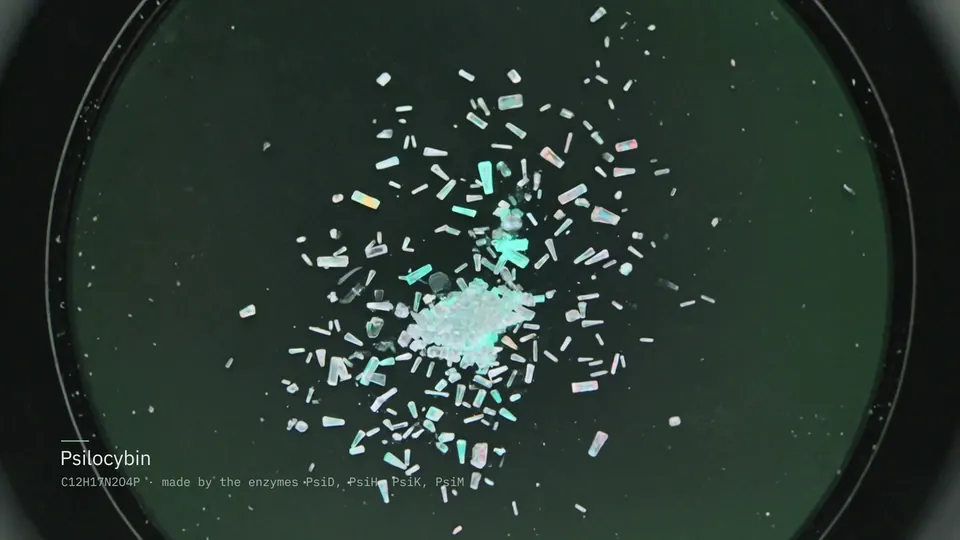
Psilocybin is the tryptamine-derived natural product of Psilocybe mushrooms, the so-called “magic mushrooms” (Fricke et al., 2017). Researchers have mapped the mushroom’s assembly line: four enzymes, named PsiD, PsiK, PsiM and PsiH, including one that decarboxylates the amino acid L-tryptophan and one that handles the phosphate-transfer step (Fricke et al., 2017). Evidence: established.
Its close relative is psilocin. The Controlled Drugs and Substances Act names both by structure: psilocin carries a hydroxyl group at position 4 of its indole ring, and psilocybin carries a phosphoryloxy group (a phosphate tag) at the same position (CDSA). One small chemical change separates them, and it matters for how the body handles them.
Psilocybin vs psilocin: what is a prodrug?
A prodrug is a compound that has to be converted before it is active. A 2017 review of how the body handles these compounds describes psilocybin as primarily a prodrug that the enzyme alkaline phosphatase dephosphorylates, meaning it strips off the phosphate tag, to leave the active metabolite psilocin (Dinis-Oliveira, 2017). The authors of a 2019 brain-imaging study describe psilocin as the compound whose stimulation of serotonin 2A receptors is believed to underlie the psychedelic effects (Madsen et al., 2019). Evidence: established.
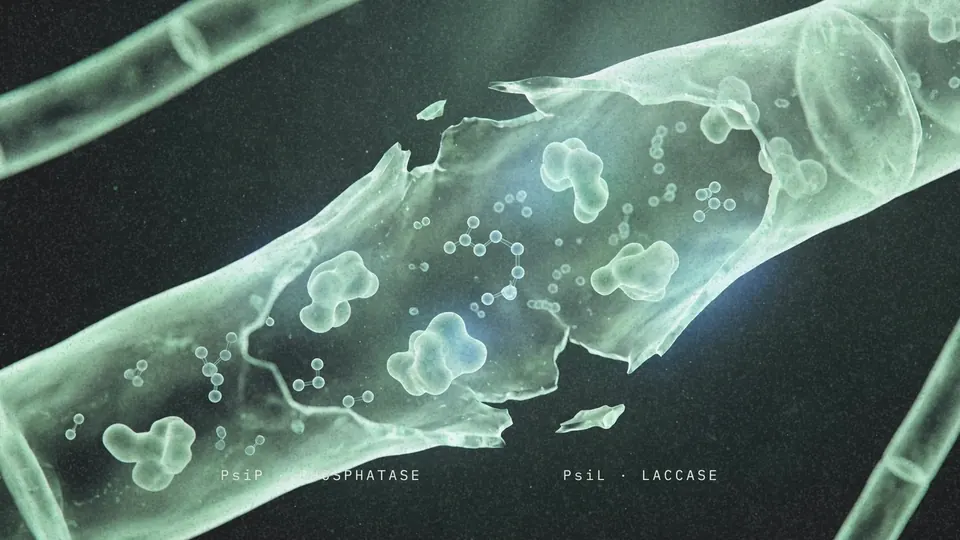
The mushroom can run the same step on itself. In Psilocybe cubensis, an enzyme called PsiP removes the phosphate from psilocybin when tissue is damaged, and the authors suggest the phosphate tag may serve a reversible protective function (Lenz et al., 2020). That is the first move in the bruising reaction we unpack in why magic mushrooms turn blue.
| Psilocybin | Psilocin | |
|---|---|---|
| Chemical difference | Phosphoryloxy group at position 4 of the indole ring | Hydroxyl group at position 4 of the indole ring |
| Role in the body | Primarily a prodrug: it is converted to psilocin | The active metabolite that acts on 5-HT2A receptors |
| What converts it | Alkaline phosphatase in the body; PsiP in damaged mushroom tissue | Not applicable: it is the product |
| In the mushroom | The dominant compound measured in 14 P. cubensis strains | Present at most in trace amounts in the dried Psilocybe mexicana first studied in 1959 |
| Canadian drug schedule | Schedule III, CDSA (item 12) | Schedule III, CDSA (item 11) |
Sources for the table: Dinis-Oliveira, 2017; Lenz et al., 2020; Sharchaton et al., 2026; Hofmann et al., 1959; CDSA.
Where does psilocybin come from?
Mushrooms make it, and not only one kind. A 2022 survey lists seven genera reported to hold psychotropic tryptamines: Psilocybe, Panaeolus, Pluteus, Gymnopilus, Pholiotina, Galerina and Inocybe. These fungi grow throughout the world and are mostly saprotrophic (they feed on dead material), though some are ectomycorrhizal, living in partnership with plant roots. The same paper notes that psilocybin was recently reported from two entomopathogenic fungi, species that infect insects (Gotvaldová et al., 2022).
Within the best-known genus, it does not follow that every species makes it. In that survey the highest levels were in Psilocybe, yet no tryptamines were detected in the P. fuscofulva and P. fimetaria collections (Gotvaldová et al., 2022). A 2022 DNA study adds that psilocybin has been empirically identified in only about 45 accepted Psilocybe species, roughly 32% of about 140 putative species that turn blue when damaged (Bradshaw et al., 2022). Evidence: established. For the rest, presence is assumed rather than measured.
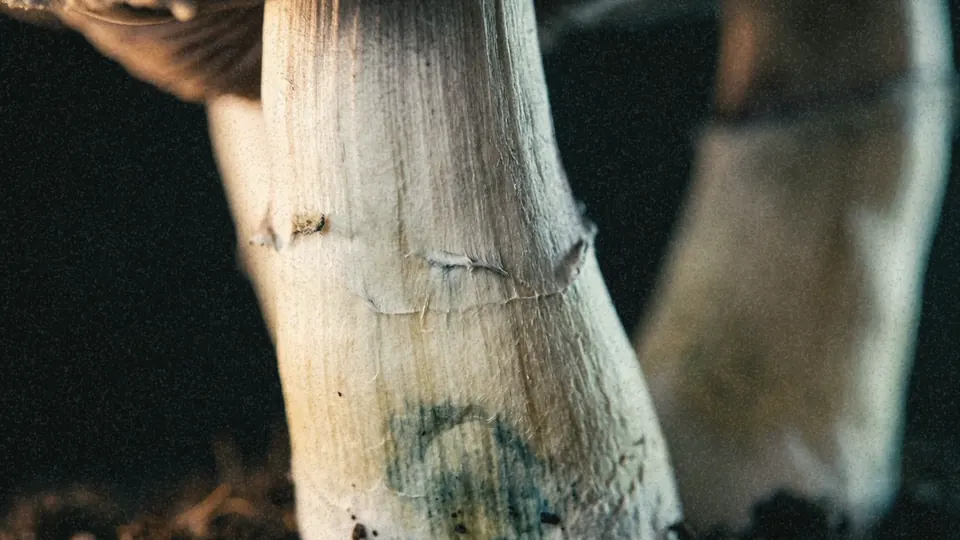
A 2024 genome study of the genus concludes that psilocybin synthesis first arose in Psilocybe, with four or five possible transfers of the genes to other mushrooms between 40 and 9 million years ago. The gene cluster had been worked out in only five of about 165 Psilocybe species, so this is a picture that may change (Bradshaw et al., 2024). Evidence: preliminary.
Why they make it is unresolved. The 2022 DNA study says that even the functional role of psilocybin and psilocin under natural conditions remains a mystery (Bradshaw et al., 2022). Our blue-bruising article covers what the mushroom’s own chemistry does and doesn’t show.
Is psilocybin the same thing as magic mushrooms?
No. Psilocybin is one molecule. A mushroom is an organism holding many. In a survey of 226 fruiting bodies from 82 collections across seven genera, researchers measured five compounds: psilocybin, psilocin, baeocystin, norbaeocystin and aeruginascin. The concentrations were “extremely variable”, and the authors warn that the varied mix of tryptamines in wild mushrooms could influence effects compared with therapy using chemically pure psilocybin, which complicates interpreting data (Gotvaldová et al., 2022).
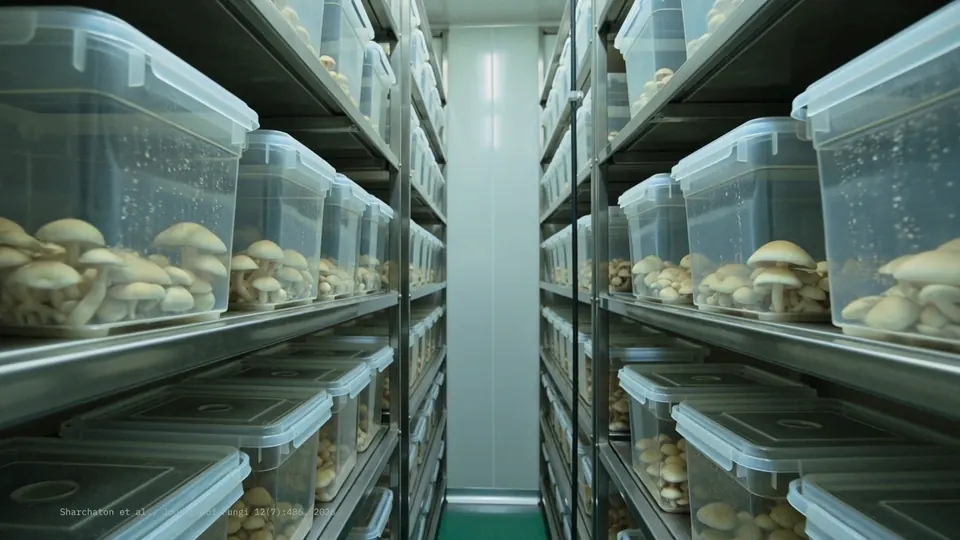
Growing conditions do not remove the variation. A 2026 study grew 14 strains of P. cubensis under uniform laboratory conditions and measured six tryptamines. Total tryptamines still varied more than 7.8-fold between strains, and individual fruiting bodies within a strain differed by 12.81% to 23.39% (as a coefficient of variation) in psilocybin. Psilocybin was consistently the dominant compound (Sharchaton et al., 2026). Evidence: established for those strains.
There may also be more in a mushroom than anyone has catalogued. The 2022 DNA study reports that the P. cubensis metabolome possibly contains thousands of uncharacterized compounds, at least some of which may be bioactive (Bradshaw et al., 2022). Evidence: preliminary.
This matters for how to read research. The trials we cite below used a synthetic psilocybin formulation: a “proprietary, synthetic formulation” in the phase 2 depression trial and “oral synthetic psilocybin” in a 2026 German trial (Goodwin et al., 2022; Mertens et al., 2026). A result with a measured, pure compound is not automatically a result for a whole mushroom. The wider picture, including species and strain names, is in what are magic mushrooms.
How does psilocybin work in the body and brain?
What is well supported
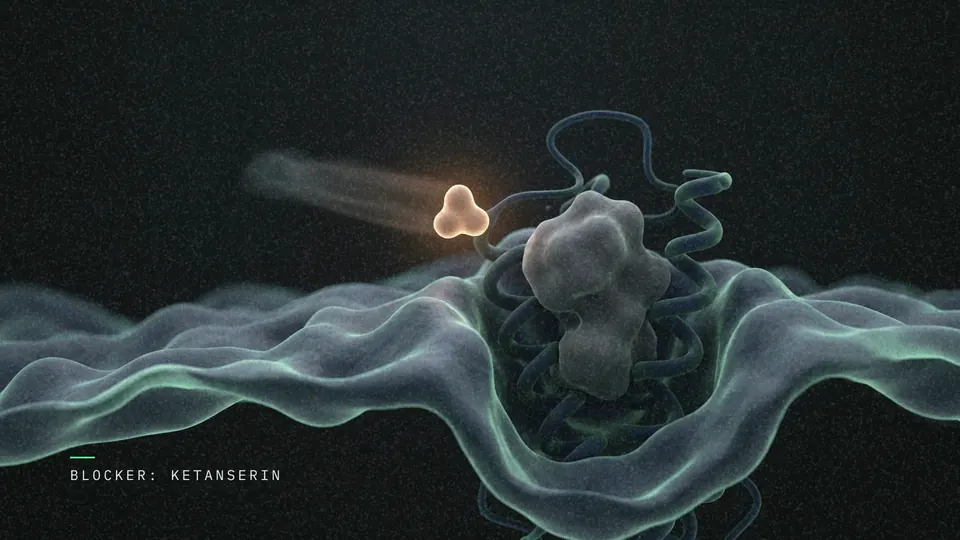
A receptor is a docking site on a cell. Reviews describe both psilocybin and psilocin as agonists or partial agonists at serotonin 2A (5-HT2A) receptors (Dinis-Oliveira, 2017). “Agonist” means the compound switches the receptor on, fully or partly. A 2016 pharmacology review reports a consensus that psychedelics act this way at 5-HT2A receptors in the brain, with particular importance for those on the branching ends (apical dendrites) of layer V pyramidal cells in the neocortex (Nichols, 2016).
Two experiments in healthy volunteers back this. In a 1998 study, the psychological effects of psilocybin were blocked dose-dependently by ketanserin, a drug that blocks 5-HT2A receptors (Vollenweider et al., 1998). In a 2019 brain-imaging study of eight volunteers, psilocybin occupied 5-HT2A receptors in the brain, and both receptor occupancy and psilocin levels in blood tracked the volunteers’ ratings of subjective intensity. The authors say this strongly supports 5-HT2A stimulation as a key determinant of the psychedelic experience (Madsen et al., 2019). Evidence: established that 5-HT2A is central to the acute effects, though the imaging study is small.
What is still open
One receptor is probably not the whole story. A 2010 survey assayed 25 psychedelic drugs, psilocin among them, and found that they are not as selective as generally believed: the drugs interacted with 42 of 49 broadly assayed sites (Ray, 2010). That work describes the class of drugs, and binding to a site is not the same as an effect. Evidence: preliminary.
Two 2023 laboratory papers show how unsettled the details are. One reports that 5-HT2A receptors inside cells, rather than on their surface, mediate the plasticity-promoting properties of psychedelics in cortical neurons (Vargas et al., 2023). The other reports that LSD and psilocin bind directly to the receptor for a growth factor called BDNF (TrkB), and that, in mice, the effects on plasticity-related signalling were independent of 5-HT2A activation (Moliner et al., 2023). Neither is a human trial, and they reach different conclusions about whether 5-HT2A is needed for these effects. Evidence: unresolved. Our article on whether psilocybin rewires the brain takes that question further.
Zooming out to the whole brain, there are models rather than answers. One proposal, “relaxed beliefs under psychedelics” (REBUS), is a theoretical framework that integrates predictive-coding ideas with the entropic brain hypothesis. Its authors present it as a model to be tested (Carhart-Harris and Friston, 2019). Imaging work has reported decreases in oscillatory power in default mode network areas after intravenous psilocybin and LSD (Nichols, 2016). A 2020 review says studies have started to close knowledge gaps on receptors, brain-wide activity and cognition (Vollenweider and Preller, 2020). Evidence: unresolved, and the field’s own papers frame it as ongoing.
The gap that matters most is between mechanism and outcome. A 2026 perspective article states that the mechanisms behind psychedelic therapy’s effects remain incompletely understood. Full-dose sessions engage neurochemistry, intense subjective experience and body physiology all at once, so it is hard to tell which components are necessary (Kuypers, 2026). Our comparison of psilocybin, LSD and DMT shows how their pharmacology differs. For DMT itself, from chemistry to law, see the DMT Library.
How was psilocybin isolated?
The short version: the Swiss chemist Albert Hofmann and colleagues did it in 1958. In March 1958, Hofmann, Heim, Brack and Kobel reported psilocybin as the psychotropic active compound of the Mexican mushroom Psilocybe mexicana in the journal Experientia (Hofmann et al., 1958). In November 1958, Hofmann and colleagues published the structure and a synthesis (Hofmann et al., 1958b).
A full account followed in Helvetica Chimica Acta in 1959. Its abstract says the two new substances, called psilocybin and psilocin, were isolated in crystalline form and are present in the fruit bodies, the artificially cultivated mycelium and the sclerotia of the mushroom, with psilocin at most in trace amounts in the dried mushroom (Hofmann et al., 1959). Evidence: established for the dates and titles, which we checked in bibliographic records, and for the 1959 summary, which we read in its abstract. The people and events around the mushroom’s path into Western science are told in our history of magic mushrooms.
What are researchers studying, and what is still unproven?
Research is not a recommendation
Psilocybin is an investigational drug. Nothing here is medical advice, and trial results describe what happened in tightly supervised studies, not what is safe or effective for any individual. We give no use or dosing guidance. If you are worried about your own health or someone else’s, see our safety page, which keeps the key emergency and poison-control information.
Researchers are studying psilocybin as a possible treatment, most visibly for depression. Studying is not proving. Health Canada says clinical trials are the most appropriate and effective way to advance research with unapproved drugs such as psilocybin, and that there are no approved therapeutic products containing psilocybin in Canada or elsewhere (Health Canada).
The results so far are mixed. In a phase 2 trial of treatment-resistant depression, funded by COMPASS Pathfinder, the highest dose reduced depression scores more than a very low control dose at three weeks. The sustained-response measure at 12 weeks did not support the same result. Adverse events occurred in 179 of 233 participants (77%), including headache, nausea and dizziness, and suicidal ideation or behaviour or self-injury occurred in every dose group. The authors called for larger and longer trials (Goodwin et al., 2022). Evidence: preliminary.
A German trial published in 2026 tested oral synthetic psilocybin with psychotherapy in 144 randomized participants. Its first comparison was not statistically significant, and the authors call the trial inconclusive overall. Safety signals included higher reports of suicidal ideation on dosing days and two serious adverse reactions, one of them hallucinogen persisting perception disorder (Mertens et al., 2026). Evidence: preliminary.
Trial design is another open problem. A 2021 review argues that effect sizes in psychedelic trials are likely over-estimated, because participants often work out whether they received the drug and their expectations colour their reports. It also finds that such trials have generally not reported pre-trial expectancy or whether blinding worked (Muthukumaraswamy et al., 2021). Evidence: preliminary, from a review, not a single experiment.
| Question | What the sources say | Evidence |
|---|---|---|
| Is psilocybin converted to psilocin in the body? | Yes: it is primarily a prodrug dephosphorylated to psilocin. | Established |
| Do these compounds act on 5-HT2A receptors? | Yes, as agonists or partial agonists. Blocking the receptor blocked psilocybin’s psychological effects in a 1998 study. | Established |
| Is 5-HT2A the only relevant target? | Probably not: psychedelics as a class touch many sites, and papers disagree about plasticity. | Preliminary |
| How does receptor action become the experience, and any lasting change? | Models exist (such as REBUS); the mechanisms remain incompletely understood. | Unresolved |
| Why do fungi make psilocybin? | The natural role remains a mystery. | Unresolved |
| Does it work as a treatment? | Early trials are mixed, with safety signals and design limits. | Preliminary |
| Is it an approved medicine in Canada? | No approved therapeutic products contain it, per Health Canada. | Established |
Condition-by-condition summaries are in our guides to the evidence on depression, PTSD, alcohol use disorder and end-of-life distress, and what a US regulatory filing means for Canada in COMP360 and the FDA.
Is psilocybin legal in Canada?
As of 24 October 2026, psilocin and psilocybin are listed in Schedule III of the Controlled Drugs and Substances Act, according to the Justice Laws site (current to 30 September 2026) (CDSA); Health Canada, on a page last modified 20 October 2026, says the production, sale and possession of magic mushrooms are illegal in Canada, with clinical trials as the route for research on unapproved drugs such as psilocybin (Health Canada).
This is general information, not legal advice. Laws and enforcement change, so check the official pages linked here before relying on any summary, including ours. The legal timeline is in how magic mushrooms became illegal in Canada.
What we still don’t know
- Why fungi make psilocybin, and whether the compound or its relatives do something for the fungus (unresolved).
- Which blue-bruising Psilocybe species truly contain psilocybin; most have never been tested for it (established).
- How much of the experience comes from 5-HT2A alone and how much from other receptors and pathways (unresolved).
- Whether 5-HT2A is needed for the plasticity effects reported in laboratory studies (unresolved).
- How receptor action leads to any lasting change, and which parts of a session are necessary (unresolved).
- Whether the findings from trials of a synthetic compound carry over to whole mushrooms (unresolved).
- Whether psilocybin works as a medicine. Results are early and mixed, and no psilocybin product is approved in Canada (preliminary).
Stay curious, and check the date on this page. We update it when the sources change. The fungi behind the molecule are in what are magic mushrooms, and the people behind its discovery are in the history of magic mushrooms.
Common questions
What is psilocybin?
A compound made by certain mushrooms, most famously in the genus Psilocybe. Health Canada names psilocybin and psilocin as the active ingredients of magic mushrooms. In the body, psilocybin is converted to psilocin, which acts on serotonin receptors. It is controlled under Canada’s Controlled Drugs and Substances Act.
What is the difference between psilocybin and psilocin?
Psilocybin carries a phosphate group at position 4 of its indole ring; psilocin carries a hydroxyl group there. An enzyme removes the phosphate in the body, so psilocybin is described as primarily a prodrug and psilocin as the active metabolite. Both are agonists or partial agonists at 5-HT2A receptors.
Is psilocybin the same as magic mushrooms?
No. Psilocybin is one molecule; a mushroom contains many compounds, including psilocin, baeocystin and others, and levels vary a lot even between strains grown under identical conditions. Trials use measured, synthetic psilocybin, so their results do not automatically apply to whole mushrooms.
How does psilocybin work?
Psilocin switches on serotonin 2A receptors, and the evidence says this is central to the acute effects: blocking the receptor blocked psilocybin’s psychological effects in a 1998 study, and a small imaging study tied receptor occupancy to reported intensity. How that becomes the experience, or any lasting change, is still not settled.
Where does psilocybin come from?
Mushrooms. A 2022 survey lists seven genera reported to contain psychotropic tryptamines, including Psilocybe, Panaeolus, Pluteus and Gymnopilus. Not every species in them makes it, and why fungi make it at all is still described as a mystery.
Who discovered psilocybin?
The Swiss chemist Albert Hofmann and colleagues. They reported psilocybin from Psilocybe mexicana in March 1958 and published its structure and synthesis in November 1958. Indigenous peoples in Mexico knew the mushrooms long before; our history article tells that part.
Is psilocybin legal in Canada?
As of 4 October 2026, psilocin and psilocybin are in Schedule III of the Controlled Drugs and Substances Act, and Health Canada says the production, sale and possession of magic mushrooms are illegal. This is not legal advice; check the official Government of Canada pages.
Is psilocybin an approved medicine, and is it safe?
Health Canada says there are no approved therapeutic products containing psilocybin in Canada or elsewhere. Trials have recorded adverse events, including headache, nausea, dizziness and, in some groups, suicidal thoughts or behaviour. This is not medical advice; our safety page points to the key information.
Shroomverse sells mushroom products. This article is general information about psilocybin science. It is not medical, legal or purchasing advice, and it does not encourage anyone to use drugs.
SOURCES
- Psilocybin and psilocin (magic mushrooms) (page modified 20 October 2026), Health Canada. Accessed . Source for: active ingredients are psilocybin and psilocin; production, sale and possession of magic mushrooms illegal in Canada; clinical trials the most appropriate way to advance research; no approved therapeutic products containing psilocybin in Canada or elsewhere; controlled under the CDSA.
- Controlled Drugs and Substances Act, S.C. 1996, c. 19, Schedule III, items 11 (psilocin) and 12 (psilocybin), Justice Laws Website, Government of Canada. Accessed . Source for the Schedule III entries and the chemical names used in the comparison table. Re-read 24 October 2026: the page states it is current to 2026-09-30 and last amended on 2026-07-18.
- Metabolism of psilocybin and psilocin: clinical and forensic toxicological relevance (Dinis-Oliveira RJ, Drug Metabolism Reviews 49(1):84–91, 2017), Taylor & Francis (peer-reviewed review); record on PubMed, PMID 28074670. Accessed . Abstract consulted; full text not open. Source for the two main compounds, agonist or partial agonist activity at 5-HT2A receptors and the prodrug description (dephosphorylation by alkaline phosphatase).
- Psychedelics (Nichols DE, Pharmacological Reviews 68(2):264–355, 2016), American Society for Pharmacology and Experimental Therapeutics (peer-reviewed review); full text via PubMed Central, PMC4813425. Accessed . Abstract consulted; full text not read. Source for the consensus on 5-HT2A receptors, the layer V pyramidal-cell detail and the reported default mode network changes.
- Psychedelic effects of psilocybin correlate with serotonin 2A receptor occupancy and plasma psilocin levels (Madsen MK, et al., Neuropsychopharmacology 44(7):1328–1334, 2019), Springer Nature (peer-reviewed); full text via PubMed Central, PMC6785028. Accessed . Abstract consulted; full text not read. Eight healthy volunteers, PET imaging. Source for psilocin as active metabolite and the occupancy and plasma-level association with subjective intensity.
- Psilocybin induces schizophrenia-like psychosis in humans via a serotonin-2 agonist action (Vollenweider FX, et al., Neuroreport 9(17):3897–3902, 1998), Wolters Kluwer (peer-reviewed); record on PubMed, PMID 9875725. Accessed . Abstract consulted; full text not open. Cited only for the finding that ketanserin blocked psilocybin’s psychological effects dose-dependently in healthy volunteers.
- Psychedelics and the human receptorome (Ray TS, PLoS ONE 5(2):e9019, 2010), PLOS (peer-reviewed, open access); full text via PubMed Central, PMC2814854. Accessed . Abstract read; the paper’s methods and tables confirm psilocin was among the drugs assayed. Source for the statement that psychedelics are not as selective as generally believed (42 of 49 broadly assayed sites).
- Psychedelics promote neuroplasticity through the activation of intracellular 5-HT2A receptors (Vargas MV, et al., Science 379(6633):700–706, 2023), American Association for the Advancement of Science (peer-reviewed); record on PubMed, PMID 36795823. Accessed . Abstract consulted; full text not open.
- Psychedelics promote plasticity by directly binding to BDNF receptor TrkB (Moliner R, et al., Nature Neuroscience 26(6):1032–1041, 2023), Springer Nature (peer-reviewed, open access); full text via PubMed Central, PMC10244169. Accessed . Abstract consulted; full text not read. Mouse and laboratory work; the abstract names LSD and psilocin.
- REBUS and the Anarchic Brain: Toward a Unified Model of the Brain Action of Psychedelics (Carhart-Harris RL, Friston KJ, Pharmacological Reviews 71(3):316–344, 2019), American Society for Pharmacology and Experimental Therapeutics (peer-reviewed, open access); full text via PubMed Central, PMC6588209. Accessed . Abstract consulted; cited only to show that REBUS is a proposed model.
- Psychedelic drugs: neurobiology and potential for treatment of psychiatric disorders (Vollenweider FX, Preller KH, Nature Reviews Neuroscience 21(11):611–624, 2020), Springer Nature (peer-reviewed review); record on PubMed, PMID 32929261. Accessed . Abstract consulted; full text not open.
- Molecules, meaning, and physiology: disentangling the active ingredients of psychedelic therapeutics (Kuypers KPC, Frontiers in Neuroscience 20:1892474, 2026), Frontiers (perspective article, open access); full text via PubMed Central, PMC13478107. Accessed . Abstract consulted; a perspective, not a trial. Cited only for the statement that the mechanisms are incompletely understood.
- Injury-Triggered Blueing Reactions of Psilocybe “Magic” Mushrooms (Lenz C, et al., Angewandte Chemie International Edition 59(4):1450–1454, 2020), Wiley (peer-reviewed, open access); full text via PubMed Central, PMC7004109. Accessed . Abstract consulted. Source for PsiP removing the phosphate to yield psilocin and the suggested reversible protective function of the phosphate ester.
- Enzymatic Synthesis of Psilocybin (Fricke J, Blei F, Hoffmeister D, Angewandte Chemie International Edition 56(40):12352–12355, 2017), Wiley (peer-reviewed); record on PubMed, PMID 28763571. Accessed . Abstract consulted; full text not open. Source for psilocybin as the tryptamine-derived natural product of Psilocybe and the four biosynthesis enzymes.
- Extensive Collection of Psychotropic Mushrooms with Determination of Their Tryptamine Alkaloids (Gotvaldová K, et al., International Journal of Molecular Sciences 23(22):14068, 2022), MDPI (peer-reviewed, open access); full text via PubMed Central, PMC9693126. Accessed . Source for the seven genera, world distribution, saprotrophic and ectomycorrhizal lifestyles, the entomopathogenic report, 226 fruiting bodies of 82 collections, the five compounds measured, highly variable concentrations, the “cocktail” caveat and the two Psilocybe collections with no detected tryptamines.
- DNA Authentication and Chemical Analysis of Psilocybe Mushrooms Reveal Widespread Misdeterminations in Fungaria and Inconsistencies in Metabolites (Bradshaw AJ, et al., Applied and Environmental Microbiology 88(24):e01498-22, 2022), American Society for Microbiology (peer-reviewed); full text via PubMed Central, PMC9764976. Accessed . Source for psilocybin confirmed in only about 45 accepted Psilocybe species (32% of about 140 putative bluing species), the “mystery” of the natural role and the possibly thousands of uncharacterized P. cubensis compounds.
- Phylogenomics of the psychoactive mushroom genus Psilocybe and evolution of the psilocybin biosynthetic gene cluster (Bradshaw AJ, et al., PNAS 121(3):e2311245121, 2024), Proceedings of the National Academy of Sciences (peer-reviewed); full text via PubMed Central, PMC10801892. Accessed . Abstract and parts of the full text consulted. Source for the origin in Psilocybe, the four to five possible transfers and the five of about 165 species figure.
- Surprising Variability in Tryptamine Profiles of Psilocybe cubensis Fruiting Bodies: Inter- and Intra-Strain Differences Across 14 Strains Cultivated Under Controlled Conditions (Sharchaton A, et al., Journal of Fungi 12(7):486, 2026), MDPI (peer-reviewed, open access); full text via PubMed Central, PMC13412672. Accessed . Abstract consulted. Source for six compounds measured, the more than 7.8-fold range, the 12.81% to 23.39% intra-strain variation and psilocybin as the dominant compound.
- Psilocybin, ein psychotroper Wirkstoff aus dem mexikanischen Rauschpilz Psilocybe mexicana Heim (Hofmann A, Heim R, Brack A, Kobel H, Experientia 14(3):107–109, March 1958), Springer (peer-reviewed). Accessed . Bibliographic record consulted (Crossref); cited for its date, authors and subject.
- Konstitutionsaufklärung und Synthese von Psilocybin (Hofmann A, Frey A, Ott H, Petrzilka T, Troxler F, Experientia 14(11):397–399, November 1958), Springer (peer-reviewed). Accessed . Bibliographic record consulted (Crossref); cited for its date and title (structure elucidation and synthesis).
- Psilocybin und Psilocin, zwei psychotrope Wirkstoffe aus mexikanischen Rauschpilzen (Hofmann A, et al., Helvetica Chimica Acta 42(5):1557–1572, 1959), Wiley (peer-reviewed). Accessed . English abstract consulted (Crossref record); full text not open. Source for crystalline isolation, the occurrence in fruit bodies, mycelium and sclerotia, and psilocin at most in trace amounts in the dried mushroom.
- Single-Dose Psilocybin for a Treatment-Resistant Episode of Major Depression (Goodwin GM, et al., New England Journal of Medicine 387(18):1637–1648, 2022), Massachusetts Medical Society (peer-reviewed); funded by COMPASS Pathfinder. Accessed . Abstract consulted (PubMed record); full text not open. Industry-funded phase 2 trial of a proprietary synthetic formulation.
- Efficacy and Safety of Psilocybin in Treatment-Resistant Major Depression: The EPISODE Randomized Clinical Trial (Mertens LJ, et al., JAMA Psychiatry 83(5):448–460, 2026), American Medical Association (peer-reviewed, open access); full text via PubMed Central, PMC13000742. Accessed . Abstract consulted; full text not read.
- Blinding and expectancy confounds in psychedelic randomized controlled trials (Muthukumaraswamy SD, Forsyth A, Lumley T, Expert Review of Clinical Pharmacology 14(9):1133–1152, 2021), Taylor & Francis (peer-reviewed review); record on PubMed, PMID 34038314. Accessed . Abstract consulted; full text not open.
- Wikidata entities used for the article’s “about” markup: psilocybin (Q208118), psilocin (Q409150), 5-hydroxytryptamine receptor 2A (Q1949517), Albert Hofmann (Q122338), psilocybin mushroom (Q336358), Wikidata. Accessed . Entity records fetched and the labels checked; used only for structured-data identifiers, not for any claim.
CHANGES
- : Added links to the DMT Library.
- : Published.
- : Re-read Health Canada’s psilocybin page (updated 20 October 2026) and the CDSA consolidation (now current to 30 September 2026, still last amended 18 July 2026), and corrected both dates. The statements cited from them are unchanged.



