THE SHROOMVERSE JOURNAL ✳ 13 MIN READ
The Tassili mushroom shaman: what the Algerian rock art really shows
Topic: Mushrooms: history and science
Published
Short answer (25 October 2026)
The Tassili mushroom shaman is a real painted figure in Algeria, but the famous “bee-faced” picture is a later redrawing, not a photograph. Reading its objects as mushrooms is one researcher’s hypothesis from 1989 and 1992, never tested and disputed by archaeologists. The paintings are probably younger than the “9,000 years” often quoted, and nothing at the site shows that anyone ate mushrooms there.
On this page 10 sections
The Tassili mushroom shaman is the best-known image used to claim that people took psilocybin mushrooms in prehistory. The figure exists, but its mushroom reading is an interpretation, and the version on posters and T-shirts is a modern drawing (The Guardian, 2025). This page separates what the rock art shows from what has been said about it.
A history and evidence check
This article is about archaeology and how a story spread. It does not describe mushroom effects, identification or use, and it is not advice. For the bigger picture, see our history of magic mushrooms and our stoned ape theory fact-check.
What is the Tassili mushroom shaman?
Tassili n'Ajjer is a sandstone plateau in southeastern Algeria. UNESCO listed it as a World Heritage Site in 1982 and describes more than 15,000 drawings and engravings there, made from about 6000 BC to the first centuries of the common era (UNESCO).
The “mushroom shaman” is one painted figure among them: a masked, squatting human-like figure with small objects sprouting from its arms and legs and scattered around its body. The Italian ethnobotanist Giorgio Samorini described it as about 0.8 metres tall and read the objects as mushroom symbols (Samorini, 1992). A Guardian long read describes the popular version as a “bee-faced” figure covered with about 50 mushrooms (Singh, The Guardian, 2025).
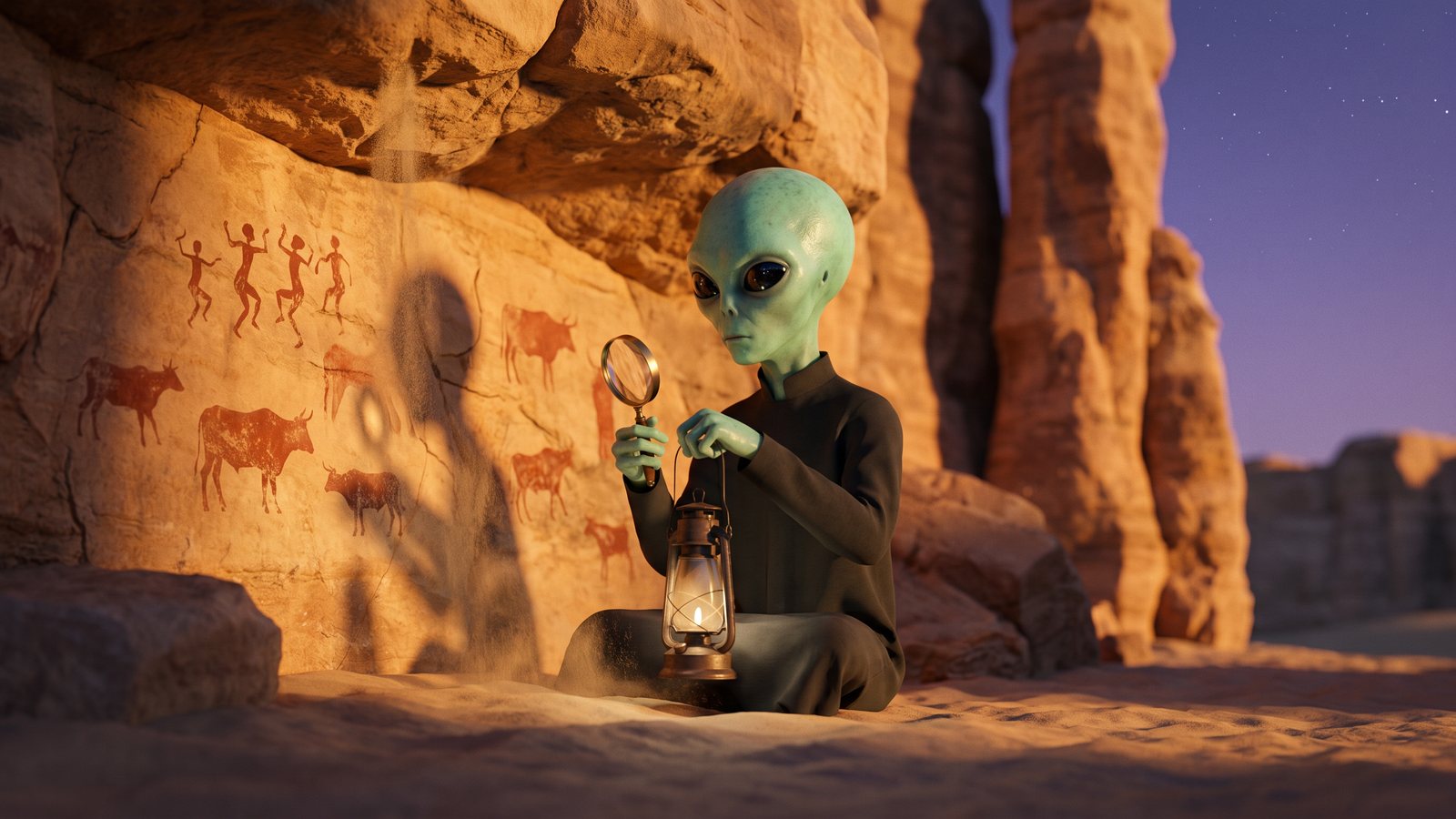
It belongs to the Round Heads style, named for large figures with round, featureless heads. The French archaeologist Jean-Loïc Le Quellec notes that the explorer Henri Lhote jokingly called them “Martians”, and that some hurried readers took the name seriously (Le Quellec, 2019).
Where did the Tassili mushroom claim come from?
From Samorini. In an Italian note of April 1989, he proposed that Round Heads paintings show a cult of hallucinogenic mushrooms, and he wrote that the dancers in a scene at Tin Tazarift each hold a mushroom in the right hand. In the same note he called the absolute chronology of the Round Heads “still doubtful” (Samorini, 1989).
His English paper of 1992, in the journal Integration, set the case out in full. Its title dates the paintings to 9000–7000 years before present. Samorini said he had seen the paintings on two visits to Tassili. He pointed to the Tin Tazarift dancers, whose objects are joined to their heads by two dotted lines that he read as “the effect that the mushroom has on the human mind”, and to two masked figures covered in the same small symbols (Samorini, 1992).
The paper is open about the gap. Samorini lists what earlier researchers had seen in the same symbol: an arrowhead, an oar, a plant (probably a flower) or an undefined sign. He argued that a mushroom was the closest match, and suggested at least two kinds were shown, one small with a pointed cap and one larger (Samorini, 1992). That is an argument from shape. No mushroom remains, residues or other physical traces are reported in the paper.
Terence McKenna brought the image to a much wider public in Food of the Gods, published by Bantam Books in 1992 (Open Library). We could not read the book. According to the Guardian’s account, McKenna’s picture was a drawing by his then-wife Kat Harrison, and it is this drawing that became the “mushroom shaman” icon (The Guardian, 2025). Our profile of Terence McKenna covers the rest of his work.
Is the famous Tassili mushroom image a photograph?
No. The writer Andy Letcher pointed out that the popular image “is not a photo of the original, but a copy”, as the Guardian reports. Harrison never saw the painting. She worked from a photograph in a book, and rather than copying it, she filled in features she thought were damaged or incomplete (The Guardian, 2025).
Samorini’s own 1992 illustrations of the main figures were also drawings, credited to a 1964 book by the photographer Jean-Dominique Lajoux (Samorini, 1992). So most people have only ever seen the figure through one or two layers of redrawing. Each layer can sharpen a shape that is faint or broken on the rock.
Even the figure’s location has been corrected. In 1992 Samorini placed it at a site called Matalem-Amazar (Samorini, 1992). His current web page places it at Ti-n-Tarin and says the 1964 book apparently cited the wrong site, following a 2010 study of Round Heads masks (Samorini, web page).
How old are the Tassili paintings?
Probably younger than the claim says, and nobody can date this figure directly. Painted rock art is hard to date because the pigments rarely hold datable carbon. A 2012 study at Tassili noted that radiocarbon attempts had failed to give reliable results, so the team dated 13 sediment samples from deposits at the foot of painted walls instead (Mercier et al., 2012).
The answer was a limit, not a date. The paintings are younger than about 9,000–10,000 years, and the method could not narrow the window further (Mercier et al., 2012). In a 2013 chronology, Le Quellec placed the classic Round Heads style after about 8000 BC and probably not before about 5500 BC. He also stressed that the Sahara has no direct dates comparable to those for European cave art (Le Quellec, 2013).
Compare that with the numbers in circulation. Samorini’s 1992 title says 9000–7000 years before present, which is about 7000–5000 BC (Samorini, 1992). UNESCO’s summary starts the whole site at 6000 BC (UNESCO). A US Forest Service page calls Tassili home to some of the world’s earliest rock art, “10,000 BC” (US Forest Service).
| When | Event | What it shows | Source |
|---|---|---|---|
| 1964 | Lajoux’s book on Tassili publishes drawings later used by Samorini | The figures reach readers as drawings | Samorini, 1992 |
| 1982 | UNESCO lists Tassili n'Ajjer as World Heritage | Over 15,000 drawings and engravings, from 6000 BC | UNESCO |
| April 1989 | Samorini’s first note, in Italian | Mushroom-cult hypothesis; chronology “still doubtful” | Samorini, 1989 |
| 1992 | Samorini’s English paper; McKenna’s Food of the Gods | Claim reaches English readers; Harrison’s drawing becomes the icon | Samorini, 1992; Guardian |
| 2012 | OSL dating of deposits below painted walls | Paintings younger than about 9,000–10,000 years | Mercier et al. |
| 2012 | Guzmán links the paintings to Psilocybe mairei | Species guess based on habitat, not on the paintings | Guzmán |
| 2013 | Le Quellec’s Saharan chronology | Round Heads probably not before about 5500 BC | Le Quellec |
| 2025 | Guardian long read on psychedelic history | Popular image is a redrawing; an earlier reading was a sheep-man | Guardian |
| 2026 | A medical review dates the art to “9000 BCE” | The age has grown by about 2,000 years in retelling | Skalski et al. |
What do critics of the Tassili mushroom reading say?
Archaeologists object on three grounds. The first is method. Le Quellec writes that the 1980s and 1990s brought many attempts to explain Saharan images through altered states of consciousness and a loosely defined “shamanism”, that these readings have been refuted, and that it is misleading to speak of shamanism in Africa at all, where that worldview is not attested (Le Quellec, 2019).
The second is the image itself. The ethnomycologist Brian Akers, who supports a mushroom reading of a different painting in Spain, wrote that he was unsure how secure Tassili’s dating is, that its style is not drawn “from life”, and that a popular drawing based on one figure became an icon of 1990s psychedelia (Akers, Mushroom the Journal). The Guardian piece adds that an earlier archaeologist read the figure as a sheep-man (The Guardian, 2025).
The third is the wider pattern. The Guardian reports that Letcher, in his 2006 book Shroom, examined claimed cases of traditional mushroom use and confirmed only two: psilocybin mushrooms in pre-Columbian Mexico and fly agaric in northern Eurasia. The same piece quotes the historian Erika Dyck, whose Saskatchewan research appears in our Humphry Osmond article, on how ancient-use stories make psychedelics seem more natural and wholesome (The Guardian, 2025).
Supporters have answered. Samorini’s web page quotes two archaeologists who called the hypothesis stimulating or worth attention, and it says Le Quellec was once open to it (Samorini, web page). Being open to a hypothesis is not the same as confirming it, and none of those comments reports new evidence.
Can anyone name the mushroom species in the Tassili paintings?
No, not from the paintings. Samorini did not name a species (Samorini, 1992). The Mexican mycologist Gastón Guzmán suggested Psilocybe mairei in 2012, because that species was first described from Algeria in a dry habitat he thought similar to ancient Tassili. He noted that he had made the suggestion in lectures since the 1990s, and that an earlier guess by Paul Stamets came without a stated source (Guzmán, 2012).
That reasoning rests on where a species grew, not on anything visible in the art. A small painted shape cannot carry the features mycologists use to tell species apart. Our guide to researching mushroom origin stories explains why a place name or a habitat match is not proof of origin.
How did the Tassili mushroom image spread online?
Through citation chains, each one a little more confident than the last. A US Forest Service page calls the figure “the oldest known petroglyph depicting the use of psychoactive mushrooms”, although it is a painting, not an engraving (US Forest Service). Guinness World Records lists Tassili under “oldest depictions of fungi” at 9,000 years, citing McKenna, Samorini and the Forest Service (Guinness World Records). In January 2021 Open Culture ran the headline that the paintings suggest humans used magic mushrooms 9,000 years ago (Open Culture).
Scientific reviews repeat it too. A 2021 paper reproduced Samorini’s drawing of the Tin Tazarift dancers as “estimated to be 7000-9000 years old” (Winkelman, 2021). A 2023 pharmacology review said the Tassili and Spanish murals “date the use” of these mushrooms back 7,000–9,000 years (Mastinu et al., 2023). A 2026 review cited Samorini’s 1992 paper but wrote “9000 BCE”, about 2,000 years older than the paper’s own title (Skalski et al., 2026).
Each step drops a qualifier. “Mushroom-like object” becomes “mushroom”, “hypothesis” becomes “evidence”, “younger than 9,000 years” becomes “9,000 years old”, and a redrawing becomes the picture of the original. The Guardian notes the figure now appears on shirts, mugs and paintings (The Guardian, 2025). The same drift shows up in the stoned ape theory, which this image is often used to illustrate.
Verdict: what does the evidence support?
- Supported: a masked Round Heads figure with many small repeated objects exists at Tassili, and Samorini published it in 1989 and 1992 (Samorini, 1992).
- Supported: the famous “bee-faced” image is a modern redrawing by Kat Harrison, made from a photograph, with damaged parts filled in (The Guardian, 2025).
- Not established: that the objects are mushrooms. Earlier researchers read the same shape as arrowheads, oars or flowers (Samorini, 1992).
- Not established: any species. The Psilocybe mairei suggestion is based on habitat (Guzmán, 2012).
- Overstated: the age. Dating shows the paintings are younger than about 9,000–10,000 years, and the style probably began no earlier than about 5500 BC (Mercier et al., 2012; Le Quellec, 2013).
- Not shown: that anyone ate mushrooms at Tassili, or that the figure is a shaman. No physical evidence of use is reported, and the shamanism label itself is disputed (Le Quellec, 2019).
Our overall rating: an interesting hypothesis, often presented as fact. The documented history of psilocybin mushroom use, from Mesoamerica onward, is told in our history of magic mushrooms, and the psilocybin timeline sets out the dated record.
What we could not check
- The text of Food of the Gods. The Internet Archive copy is restricted, so McKenna’s own words and his caption are known to us only through other writers.
- Lajoux’s 1964 book and the 2010 study of Round Heads masks that corrected the site name. We rely on Samorini’s account of both.
- Akers and colleagues’ 2011 Economic Botany paper and Letcher’s book Shroom, which we know only through later summaries.
- Malika Hachid’s 2013 comment on the dating study and the authors’ reply, which exist but which we did not read.
- Who first read the figure as a sheep-man. The Guardian does not name the archaeologist.
Common questions
What is the Tassili mushroom shaman?
A masked, squatting figure painted in the Round Heads style at Tassili n'Ajjer, Algeria, with small objects sprouting from its body. Giorgio Samorini read those objects as mushrooms in 1989 and 1992. The reading is a hypothesis, not an established finding.
Is the bee-faced mushroom shaman image real?
The painting is real, but the famous image is a drawing by Kat Harrison, made for Terence McKenna’s 1992 book from a photograph. According to the Guardian’s account, she filled in parts she thought were damaged.
How old is the Tassili mushroom painting?
No one has dated the figure directly. Sediment dating shows Tassili paintings are younger than about 9,000 to 10,000 years, and Le Quellec places the Round Heads style probably after about 5500 BC.
Is Tassili the oldest evidence of magic mushroom use?
It is often called that, including by the US Forest Service and Guinness World Records. But the mushroom reading is disputed, the age is uncertain, and no physical evidence of mushroom use has been reported at the site.
What mushroom species do the Tassili paintings show?
Nobody can tell from the paintings. Gastón Guzmán suggested Psilocybe mairei because it was described from Algeria, but that is an argument from habitat, not from the images.
Did Terence McKenna discover the Tassili mushroom shaman?
No. Samorini published the mushroom reading first, in 1989. McKenna popularized it in Food of the Gods in 1992 with a redrawing by Kat Harrison.
Do archaeologists accept the mushroom shaman idea?
Mostly not as proven. Jean-Loïc Le Quellec argues that altered-state and shamanism readings of Saharan art have been refuted. Some researchers have called the idea worth studying, without adding new evidence.
Does the Tassili mushroom shaman support the stoned ape theory?
No. Even if the figure showed mushrooms, it would be thousands of years old, not the more than a million years the stoned ape theory concerns. Our stoned ape fact-check covers that idea.
Shroomverse sells mushroom products. This article is general information about archaeology and the history of an idea. It is not medical, legal or purchasing advice, it does not encourage anyone to use drugs, and it does not recommend any product.
SOURCES
- The oldest representations of hallucinogenic mushrooms in the world (Sahara Desert, 9000-7000 B.P.) (Samorini G., Integration 2&3: 69-78, 1992), Integration: Journal for Mind-Moving Plants and Culture; PDF on the author's website. Accessed . Read in full. Supports the mushroom-cult hypothesis, the Tin Tazarift dancers and dotted lines, the two masked figures about 0.8 m tall (Aouanrhat and Matalem-Amazar), the earlier readings as arrowhead, oar or flower, the two visits, the 9000-7000 BP range and the drawings credited to Lajoux 1964.
- Etnomicologia nell'arte rupestre sahariana (Periodo delle “Teste Rotonde”) (Samorini G., B.C. Notizie 6(2), April 1989), Centro Camuno di Studi Preistorici; PDF on the author's website. Accessed . Read in full (Italian). Supports the first statement of the hypothesis, the Tin Tazarift dancers each holding a mushroom, and the chronology described as still doubtful.
- I funghi allucinogeni del Sahara (Samorini G., web page), samorini.it. Accessed . Read in full (Italian). Supports the relocation of the figure to Ti-n-Tarin after Fouilleux & Mouchet 2010, the supportive comments by other archaeologists, and the full bibliography of the 1989 and 1992 papers.
- OSL dating of quaternary deposits associated with the parietal art of the Tassili-n-Ajjer plateau (Central Sahara) (Mercier N., Le Quellec J.-L., Hachid M., Agsous S., Grenet M., Quaternary Geochronology 10: 367-373, 2012), Elsevier; abstract read through the HAL open archive (halshs-00696531); DOI confirmed via Crossref. Accessed . Abstract only (HAL: https://shs.hal.science/halshs-00696531v1). Supports: antiquity hotly debated; radiocarbon attempts unreliable; 13 sediment samples; paintings younger than about 9-10 ka; interval cannot be narrowed.
- Périodisation et chronologie des images rupestres du Sahara central (Le Quellec J.-L., Préhistoires méditerranéennes 4, 2013), OpenEdition Journals; DOI confirmed via Crossref. Accessed . Abstract and dating sections read. Supports: classic Round Heads after c. 8000±900 cal BC and probably not before c. 5500 cal BC; no direct dates comparable to European cave art.
- Arts rupestres au Sahara central (Le Quellec J.-L., Inference 5, 2019), Inference: International Review of Science; DOI confirmed via Crossref. Accessed . Read in full (French). Supports Lhote's joking 'Martians' nickname, the critique of altered-state and shamanism readings as refuted, and shamanism not being attested in Africa.
- New taxonomical and ethnomycological observations on Psilocybe s.s. from Mexico, Africa and Spain (Guzmán G., Acta Botanica Mexicana 100: 79-106, 2012), Acta Botanica Mexicana; PDF on SciELO México. Accessed . Read in full. Supports the Psilocybe mairei suggestion based on its Algerian type locality and habitat, lectures since the 1990s, Stamets' unsourced guess, and Samorini not naming a species.
- The ancient psychedelics myth: ‘People tell tourists the stories they think are interesting for them’ (Manvir Singh, The Guardian long read, 1 May 2025), The Guardian. Accessed . Read in full. Supports the bee-faced description, about 50 mushrooms, Letcher's point that the image is a copy by Kat Harrison made from a photograph with features filled in, the sheep-man reading, Letcher's two confirmed cases, Erika Dyck's comment and the merchandise.
- A Cave in Spain Contains the Earliest Known Depictions of Mushrooms (Brian P. Akers), Mushroom the Journal. Accessed . Read the page (issue date not shown). Supports Akers' doubts about the security of Tassili's dating, its non-naturalistic style, and the drawing becoming an icon of post-1990s psychedelia.
- The Evolved Psychology of Psychedelic Set and Setting (Winkelman M.J., Frontiers in Pharmacology 12: 619890, 2021), Frontiers; full text read via Europe PMC (PMC7959790). Accessed . Full text. Figure 1 reproduces Samorini's Tin Tazarift relief, 'Estimated to be 7000-9000 years old'.
- The Bright Side of Psychedelics: Latest Advances and Challenges in Neuropharmacology (Mastinu A. et al., International Journal of Molecular Sciences 24(2): 1329, 2023), MDPI; full text read via Europe PMC (PMC9865175). Accessed . Full text. States the Tassili and Selva Pascuala murals 'date the use' of these mushrooms back 7000-9000 years; used only as an example of how the claim is repeated.
- Psilocybin in Neuropsychiatric Disorders: Seeking Valuable Evidence in History, Pure Science, Clinical Trials and Real-World Data (Skalski P. et al., Brain Sciences 16(4): 358, 2026), MDPI; full text read via Europe PMC (PMC13115139). Accessed . Full text. Says the rock art dates 'back to 9000 BCE' while citing Samorini 1992, whose title gives 9000-7000 BP; used only as an example of date inflation.
- Plants of Mind and Spirit: The Mighty Fungi, US Forest Service (USDA). Accessed . Read the page. Calls the figure the oldest known petroglyph of psychoactive mushroom use, says the mushrooms are postulated to be Psilocybe, and dates the site's earliest rock art to 10,000 BC.
- Oldest depictions of fungi, Guinness World Records. Accessed . Read the page. Lists Tassili at 9,000 years, citing McKenna (1992), Samorini (1992) and the US Forest Service.
- Algerian Cave Paintings Suggest Humans Did Magic Mushrooms 9,000 Years Ago (27 January 2021), Open Culture. Accessed . Read the page. Used only for the headline and date, as an example of online spread.
- Tassili n'Ajjer (World Heritage List, property 179), UNESCO World Heritage Centre (read through an Internet Archive copy of January 2026). Accessed . Supports inscription in 1982 and 'more than 15,000 drawings and engravings' from 6000 BC to the first centuries of the common era.
- Food of the gods: the search for the original tree of knowledge (Terence McKenna, Bantam Books, 1992), catalogue record, Open Library. Accessed . Confirms title, publisher and year. We did not read the book.
CHANGES
- : Published.



