SHROOMVERSE FILMS · TRANSCRIPT
Penis Envy: The Mushroom Behind the Myth
It may be the most recognizable name in modern mushroom culture, and one of the hardest to trace. We followed the Penis Envy legend from a 1971 Amazon expedition and an unsolved 1981 murder to a peer-reviewed side-by-side lab comparison, to separate what’s documented from what’s simply repeated.
Every claim is labelled on screen by its evidence: documented, limited evidence, anecdotal, disputed, marketing or unknown.
It’s an educational film. It isn’t about our products, and there’s no growing, sourcing or dosing advice in it. Some scenes are AI-generated illustrations, and the narration is a synthetic voice.
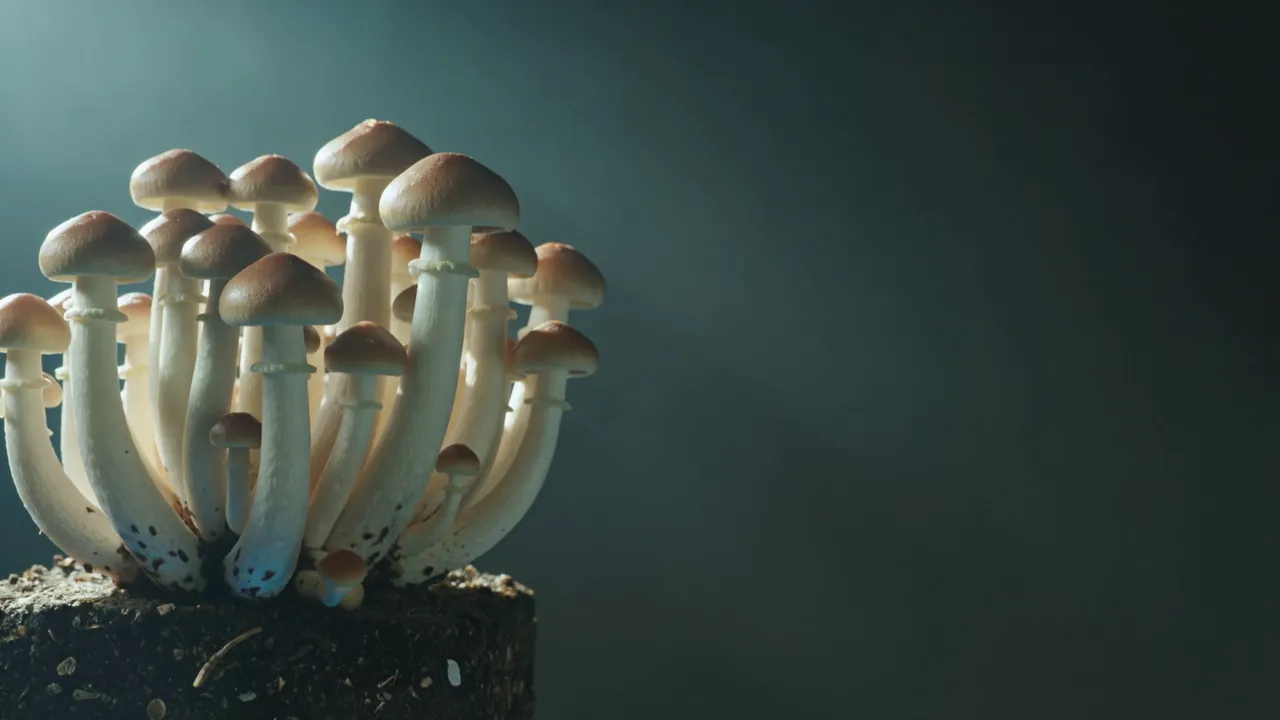
Key facts
- Psilocybe cubensis was first described by science in 1906, from a cattle pasture in Cuba, as Stropharia cubensis (Earle 1906, via GBIF).
- “Penis Envy” is not a species or a formally described variety: it is an informal name for a cultivated line of P. cubensis. A 2021 genome paper notes that “the strain name is anecdotal” (McKernan et al. 2021).
- In 1971 Terence and Dennis McKenna travelled to La Chorrera in the Colombian Amazon and brought home P. cubensis spores. Dennis McKenna has described the trip himself (McKenna 2021).
- We found no document that links the physician Steven Pollock to this mushroom. The polished origin story was popularised by the journalist Hamilton Morris in Vice in 2009 (Morris 2009).
- The earliest dated use of the name we could verify is a forum thread from November 2005 (forum thread, 2005).
- In a 2023 genetic study, genomes sold under this name were among the most inbred of any cultivated P. cubensis (McTaggart et al. 2023).
Restated from the film’s narration. Each fact links the source it rests on; the full list is under the transcript.
FULL TRANSCRIPT
Cold open
It may be the most recognisable name in modern mushroom culture. An awkward name — with a serious reputation. Denser. Stranger. Stronger, people say. Its origin story runs through the Amazon, a famous psychedelic explorer, and an unsolved murder. But go looking for the paperwork, and the trail goes quiet. So how did this mushroom become a legend — and how much of that legend survives contact with the evidence?
I · The name and the legend
Start with what nobody disputes. Psilocybe cubensis is a real species — first described by science in 1906, from a cattle pasture in Cuba. It grows wild in warm, humid regions around the world, often on the dung of grazing animals. "Penis Envy" is not a species, or even a formally described variety. It's an informal name for a cultivated line — closer to a breed than to a new kind of organism.

The name itself is borrowed: a term from early psychoanalysis, introduced by Sigmund Freud in 1908. How it ended up on a mushroom is where the documented history starts to thin. Here's the version most people have heard. In early 1971, the brothers Terence and Dennis McKenna travelled to La Chorrera, in the Colombian Amazon, and brought home spores of Psilocybe cubensis.
That part is documented. Dennis McKenna has described it himself. The legend continues. The spores, it's said, reached Steven Pollock — a Texas physician who studied psilocybin mushrooms. He selected a strange, thick-stemmed form, and mailed a spore print shortly before he was shot dead in San Antonio, in 1981. The case has never been solved. Pollock was real. His research was real. His death was real.
But the link between Pollock and this mushroom? We couldn't find a single document that shows it. The polished version was popularised in 2009 by the journalist Hamilton Morris, writing in Vice. In that same article, Dennis McKenna said he'd never heard of the strain. Years later, Morris acknowledged that many origin stories had circulated — and that some had come from him.
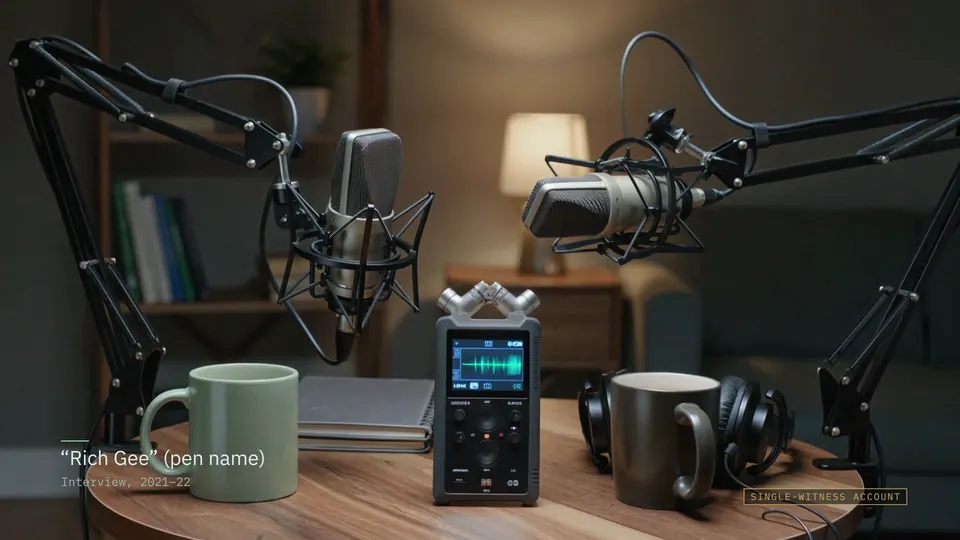
In a 2021 interview, a cultivator writing as Rich Gee offered a different account: that he developed and named the line himself, from Amazonian spores that reached him through friends, not through Pollock. But that's one witness, decades later — and even his retellers disagree about when the name was coined. The earliest dated use of the name we could verify is a forum thread from 2005.
Underground history is hard to check. The activity was illegal, people used pseudonyms, and stories travelled by word of mouth. When scientists sequenced a sample in 2021, they included a blunt note: the strain name is anecdotal.
II · What appears different?
So set the story aside. What about the mushroom itself? Growers describe it the same way, again and again. Unusually thick, dense stems. Small caps that are slow to open, often staying partly closed, still joined to the stem by a thin veil. Heavy, compact fruiting bodies. And very few spores. It's a consistent picture. But we couldn't find a single scientific study that has actually measured those traits.
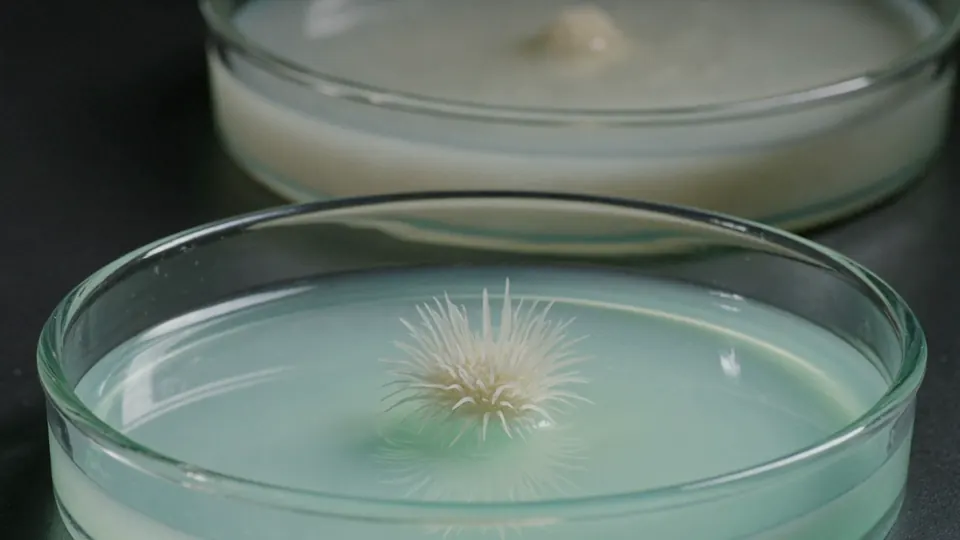
What does have some support is the genetics. By most accounts, the line has been kept alive by propagating tissue rather than spores — and in a 2023 study, genomes sold under this name were among the most inbred of any cultivated cubensis — a line copied, again and again, from itself. Appearance has limits anyway. A thick stem is not a chemical measurement. Two mushrooms can look alike and test very differently. So what does the laboratory actually say?
III · The potency question
First, what does "potency" mean? These mushrooms make psilocybin using a small cluster of genes — a pathway scientists recreated in a test tube in 2017. Psilocybin is mostly a delivery form. The body removes a phosphate group, converting it into psilocin — the molecule that acts on serotonin receptors in the brain. In the lab, potency simply means how much of these compounds a sample contains, per gram of dried mushroom. And that number moves. A lot.
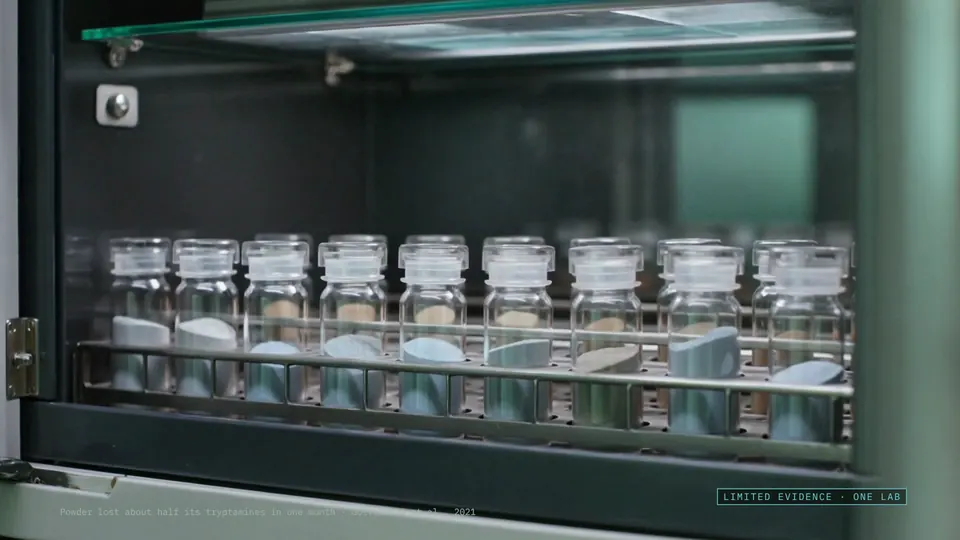
Studies of Psilocybe cubensis report several-fold differences between samples of the same species. Caps tend to carry more than stems. Successive harvests from the same culture don't match. And the chemistry is fragile. That blue bruise is psilocin breaking down into pigment. In one lab study, powdered mushrooms lost around half their tryptamines within a month. So has anyone tested this variety properly — side by side, under the same conditions? As far as we can find, once.
In a study published in 2026, researchers grew fourteen named cubensis strains under identical conditions, then measured them. The sample labelled Penis Envy ranked second overall — and had the highest psilocin of the group. A strain called Mak IND came first. And two varieties linked to Penis Envy — Albino Penis Envy and Enigma — measured well below it.
It's a real result. But each strain was grown once. And even mushrooms of the same strain, grown side by side, varied noticeably. One strong result is a data point. It is not a guarantee for every mushroom sold under the name.
IV · How a cultivar becomes an icon
So if the evidence is this thin, where does the certainty come from? Start with the name. Memorable. Faintly transgressive. Impossible to forget. Add scarcity. A mushroom that drops few spores is harder to share — and things that feel rare tend to feel valuable. Add the internet. From the late 1990s, online forums gave underground growers a shared memory.
Stories were retold, trimmed and embellished — and psychologists have shown that simply hearing a claim repeatedly makes it feel more true. Add expectation. We notice what confirms our beliefs — and in one small study, most people given a placebo at a staged psychedelic party said they felt effects. And add commerce. Vendors built whole families of spin-offs: albinos, hybrids, crosses.
Grower competitions began ranking samples. Interesting numbers, but entrants submit their own best batches, usually as single samples. It's a leaderboard, not a controlled experiment. Each piece reinforced the others, until the reputation began producing its own evidence.
V · What the name cannot guarantee
Which leaves a practical truth. A strain name is a label — not a chemical certificate. The same name from different sellers doesn't always mean the same genetics. Appearance can't confirm content. And content shifts with growing, handling and storage. Chemistry isn't the whole story, either. The amount of psilocybin best predicts how intense an experience is — but mindset and surroundings shape what people report. A trip report is not a measurement.

Then there's the law. Psilocybin remains controlled in most places — including under U.S. federal law and in Canada — with narrow, regulated exceptions that vary by jurisdiction. And the risks are real. Health agencies warn of panic, paranoia and a racing heart — with added risk for people with heart conditions or psychiatric illness. In the United States, poison-centre cases involving psilocybin roughly tripled between 2013 and 2022. Unregulated products have even been found to contain ingredients that weren't on the label. Unpredictable potency makes all of it harder to judge.
VI · Myth versus evidence
So — is the legend true? Part of it may be. The one controlled comparison we found placed this variety near the top, and competition results point the same way. And one genome study found a distinct, tightly inbred line. But the boldest versions of the claim — the strongest mushroom in the world, reliably twice as potent — go further than the evidence does.
In that same study, its own relatives didn't share its numbers. And no single result can speak for every mushroom sold under one name. The origin story is weaker still. The McKennas' 1971 journey is documented. Pollock's life and death are documented. The thread that connects them to this mushroom is not. And that uncertainty didn't weaken the legend. It fed it. Every gap in the record left room for another retelling.
Final thought
In the end, this mushroom became famous not only for what may be inside it — but for everything people built around it. A name borrowed from psychoanalysis. A river in the Amazon. A murder no one solved. A number on a leaderboard. Some of it is true. Some of it is simply repeated. Science can measure the chemistry. The story is much harder to test.
KEY SOURCES
- Sharchaton A et al. 2026, "Surprising Variability in Tryptamine Profiles of Psilocybe cubensis Fruiting Bodies…", J. Fungi 12(7):486
- McTaggart AR et al. 2023, Current Biology 33:5147–5159 (PE-labelled genomes among most inbred; pedigrees "exist in lore but are not authenticated")
- McKernan K et al. 2021, "A draft reference assembly of the Psilocybe cubensis genome", F1000Research 10:281 — quote: "The strain name is anecdotal."
- McKernan K et al. 2021, F1000Research 10:961 (81 genomes; strain names unvalidated)
- F. S. Earle (1906), Stropharia cubensis, Inf. An. Estac. Centr. Agron. Cuba 1:240 — via GBIF record
- Dennis McKenna, "The Experiment at La Chorrera: A 50-Year Retrospective", McKenna Academy, 2021
- S. H. Pollock, J. Psychedelic Drugs 6(1):85–89 (1974); 7(1):73–84 (1975); 8(1):43–57 (1976)
- H. Morris, "A Nice, Thick, Uncut 12-inch Shroom", Vice, 1 Feb 2009 (full text via Vice Portugal translation, 2014)
- Hamilton Morris Podcast, "The True Story of the Penis Envy Mushroom", episode notes, 1 Apr 2022
- Shroomery forum thread #5000631, "Penis Envy 6..whats the real deal?", Nov 2005
- Concept introduced by S. Freud, "On the Sexual Theories of Children" (1908) — Wikipedia "Penis envy"; EBSCO Research Starters
- Fricke J, Blei F, Hoffmeister D 2017, Angew. Chem. Int. Ed. 56:12352–12355 (PsiD/PsiH/PsiK/PsiM; in-vitro synthesis)
- Lenz C et al. 2020, Angew. Chem. Int. Ed. 59:1450–1454 (PsiP/PsiL blueing)
- Gotvaldová K et al. 2021, Drug Test. Anal. 13:439–446 (stability; drying, storage, cap vs stem)
- Bigwood J, Beug MW 1982, J. Ethnopharmacol. 5:287–291 (variation across flushes)
- Dinis-Oliveira RJ 2017, Drug Metab. Rev. 49:84–91 (psilocybin → psilocin)
- Madsen MK et al. 2019, Neuropsychopharmacology 44:1328–1334 (psilocin, 5-HT2A occupancy)
- Studerus E et al. 2012, PLoS One 7:e30800 (predictors of response; 409 sessions)
- Olson JA et al. 2020, Psychopharmacology 237:1371–1382 (placebo at a psychedelic-style party)
- Hasher L, Goldstein D, Toppino T 1977, J. Verbal Learn. Verbal Behav. 16:107–112 (illusory truth)
- Nickerson RS 1998, Rev. Gen. Psychol. 2:175–220 (confirmation bias)
- DEA, bulk manufacturer application notice, Federal Register 28 Sep 2026 (psilocybin 7437 and psilocyn 7438 listed as Schedule I)
- Controlled Drugs and Substances Act, Schedule III items 11–12 (Justice Laws, current to 21 Sep 2026). On 1 Oct 2026 the SAP class exemption was replaced by the Controlled Substances Regulations (SOR/2025-242); SAP access continues
Keep exploring.
- All Shroomverse films
- DMT: The Molecule Beyond Reality: documentary and full transcript
- Tidal Wave: documentary and full transcript
- Amazonian: what the name can and can’t tell us: documentary and full transcript
- Blue Meanie: one nickname, two mushrooms: documentary and full transcript
- Albino Penis Envy: no pigment, so why is it blue?: documentary and full transcript
- Penis Envy mushroom history: the true story behind the name
- The Penis Envy mushroom genome: what the name and the records show
- The history of magic mushrooms: from Mesoamerica and María Sabina to Life magazine and today
- What are magic mushrooms? A plain-English guide
- Psychedelic Toronto: a history
- Toronto help lines