SHROOMVERSE FILMS · TRANSCRIPT
DMT: The Molecule Beyond Reality
What is happening inside the human mind when reality itself seems to change? A science documentary about DMT: the molecule, its history across cultures, what it does in the brain, the reports of other worlds and beings, the claims about the body’s own DMT, and what research can and cannot yet say.
Educational only: it doesn’t recommend DMT and has no instructions for use. Images are AI-generated reconstructions or illustrations unless labelled; the narration is an AI voice, and the witness voice is a dramatised composite of published accounts.
It’s an educational film. It isn’t about our products, and there’s no growing, sourcing or dosing advice in it. Some scenes are AI-generated illustrations, and the narration is a synthetic voice.
FULL TRANSCRIPT
The Impossible Experience
COMPOSITE WITNESS: First a sound, rising. Then the room came apart into colour. And then I was somewhere. Not a dream. Somewhere. People who take DMT describe this again and again. Not blurred vision, not brighter colours, but arrival: in a place with its own architecture, its own light, and sometimes its own inhabitants. Some say they were greeted. Some say they were studied.
Many say it felt more real than the room they had left. Then, within minutes, it's over. The room returns. The glass of water is exactly where it was. COMPOSITE WITNESS: I've been back for years. I still don't know where I went. Nothing you will see in this film is footage of that place. No such footage exists. What exists are reports, measurements, and a molecule that can be weighed, drawn and studied under controlled conditions.
This film follows that molecule through chemistry, history and the brain, to the edge of what science can currently measure. Because underneath every account lies one question. What is happening inside the human mind when reality itself seems to change?
What Exactly Is DMT?
Strip away the stories, and DMT is small. N,N-dimethyltryptamine: twelve carbon atoms, sixteen hydrogens, two nitrogens. Thirty atoms in all. Its skeleton is called tryptamine: a double ring named indole, joined to a short chain that ends in a nitrogen atom. That skeleton runs all through biology. Tryptophan, an amino acid we get from food, is its parent. Serotonin, one of the brain's chemical messengers, is built on it.
So is melatonin, the hormone of night. DMT differs from serotonin in two small places. Serotonin carries an oxygen and a hydrogen on its ring; DMT doesn't. And DMT's nitrogen carries two methyl groups. That's the "dimethyl" in its name. Small differences, large consequences. They change which receptors the molecule fits, whether it can cross from the blood into the brain, and how quickly the body breaks it down.
But a structure diagram tells you almost nothing about what a molecule will feel like. On paper, serotonin and DMT look like cousins. One helps regulate mood, sleep and digestion in every one of us, every day. The other can replace ordinary experience within a minute or two. How it enters the body changes its timing completely. In clinical studies, given into a vein, its effects arrive within a minute or two and are largely over in about half an hour.
Half of it is gone from the blood in around six minutes. Swallowed on its own, it does almost nothing. An enzyme in the gut and liver, monoamine oxidase, destroys it before it can reach the brain. That's why ayahuasca, the Amazonian brew, behaves so differently. It combines DMT-containing plant material with other plant compounds that block that enzyme. The experience then lasts hours, not minutes, and the brew carries active compounds of its own.
So "DMT" can mean a pure compound given in a hospital, a brew drunk in a ceremony, or an unregulated substance of unknown purity. They aren't interchangeable. Different chemistry, different timing, different settings, different risks. Whenever a study reports a finding, the first question is: which one? And to understand any of them, we have to ask where they came from, and who knew about them first.
A History That Crosses Cultures
In the Andes of northern Peru stands Chavín de Huántar, a stone temple complex nearly three thousand years old. Archaeologists recovered snuff tubes there, carved from bone. In 2025, chemical analysis of residues inside them found DMT, bufotenine and nicotine. Far to the south, in a rock shelter in Bolivia, archaeologists found a ritual bundle about a thousand years old.
Inside a pouch were traces of DMT, bufotenine, cocaine-related compounds, and harmine, one of the compounds that lets ayahuasca work when swallowed. That doesn't prove anyone drank ayahuasca a thousand years ago. It shows that these plants were known, gathered, and carried together. Today, ayahuasca is used by many peoples of the western Amazon, among them the Shipibo-Konibo of Peru, each with their own healers, songs, rules and meanings.
There's no single Amazonian belief about it, and no single way it is used. How old the practice of drinking it is remains disputed. Some scholars argue it spread across much of its current range only in recent centuries. Others read the evidence differently. The honest answer is that we don't know. What isn't in dispute is the order of events.
This knowledge was held by Indigenous peoples long before outsiders arrived to study it. The laboratory story begins in 1931, in Canada. The chemist Richard Manske made DMT while studying plant compounds. He had no idea what it might do to a human mind. For a quarter of a century, nobody found out. In 1956, in Budapest, the Hungarian chemist and psychiatrist Stephen Szára wanted to study LSD, and couldn't obtain it.
So he made DMT himself, and tested it on himself first. He went on to give it to about thirty volunteers. Some early Budapest experiments also involved psychiatric patients, a practice that wouldn't pass an ethics review today. DMT entered the scientific literature as a short-acting psychedelic, a curiosity. Then, as the 1960s ended, it was swept into the worldwide control of psychedelics, and human research all but stopped.
In 1990, at the University of New Mexico, the psychiatrist Rick Strassman began giving DMT to human volunteers under a federal research approval, after decades in which such studies had all but disappeared. Over five years, roughly sixty volunteers received about four hundred doses. Strassman later wrote that his volunteers described something far more often than he expected: contact with beings.
But before anyone could ask what those beings were, there was a more basic question. What does this molecule actually do when it reaches the brain?
What Happens Inside the Brain?
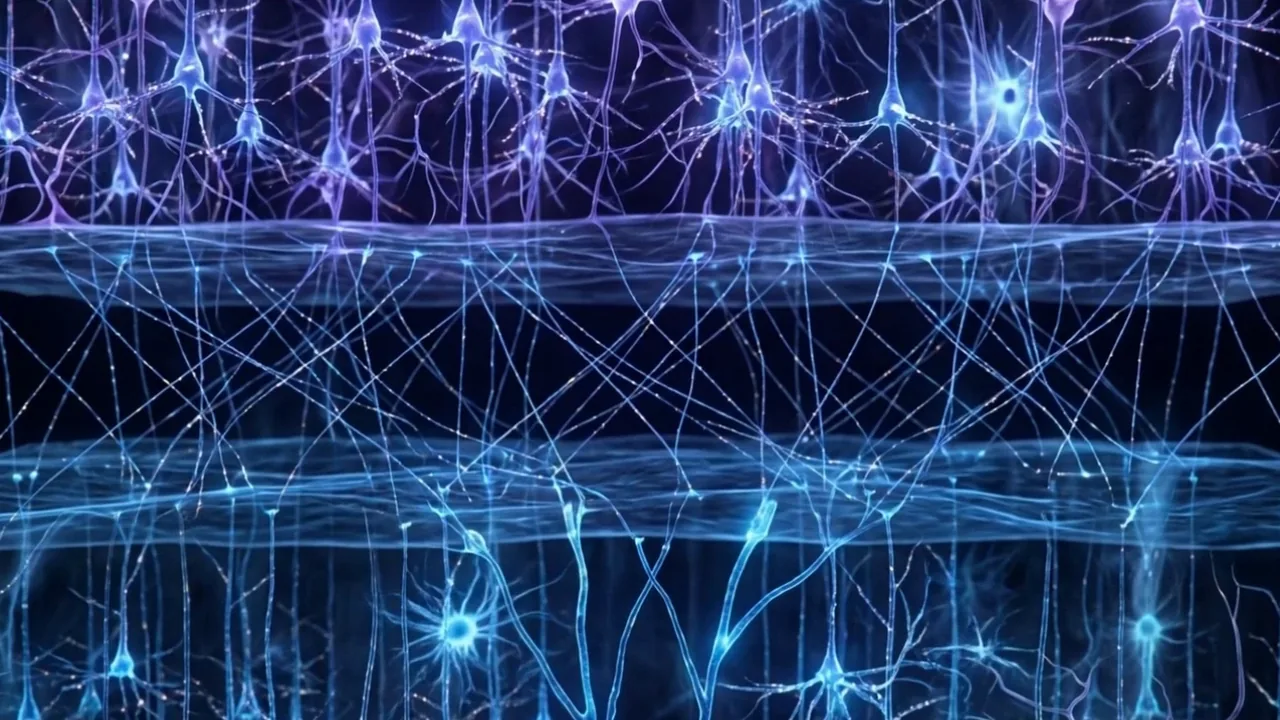
Your brain contains tens of billions of neurons. They talk to each other partly through chemical messengers, released across tiny gaps and caught by receptors: proteins on the next cell, shaped to recognise particular molecules. Serotonin has more than a dozen receptor types. DMT can bind many of them. It isn't a precise key for a single lock. But one receptor stands out: the serotonin 2A receptor, dense on the large pyramidal neurons of the cortex.
Across the classic psychedelics, blocking 2A blunts the experience. In one controlled study of ayahuasca, the blocking drug ketanserin substantially weakened its visual effects. Here is a gap worth knowing about. That decisive blocking experiment has never been published for injected DMT itself. That 2A is necessary is a reasonable assumption, not yet a demonstrated fact. And the picture is getting stranger.
In 2026, a small study found that blocking a different serotonin receptor, 1A, made DMT's effects stronger, not weaker. A molecule binding a receptor is only the first step. What changes is the conversation among billions of cells. To listen in, researchers mainly use two tools: EEG, which records electrical rhythms through the scalp, and fMRI, which follows changes in blood flow.
In 2019, a team at Imperial College London recorded EEG from thirteen volunteers given DMT. Within a minute or two, the alpha rhythm, a steady wave of relaxed wakefulness, collapsed. The more intense the experience, the deeper the collapse. Slower rhythms rose, and the signal became more complex. In 2023, the same group combined EEG with fMRI. The largest changes were in the brain's most integrative regions, where information from the senses and from memory is brought together, and where 2A receptors are densest.
Then the field checked itself. In 2026, a mega-analysis pooled eleven imaging datasets from 267 people across several psychedelics. Some famous headlines shrank. The claim that psychedelics dissolve the brain's default network held up only weakly. What held up best was stronger coupling between high-level networks and the senses. These tools have limits. fMRI follows blood, not neurons, and psychedelics act on blood vessels too.
People move more in the scanner. Volunteers can usually tell whether they received the drug. And a scan shows activity, not what that activity means, or what it's like. To connect activity with experience, many researchers start from one idea about perception itself. Your brain never meets the world directly. It sits in darkness and receives signals: light on the retina, pressure on the skin.
From those signals, and from everything it has learned, it predicts what is out there, and corrects the prediction when the signals disagree. On this view, the world you experience is the brain's best guess. In 2019, the neuroscientists Robin Carhart-Harris and Karl Friston proposed that psychedelics loosen the grip of the brain's highest-level assumptions. Signals from below, normally kept in check, rise up and reshape experience.
It's a hypothesis: partly supported, still being tested. There are hints in the data. One re-analysis found that under DMT, with eyes closed, brain waves began travelling in the direction more typical of signals arriving from the eyes. As if the brain were processing images that weren't there. The simplest visuals may have the simplest explanation. In 2001, mathematicians showed that destabilising activity in the primary visual cortex could produce spirals, lattices, tunnels and cobwebs: the same basic forms reported across drugs, migraine and flickering light.
The geometry may be the visual system showing us its own wiring. But a spiral is not a city. And a pattern is not a person. The geometry is the easy part. The hard part is what people describe next.
Why Do People Report Entering Other Worlds?
Researchers have now gathered thousands of DMT reports: from hospital studies, from people at home, from surveys and from online forums. No two are the same. But certain features recur, and they tend to arrive in a rough order. First, often, geometry. Not flat patterns, but structures with depth, colour and motion, sometimes described as more intricate than anything the person could have imagined.
COMPOSITE WITNESS: It was like being inside a mathematical object. Every surface was made of smaller surfaces, and all of it was moving. Then, for many, a sense of arriving somewhere. Chambers, domes, corridors, landscapes. Spaces that seem built, with a coherent layout and a light of their own. A careful 2026 study interviewed twenty-three people after they were given DMT during brain imaging.
Their reports followed a sequence. The body and the senses changed first. Then a three-dimensional space formed. Only after the space had formed did presences appear, and in most cases they inhabited a landscape. People also describe communication without ordinary language: meaning that seems to arrive whole, understood rather than heard. Time behaves strangely. A few minutes on the clock can feel like hours, or like no time at all.
At the most intense levels, many describe the self coming apart: no body, no name, no boundary between the one experiencing and what is experienced. Researchers call this ego dissolution, and they measure it with questionnaires. COMPOSITE WITNESS: There was no "me" left to be afraid. There was only seeing. Emotion runs through all of it. Awe is common. So is fear.
In one large survey of people describing their most memorable encounter, forty-one percent reported fear. Some describe overwhelming love; others describe panic. And then there's the feeling that makes these reports so hard to set aside. Asked directly in that survey, about four in five said the encounter felt more real than everyday reality. Yet when people wrote freely about their experiences online, almost none mentioned it unprompted.
How you ask shapes what you hear. That isn't a reason to dismiss the reports. It's a reason to study them carefully. Setting matters too: a hospital bed, a ceremony, a bedroom. So do expectation, history and state of mind. Some people report no other world at all, only colour, noise and confusion. Within minutes, the effects of injected or inhaled DMT recede.
The ordinary room reassembles. What remains is memory, and the problem of what to make of it. COMPOSITE WITNESS: I came back and the chair was a chair again. I sat there trying to describe it, and every word was wrong. Memory itself may be part of the puzzle. Studies across several psychedelics, mostly not DMT, suggest they can weaken detailed recall while strengthening the feeling of familiarity.
The new can feel strangely known. Which brings us to the reports that set DMT apart from almost every other drug: the ones in which someone, or something, is waiting.
The Entity Question
How often do people meet beings on DMT? It depends on who you ask, and how. In nearly 3,800 experiences posted online, 45 percent described an entity. In the 2026 laboratory interviews, seventeen of twenty-three people did. In a field study of experienced users at home, thirty-four of thirty-six sessions did. And the figure most often quoted, "about half", doesn't lead back to any original count.
The beings take many forms. In the online accounts, the most common were feminine figures, then deities, then alien-like beings. The famous "machine elves", a phrase from Terence McKenna's talks in the late 1980s, appeared in under three percent of encounters. In most accounts, the being makes the first move. It notices the visitor, approaches, shows something, or seems to teach.
Many people call them benevolent. Others describe them as indifferent, or frightening. COMPOSITE WITNESS: It knew I was coming. That's the part I can't get past. It was expecting me. So what's going on? Start with the strongest version of the realist view: the beings exist independently, and DMT lets people perceive them. Some researchers take this seriously enough to propose tests.
Could a being reveal something the person couldn't otherwise know: a colour hidden in another room, a number passed between two people in separate sessions? None of these tests has yet been run. Now the neuroscientific view. The brain has dedicated machinery for detecting other minds: faces, voices, intentions. And it can produce a convincing presence without any drug at all.
In one patient being assessed for epilepsy surgery, electrical stimulation at a single point in the brain produced the feeling of a person standing behind her. In healthy volunteers, a robot that slightly mismatches touch and movement can make people feel that someone is there. Many people with Parkinson's disease report a felt presence. People losing their sight can see detailed figures in costumes, and know they aren't real.
These are not the same as DMT encounters. Clinical presences are usually vague and rarely communicate. DMT beings are described as vivid and intensely interactive. But they show that a brain can build a someone. Culture shapes what appears. Where sleep paralysis has a named night visitor, people report it more often. At one ayahuasca centre whose rituals spoke of demons, participants met demons.
And one 2026 theory offers a mechanism: when the brain loses track of which experiences it is generating itself, its own constructions may feel as if they belong to someone else. Notice what none of this does. It doesn't explain why the beings arrive so consistently after a space has formed. And it doesn't prove they aren't there. Similar reports aren't proof of existence either: people share expectations, and brains share architecture.
Both produce recurring patterns. No controlled study has yet changed what people expect and then measured who they meet. Until someone does, the entity question is not unanswerable. It is unanswered.
The Mystery of Endogenous DMT
One of the most repeated claims about DMT is that your own body makes it. Part of that claim is true. In 1961, the biochemist Julius Axelrod found an enzyme in rabbit lung that could turn naturally occurring compounds into DMT. Later studies reported DMT in human blood and urine, though a 2018 review concluded that many early measurements were probably wrong.
How much the body makes, and why, is still unknown. The gene for that enzyme, INMT, is active in many human tissues. And in 2019, researchers at the University of Michigan measured DMT in the brains of living rats, at levels around half those of serotonin in the same samples. When the rats' hearts were stopped, brain DMT rose about threefold, and it did so whether or not the pineal gland had been removed.
Then the puzzle deepened. When the gene for INMT was deleted in rats and mice, the animals still produced DMT-type compounds. There may be another route. It hasn't been found. And here is what has never been done. DMT has never been measured in a living human brain. That matters, because the most popular story about our own DMT goes much further.
It says the pineal gland, a small structure deep in the brain that makes melatonin, releases a flood of DMT at birth, in dreams, or at the moment of death. Strassman himself offered that idea as speculation in 2000, and it spread widely. Current evidence doesn't support it. No pineal surge has been measured in humans, the rat brains made DMT without a pineal gland, and the amounts found so far aren't known to be psychoactive.
Unsupported is not the same as disproven. But there is a long distance between "the body can make DMT" and "DMT causes dreams, near-death experiences or deathbed visions". No study has crossed it. Near-death experiences and DMT experiences do share themes: light, presences, a sense of another reality. In a 2018 study, most volunteers given DMT scored above a standard threshold on a near-death experience scale.
But the contents differ. Deceased relatives appear in about six percent of DMT reports, and in about twenty-seven percent of near-death accounts. The same outline. Different contents. Whatever the body's own DMT is doing, it hasn't been shown to be this. Which leaves a deeper question. What is the experience of reality made of in the first place?
DMT and the Science of Consciousness
Science is very good at measuring what a brain does. It's much less good at measuring what it's like to be that brain. Researchers can record rhythms, blood flow, chemistry and behaviour. For the experience itself, they still depend on what people tell them. That isn't a flaw to be engineered away. Experience is the thing being studied, and only one person has direct access to it.
Some researchers work to make those reports better, with interviews that guide people back through an experience moment by moment without suggesting answers. The 2026 study of presences used this method. Better questions narrow the gap between experience and report. Nothing closes it completely. Which leads to the question at the centre of this film. When something feels real, what is the brain doing?
At University College London, researchers have studied how people decide whether something they see is really there or imagined. When people imagined a faint pattern that matched one on the screen, they were more likely to judge it real. In the brain, activity in one visual region rose with how real something seemed, and a separate network appeared to read that signal and turn it into a yes or a no.
In other words, "this is real" may be a judgment the brain makes, not simply a property of what is out there. No one has yet measured that judgment under any psychedelic. It's one of the most obvious experiments in the field, and it hasn't been done. The feeling of hyper-reality isn't unique to DMT. People who described meeting "God" without any drug rated those encounters nearly as real as DMT users rated theirs.
In a survey of mostly drug-free spiritual experiences, most said the experience felt more real than ordinary reality. So does feeling real tell us whether something exists? An experience can be vivid, consistent and meaningful, and still be generated from within, as a dream is. An experience can also be accurate. The feeling alone doesn't tell you which. There's a parallel in the feeling of insight.
In laboratory studies, an induced "aha" moment made people rate unrelated statements as truer, even false ones. Psychedelics reliably increase the feeling of insight. Whether those insights are true has barely been tested. None of this settles the oldest questions. Some thinkers hold that consciousness is produced entirely by the brain; others, that it's more fundamental than matter. DMT experiences don't decide between them.
A theory that explains a report doesn't prove the report false, and a vivid report doesn't prove the theory wrong. But not every idea is equally well supported. Brain-based accounts are making predictions that can be tested now. Realist accounts have only just begun to propose tests of their own. What science can do is turn ideas into experiments, and some are already running, for a reason that has nothing to do with other worlds.
Therapeutic Potential and Scientific Limits
Psychedelic medicine research has grown quickly, mostly with psilocybin. DMT is different. Its effects are far shorter, its pharmacology differs, and results from one psychedelic can't simply be transferred to another. By 2026, a couple of dozen DMT and ayahuasca trials had been registered. Most were early studies in healthy volunteers, asking basic questions about safety. In 2026, the first placebo-controlled trial of DMT alone for depression was published.
Thirty-four people with major depression received a single dose or a placebo, with psychological support. Two weeks later, depression scores had fallen significantly more in the DMT group. It's a promising signal, and a small one. The trial was short and the sample was small. Volunteers in psychedelic trials can often tell what they received, which weakens blinding. And the longer-term results came from an open-label phase, in which everyone knew.
In Brazil, an open-label study gave inhaled DMT to fourteen people with treatment-resistant depression and reported large improvements within a week. Without a control group, those results can't separate the drug from expectation, attention and natural recovery. A controlled trial is now under way. Other trials are testing longer infusions and DMT-like molecules. Some companies announce results in press releases before peer review.
A press release is not a published trial. One open question goes to the heart of this film. Is the experience itself what helps, or is it a side effect of a chemical change that could work without it? In Basel, a trial is testing exactly this, giving DMT to some participants under deep sedation, so that they don't consciously experience it.
Results are expected later this decade. Until trials like these report, DMT isn't an approved treatment for any condition. Stories of transformation are real to the people who tell them. But they aren't a substitute for controlled evidence, partly because the people who improved are the ones most likely to tell their stories.
The Risks and the Real-World Consequences
In supervised trials, DMT causes a sharp, short-lived rise in heart rate and blood pressure. Serious adverse events have been rare. But trial volunteers are screened, monitored by medical staff, and usually excluded if they have heart disease or a personal or family history of psychosis. Outside those conditions, the risks change. The most common are psychological: panic, terror, confusion, an experience that feels impossible to escape.
The body may be safe while the person inside it feels anything but. Profound changes in perception can also lead to accidents: falls, wandering, dangerous actions taken without realising it. In studies, participants lie down and are never left alone. Interactions are a serious concern. Ayahuasca contains MAO inhibitors. Combined with some antidepressants or other drugs that raise serotonin, they carry a risk of serotonin toxicity, which can be life-threatening.
Reviews find that serious cases mostly involve exactly this kind of combination. For people with a history of psychosis or bipolar disorder, the risks may be higher and are poorly understood. Rarely, psychedelic use has been followed by lasting problems, including a persistent sense that the world or the self is unreal. Deaths after DMT use have been reported. They are rare, several other drugs were usually present, and DMT has not been shown to be the sole cause.
Rare is not the same as never. The safety record of one preparation, in one setting, doesn't transfer to another. A hospital infusion with physicians in the room isn't an unregulated substance used alone. And there are legal risks. DMT is controlled under international law. It's Schedule I in the United States, Class A in the United Kingdom, and Schedule III in Canada.
Laws on ayahuasca and religious use differ from country to country, and they change. This film doesn't recommend DMT, and it doesn't explain how to use it. If you are struggling with your mental health, a qualified professional is the place to start.
What Do We Actually Know?
So, after all of this, what do we actually know? Established: DMT is a small tryptamine, closely related to serotonin. Injected, it acts within a minute or two and fades within half an hour. Swallowed alone, it's destroyed before it reaches the brain. It binds many serotonin receptors and alters brain rhythms in step with the intensity of the experience.
And it reliably produces intense experiences in which reports of other places and beings are common. Emerging: which receptors are truly necessary. How brain networks reorganise. Whether DMT's effect on depression holds up in larger, longer trials. What the body's own DMT is for. Unknown: whether the beings people meet exist independently of the brain that meets them. Whether a human brain ever makes enough DMT to change experience.
And why the experience feels so real. And three experiments that would move all of this forward haven't yet been done: measuring how the brain judges reality under DMT, testing whether expectation shapes who people meet, and finding out whether the experience itself is what heals.
The Final Question
Every night, without any drug, your brain builds a world in the dark: places, people, conversations. It feels real until you wake. Every waking moment, it does something similar. It combines signals with expectation and hands you a world you never think to question. DMT appears to change how that world is built, within a minute or two, so radically that people come back describing somewhere else.
COMPOSITE WITNESS: I don't need you to believe it was real. I need you to believe it was real to me. Both can be true. An experience can be completely real as an experience, and still leave open what it was an experience of. Science has answered part of this: the molecule, the receptors, the rhythms. It hasn't answered the rest, and some of it may need tools we don't have yet.
So perhaps the deepest question isn't what DMT shows people. It's what it reveals about the ordinary world they come back to: the one in front of you now. If a brain can build a world that feels more real than this one, how, exactly, does it decide that this one is real?
Credits and sources
SOURCES
- Alamia et al. (2020), eLife
- Arzy et al. (2006), Nature
- Axelrod (1961), Science
- Barker (2022), Psychopharmacology
- Blanke et al. (2014), Curr Biol
- Bressloff et al. (2001), Phil Trans R Soc B
- Carhart-Harris & Friston (2019), Pharmacol Rev
- Davis et al. (2020), J Psychopharmacol
- Dean et al. (2019), Sci Rep
- Dijkstra & Fleming (2023), Nat Commun
- Dijkstra et al. (2025), Neuron
- Doss et al. (2024), Psychol Rev
- Erritzoe et al. (2026), Nat Med
- Falchi-Carvalho et al. (2025), Neuropsychopharmacology
- Gallimore, Hermansson & Hoffman (2026), preprint
- Girn et al. (2026), Nat Med
- Griffiths et al. (2019), PLOS ONE
- Gumpper et al. (2025), Nat Commun
- Kugel et al. (2025), Neurosci Biobehav Rev
- Laukkonen et al. (2020), Cognition
- Lawrence et al. (2022), Sci Rep
- Mago et al. (2026), Neurosci Conscious
- Michael et al. (2021), Front Psychol
- Michael et al. (2025), Front Psychol
- Miller et al. (2019), PNAS
- Riba et al. (2014), Drug Test Anal
- Rick et al. (2025), PNAS
- Sanders et al. (2026), Neurosci Conscious
- Son et al. (2008), PNAS
- Stojanović et al. (2026), Clin Pharmacol Ther
- Strassman et al. (1994), Arch Gen Psychiatry
- Timmermann et al. (2018), Front Psychol
- Timmermann et al. (2019), Sci Rep
- Timmermann et al. (2023), PNAS
- Valle et al. (2016), Eur Neuropsychopharmacol
- Yaden et al. (2017), Psychol Conscious
- Zahid, Strassman et al. (2026), J Psychopharmacol
- Molecular structures built from PubChem data; protein structures from the RCSB Protein Data Bank (9AS1, 2Z5X, 2A14).
Keep exploring.
- All Shroomverse films
- Tidal Wave: documentary and full transcript
- Penis Envy: The Mushroom Behind the Myth: documentary and full transcript
- Amazonian: what the name can and can’t tell us: documentary and full transcript
- Blue Meanie: one nickname, two mushrooms: documentary and full transcript
- Albino Penis Envy: no pigment, so why is it blue?: documentary and full transcript
- What is DMT? The molecule, where it comes from, and what science actually knows
- What happens in the brain on DMT? EEG, fMRI and the limits of the evidence
- DMT entity encounters: what researchers have recorded
- Why does DMT feel “more real than real”? What the science of realness can and cannot explain
- Pineal gland activation: what the science says about “activating” or “decalcifying” it
- Psychedelic Toronto: a history
- Toronto help lines