THE SHROOMVERSE JOURNAL ✳ 18 MIN READ
Is Santa a mushroom? The fly agaric Christmas theory, fact-checked
Topic: Mushrooms: history and science
Published
Listen: the 3-minute version
AI-narrated summary of this article
Short answer, checked 4 October 2026
No. We found nothing that shows Santa Claus comes from a mushroom. Siberian peoples did use the fly agaric (Amanita muscaria), but Santa’s sleigh, reindeer, chimney and red coat can each be traced in print to 1800s sources that mention no mushroom, and the one link to Sámi shamans is a single report from the 1940s. The fly agaric is also toxic, and it is not psilocybin.
On this page 8 sections
The idea is that Santa Claus began as a Siberian or Sámi shaman who handed out hallucinogenic mushrooms at midwinter. It is a fun story, and it starts from something real: peoples in Siberia did use the fly agaric, the red mushroom with white flecks. But the steps from there to Santa do not hold up against the sources we could read. The sleigh, the reindeer, the chimney and the red coat can all be traced in print to 1800s sources that do not mention mushrooms.
This article follows the theory back to its sources, as our stoned ape theory fact check does for another popular claim. It looks at what the retellings say, whether R. Gordon Wasson’s 1968 book Soma, usually named as the starting point, makes the claim, what historians of Christmas say, what the Siberian and Sámi records document and where they stop, and where the red and white come from. It ends with a verdict that sorts what is supported from what is speculation.
The fly agaric is poisonous. This is history, not a guide.
Amanita muscaria is a toxic mushroom. Poison centres and hospital reports describe vomiting, confusion, seizures and intensive-care admission after people ate it, and nothing here is advice to eat it. If someone has eaten a wild mushroom, do not wait for symptoms: call your regional poison centre. The Ontario Poison Centre is 1-800-268-9017 and answers 24 hours a day (Ontario Poison Centre); the other provincial centres are listed at infopoison.ca. If the person is seriously unwell, call 911. More on our safety page.
What is the fly agaric Santa theory?
National Geographic summarizes the usual form like this. Sámi or Siberian shamans collected and dried fly agaric and gave it as gifts at the winter solstice, passing it through openings in roofs because snow had blocked the doors. Their reindeer were said to be high on the mushroom too, or to guide the shamans on visions. Retellings add that the shamans wore red suits, and that red-and-white wrapped presents under an evergreen look like mushrooms growing at the foot of a conifer (National Geographic, 2023).
Live Science’s 2012 report quotes an anthropologist, John Rush, and a classics professor, Carl Ruck, who each support a version of it. It credits the tree-and-presents idea to a 2003 book, Mushrooms and Mankind, by the late James Arthur (Live Science, 2012). Those are claims reported by journalists. None of the pieces we read points to a historical document for them, which is why we go to the sources next.
Where does the Santa mushroom theory come from? Did Wasson say it?
NPR’s 2010 Morning Edition report traces the idea at Harvard to the mycologist Donald Pfister, who tells his students the story each Christmas. His account begins with Wasson, whom NPR calls an amateur scholar: Wasson’s book argued that fly agaric was used in ancient ceremonies by shamans in the Far East, and other scholars then noted that both shamans and reindeer in Siberia were known to eat it (NPR, 2010).
So the usual starting point is Wasson’s Soma: Divine Mushroom of Immortality. We read an Internet Archive scan of its 1968 first edition and searched the text for Santa, Claus, Nicholas, Noel, sleigh, Father Christmas, solstice and Christmas. None of the first six appears. “Christmas” appears once, as a date in a photo caption, and a sledge appears once, pulled by dogs in a Koryak tale (Wasson, 1968). The scan is machine-read, so a stray mistake could hide a word, but the book does not make the Santa argument.
What Soma does contain is the raw material. It lists the Siberian peoples who used the fly agaric. It describes reindeer craving the mushroom and human urine. And it remarks, in passing, that in Germany the red mushroom with white spots appears on greeting cards as a sign of good luck, and that chimney-sweeps regard it as theirs (Wasson, 1968). Its main thesis, that the Vedic drink Soma was the fly agaric, is a separate and contested claim; Nyberg called it very controversial (Nyberg, 1992).
We could not trace who first joined these pieces into a Santa story. Tim Frandy, a scholar of Nordic studies from the Sámi descendant community, says news stories on it tend to rely on the same handful of sources and do not consult Sámi people (National Geographic, 2023). Evidence: the Santa claim cannot be traced to Wasson’s book. It is a later retelling.
What do Siberian and Sámi sources actually document?
Siberia: real use, but not what the legend needs
The Siberian record is real. Wasson gives the earliest eyewitness account as an entry in the diary of a Pole, Adam Kamienski, in 1658, among the Ostyak (now usually called Khanty) of the Irtysh River. He lists use among the Ostyak, Vogul, Ket and Samoyed peoples and, in the far north-east, the Chukchi, Koryak and Kamchadal (Wasson, 1968).
Harri Nyberg’s 1992 comparison of Siberian and Mesoamerican practice draws on the ethnographic literature, above all a 1991 review by Maret Saar that we did not open. It describes two regions of customary use, western Siberia with the Taimyr Peninsula and the far north-east, and says use was both religious and recreational. It was not obligatory and not limited to shamans, and mushrooms had commercial value. The mushroom was treated as a tool or ally rather than a sacred object, and shamans’ trances did not depend on it. Nyberg’s list of peoples for these two regions does not include the Sámi, and he mentions the Lapps only in passing as the western edge of the wider area (Nyberg, 1992). Evidence: established that fly agaric was used in parts of Siberia; it was not a midwinter gift-giving rite in anything we read.
Wasson himself warns that many of the European observers whose accounts he reprints were superficial or disdainful and relied on local informants of doubtful reliability (Wasson, 1968). We read those accounts only through Wasson and Nyberg, so details such as dates and practices should be treated as second-hand.
What about reindeer, roofs and gifts?
Wasson reports, citing early travellers including Steller and Langsdorff, that reindeer crave both fly agaric and human urine, to the point of becoming unmanageable (Wasson, 1968). Evidence: reported, second-hand. Nothing we read describes reindeer flying, and Pfister’s suggestion that people hallucinating might have felt that they flew is an idea, not a record (NPR, 2010).
Roofs do appear in the ethnography. An 1797 account that Wasson reprints has a Polish army officer entering a Kamchatka dwelling, as was customary, through the smoke-hole in the roof, and Wasson quotes a description of a shaman’s ritual climb of a birch pole through that hole to reach the other world (Wasson, 1968). Neither passage involves gifts, midwinter or mushrooms delivered to anyone. The roof entry is documented; the gift-giving is not.
What about the Sámi?
Wasson cites the Finnish scholar T. I. Itkonen’s 1946 book for a tradition among the reindeer Sámi of Inari that their sorcerers once ate fly agarics with seven dots, and he lists the Inari Sámi (he calls them Lapps) among peoples with oral memories of past use (Wasson, 1968). That is the evidence.
Tim Frandy, an assistant professor of Nordic Studies at the University of British Columbia and a member of the Sámi descendant community, told National Geographic that this is the only time he has seen Sámi shamans tied to amanita, and that it is possible, even likely, that Sámi people formerly used it. He adds that evidence for shamans’ use in rituals is scant and that a link to Christmas lore is unlikely. Sámi midwinter customs centred on avoiding a dangerous being, the stállu, with silence and precautions, which he says looks nothing like a gift-giver. He also notes that the mushrooms are long gone under snow by December, and that Sámi people have widely criticized the theory as a romanticized misreading of their culture (National Geographic, 2023). Evidence: not supported.
What do historians and folklorists of Christmas say?
Ronald Hutton, a history professor at the University of Bristol, told NPR that he had examined the evidence on Siberian shamanism and found that shamans did not travel by sleigh, did not usually deal with reindeer spirits, very rarely took the mushrooms to enter trances and did not wear red and white clothes. He says the Santa Claus we know was invented by a New Yorker, Clement Clarke Moore, who turned a medieval saint into a flying, reindeer-driving spirit (NPR, 2010).
Live Science reports that two other historians, Stephen Nissenbaum, who wrote a book on Christmas traditions, and Penne Restad, were unaware of any link between Santa and shamans or mushrooms. It also reports that Pfister called the connection with Christmas a coincidence and knew of no direct link. Rush and Ruck dispute Hutton’s points: they say shamans did deal with reindeer spirits, that the red-and-white clothing detail reflects the mushroom’s colours, and that the sleigh stands for a journey to another realm (Live Science, 2012). Evidence: disputed in the press, with no primary source offered for the shaman-clothing and reindeer-spirit claims.
There is one real scrap of spotted dress in the material Wasson reprints. In a Koryak tale recorded by Waldemar Jochelson, a hero’s wives make round, broad-brimmed hats with red and white spots to look like fly-agaric people and travel with them (Wasson, 1968). It is a mushroom-dress motif in a folk tale about spirit people, not a description of a shaman’s costume, and it says nothing about Santa. Evidence: limited, one tale.
The documented history of Santa
The chain of evidence for Santa is in print. A poem titled “Account of a Visit from St. Nicholas” appeared anonymously in the Troy Sentinel on 23 December 1823. It has a miniature sleigh, eight reindeer, a roof, a chimney and stockings, and a plump, jolly old elf. He is “dress’d all in fur” and tarnished with ashes and soot, with a white beard (Troy Sentinel, 1823). The Library of Congress notes that the poem was later credited to Moore, that the family of Henry Livingston Jr. also claimed it, and that it never calls St. Nicholas “Santa” (Library of Congress, 2020).
Before that, Dutch immigrants in New York kept the feast of St. Nicholas as “Sinter Klaas”, and Washington Irving put the character in his 1809 History of New York. A generation after Moore, the Library of Congress says, Thomas Nast drew the Santa people would recognize in Harper’s Weekly, with the image of 1 January 1881 becoming a kind of official portrait (Library of Congress, 2020). Maria Kennedy, an American studies scholar at Rutgers University, describes the change from the Christian St. Nicholas to a folkloric elf as an interplay of many Christian and pagan midwinter customs (National Geographic, 2023). Evidence: established in outline.
Where do Santa’s red and white really come from?
Not from Moore’s poem, which names no colour for the fur outfit. The Library of Congress says Santa’s red coat, pipe, workshop and North Pole address first appeared in Nast’s drawings (Library of Congress, 2020). None of the sources we read says why Nast chose red, so we do not offer a reason. Coca-Cola says it did not create the legend of Santa Claus and that depictions before 1931 varied, including a tall gaunt man and an elf. It credits the Sundblom paintings it commissioned that year with establishing a warm, rosy-cheeked, white-bearded Santa (Coca-Cola Company).
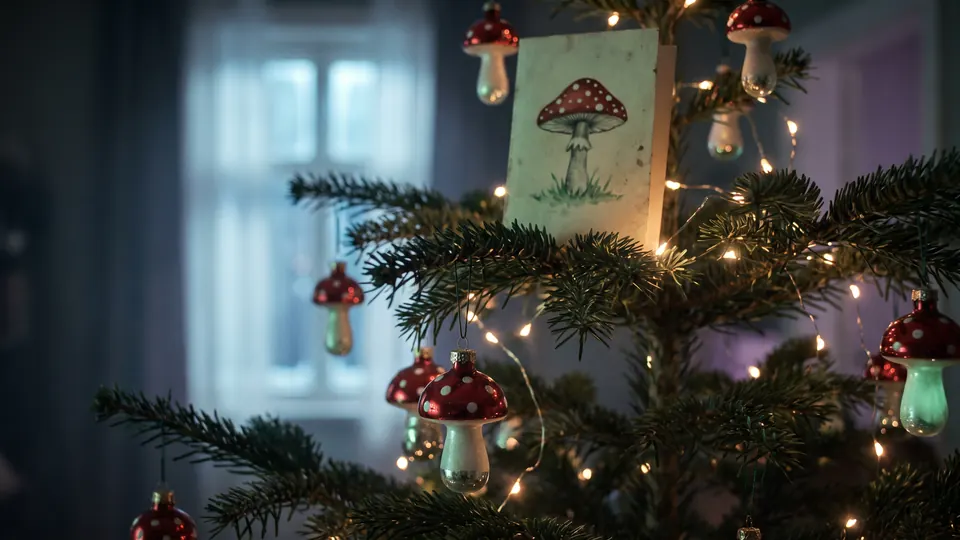
The mushroom itself is another story. Wasson notes the fly agaric as a good-luck emblem on German greeting cards (Wasson, 1968), and NPR reports that mushroom ornaments are common on Christmas trees across the West (NPR, 2010). Frandy says that growing up Finnish, Swedish and Sámi he never heard of mushroom associations with Christmas until mushroom tree decorations went on sale (National Geographic, 2023). We found no source dating when the mushroom joined Christmas. Our own reading, not a sourced finding, is that the ornaments borrow its luck symbolism. That would mean the mushroom came to Christmas decoration, not that Santa came from the mushroom.
The idea that red-and-white presents mimic mushrooms under a conifer is easy to state and hard to test. It is true that Amanita muscaria grows with birch and pine (Nyberg, 1992). But that is a fact about where the mushroom grows. The Library of Congress notes that Christmas trees were not common in the United States until the 1840s (Library of Congress, 2020), and we found no source linking wrapping paper to mushrooms. Evidence: speculation.
Is the fly agaric a magic mushroom, and is it safe?
No on both counts. “Magic mushroom” usually means one that contains psilocybin. The fly agaric’s active compounds are ibotenic acid and muscimol, which act on the brain’s glutamate and GABA systems, not on serotonin pathways, and a 2025 toxicology review sorts it with “CNS toxicity” mushrooms, not with the psilocybin group (Stoeva-Grigorova et al., 2025). Nyberg likewise stresses that the two groups contain chemically unrelated compounds (Nyberg, 1992). Our guide to what magic mushrooms are covers the psilocybin side.
The Ontario Poison Centre’s newsletter for health-care workers lists ibotenic acid and muscimol as their own group, with symptoms usually starting within about 30 minutes to three hours: intoxication and drowsiness, then confusion, euphoria, delirium and hallucinations lasting roughly 4 to 12 hours (Ontario Poison Centre, 2023). That is an account of poisoning, not of a benefit.
Case reports show how serious it can get. Two older adults in Bulgaria arrived in a coma, one with a seizure, needed intensive care and recovered; the authors say management is mainly supportive, and that deaths are exceedingly rare (Stoeva-Grigorova et al., 2025). In Minnesota in 2018, a poison-control report described a man who needed a breathing machine for four days and spent eight days in hospital (Taylor et al., 2019). Rare is not the same as safe. The 2025 review adds that the amount of active compounds varies with season and growing conditions, so one mushroom cannot be assumed to match another.
Wasson argued that Europeans had long exaggerated the mushroom’s lethality and that many Siberian travellers acquitted it of causing death (Wasson, 1968). Even so, old accounts of how people handled it are not safety evidence. Poison-control reports describe hospital cases, and the Ontario Poison Centre says only a mycologist can tell safe from toxic wild mushrooms, that you should call before symptoms appear, and that cooking wild mushrooms does not make them safe (Ontario Poison Centre).
Products add another risk. A 2024 CDC report from a Virginia poison center described five cases, including a 3-year-old, after people ate gummies labelled as containing Amanita muscaria or mushroom blends. Four of six bags tested held unlabelled psilocybin or psilocin (Michienzi et al., 2024). For general risks, see our safety page.
Verdict: what is supported, and what is speculation?
| Claim | Verdict | Basis |
|---|---|---|
| Siberian peoples used the fly agaric | Supported | Eyewitness accounts back to 1658 and Nyberg’s review of the literature; use was recreational as well as shamanic. |
| Sámi shamans used it | Not established | One 1940s report of an oral tradition at Inari. A Sámi scholar finds scant evidence and rejects the Santa link. |
| Shamans gave mushrooms as solstice gifts through roofs | No source found | Roof entry and smoke-hole rituals are documented; gift-giving is not. The retellings cite no primary source. |
| Reindeer eat fly agaric | Reported, second-hand | Early travellers’ accounts as summarized by Wasson; we did not read them directly. |
| Flying reindeer come from hallucinations | Speculation | Offered as an idea by a mycologist. The sleigh and the eight named reindeer are in the 1823 poem. |
| Shamans wore red suits with white trim | Disputed | Hutton says no, Ruck says yes. The only spotted dress we found is a hat in a Koryak folk tale, not a shaman’s costume. |
| Santa’s red coat comes from the mushroom | Not supported | No colour is named in the 1823 poem. The Library of Congress credits Nast’s drawings. |
| Wasson said Santa was a mushroom | Not found | Not in the text of Soma that we searched. |
| Fly agaric imagery appears around Christmas | Supported as an observation | Mushroom ornaments are common; Wasson notes the mushroom as a luck symbol in Germany. When it joined Christmas is not traced. |
| The fly agaric is a safe magic mushroom | False | Different compounds from psilocybin; poisoning with hospital admission is documented. |
Our overall verdict: the fly agaric Santa theory is speculation built on a real fact. Siberian peoples did use the mushroom, and Santa’s look is well documented, but we found no source that connects the two. The few links offered, a roof opening, reindeer and the colour red, each have a more ordinary explanation or no evidence at all. The theory also leans on Sámi culture in ways Sámi scholars reject. Nothing here is a reason to eat any mushroom.
What we could not verify
- Who first proposed the link between Santa and the fly agaric.
- Whether Siberian shamans’ clothing resembled the mushroom. Hutton and Ruck disagree, and we found no primary source beyond one Koryak folk tale.
- Sámi use of the fly agaric beyond Itkonen’s 1940s report.
- The original Siberian travellers’ accounts. We read them through Wasson and Nyberg, and did not open Saar’s 1991 review.
- Why Nast gave Santa a red coat.
For the other mushrooms in this story, see the history of magic mushrooms, where psilocybin ceremony in Mesoamerica is the documented case, and María Sabina and the Mazatec velada.
Common questions
Is Santa Claus based on a mushroom?
We found no source that shows it. The theory says Siberian or Sámi shamans handing out fly agaric inspired Santa. Siberian use of the mushroom is documented, but the sleigh, reindeer and chimney appear in an 1823 poem and the red coat in Nast’s drawings of the 1800s, and neither source mentions a mushroom.
Did Wasson say Santa was a fly agaric?
Not in Soma, as far as we could find. We searched an Internet Archive scan of the 1968 first edition for Santa, Claus, Nicholas, sleigh and Christmas and found no Santa argument. NPR links the idea to Wasson’s work through later scholars and retellings.
Did Siberian shamans really use fly agaric?
Yes, in parts of Siberia. Accounts go back to 1658, and a 1992 review says use was religious and recreational, not obligatory and not limited to shamans. We found no source for gift-giving at the winter solstice.
Did Sámi shamans use fly agaric?
Possibly, but the evidence is thin. The main item is a 1940s Finnish report of a tradition at Inari. A Sámi scholar says use is possible, even likely, but that shamans’ use is scant in the record, and Sámi people have widely criticized the Santa theory.
Where do Santa’s red and white come from?
Not from Moore’s 1823 poem, which names no colour. The Library of Congress says the red coat first appeared in Nast’s drawings. Coca-Cola says it did not create Santa, though its 1931 ads reinforced the look. We found no source on why red was chosen.
Is the fly agaric the same as magic mushrooms?
No. Magic mushrooms contain psilocybin. The fly agaric contains ibotenic acid and muscimol, which act on different brain systems, and toxicologists classify it separately. See our guide to what magic mushrooms are.
Is the fly agaric poisonous?
Yes. Poison centres and case reports describe vomiting, confusion, delirium, seizures and hospital stays. Deaths are reported as rare, but serious illness is not. See our safety page at /safety.
What should I do if someone has eaten a wild mushroom?
Do not wait for symptoms. Call your regional poison centre; the Ontario Poison Centre is 1-800-268-9017, and other provinces are listed at infopoison.ca. Call 911 if the person is seriously unwell.
Shroomverse sells mushroom products. This article is general information about history. It is not medical, legal or purchasing advice, and it does not encourage anyone to use drugs.
SOURCES
- Soma: Divine Mushroom of Immortality (R. Gordon Wasson), New York, 1968, Internet Archive scan. Accessed . Supports the list of Siberian peoples, the 1658 account, the reindeer observations, the Itkonen report on Inari, the 1797 smoke-hole entry, the Koryak tale with spotted hats, the greeting-card remark and the absence of any Santa argument. Machine-read text, searched for Santa, Claus, Nicholas, Noel, sleigh, Father Christmas, solstice and Christmas.
- Religious use of hallucinogenic fungi: A comparison between Siberian and Mesoamerican cultures (Nyberg), Karstenia 32:71–80, 1992. Accessed . Supports the account of Siberian use, the comparison with Psilocybe, the chemistry, the habitat with birch and pine, and the view that the Soma claim is controversial. Full text read.
- Did 'Shrooms Send Santa And His Reindeer Flying? (Richard Harris), NPR, Morning Edition, December 2010. Accessed . Journalism. Supports Pfister’s account, the link to Wasson’s work, Hutton’s statements and mushroom ornaments.
- Magic Mushrooms May Explain Santa & His 'Flying' Reindeer (Douglas Main), Live Science, 20 December 2012. Accessed . Journalism. Supports the statements of Rush, Ruck, Pfister, Nissenbaum and Restad, and the Arthur book claim.
- What does Santa have to do with … psychedelic mushrooms? (Olivia Campbell), National Geographic, 21 December 2023. Accessed . Journalism. Supports the usual form of the theory and the statements of Frandy and Kennedy.
- Account of a Visit from St. Nicholas, Troy Sentinel, 23 December 1823 (transcription), Wikisource. Accessed . Transcription of the newspaper text; supports the poem’s description of Santa, and the absence of colour.
- A Visit from Santa…Who You Might Not Recognize (Neely Tucker), Library of Congress, Timeless blog, 23 December 2020. Accessed . Supports the first publication, attribution, the Dutch and Irving background, the Christmas-tree remark and Nast’s role in the red coat.
- Did Coca-Cola invent Santa Claus?, The Coca-Cola Company. Accessed . The company’s statement that it did not create Santa and that depictions varied before 1931.
- Acute Amanita muscaria Toxicity: A Literature Review and Two Case Reports in Elderly Spouses Following Home Preparation (Stoeva-Grigorova et al.), Toxins 17(12):570, 2025. Accessed . Supports the compounds and their targets, the symptoms, the case reports, the variability and the rarity of deaths.
- Toxicology Times: Mushrooms (September 2023), Ontario Poison Centre, The Hospital for Sick Children. Accessed . Newsletter for health-care providers. Supports the poison-centre grouping, onset and duration for ibotenic acid and muscimol.
- Mushrooms, Ontario Poison Centre. Accessed . Supports the advice that only a mycologist can identify safe mushrooms, to call before symptoms, and that cooking does not make wild mushrooms safe.
- Notes from the Field: Acute Intoxications from Consumption of Amanita muscaria Mushrooms, Minnesota, 2018 (Taylor et al.), MMWR 68(21):483–484, 2019. Accessed . Supports the case report of ventilation for 4 days and 8 days in hospital.
- Notes from the Field: Schedule I Substances Identified in Nootropic Gummies Containing Amanita muscaria or Other Mushrooms, Charlottesville, Virginia, 2023–2024 (Michienzi et al.), MMWR 73(28):628–630, 2024. Accessed . Supports the five poison-centre cases and the unlabelled psilocybin or psilocin in four of six bags.
- Canadian poison centres, Canadian Association for Poison Centres and Clinical Toxicology (infopoison.ca). Accessed . Lists the five regional centres and their numbers.
CHANGES
- : Published.



