SHROOMVERSE FILMS · TRANSCRIPT
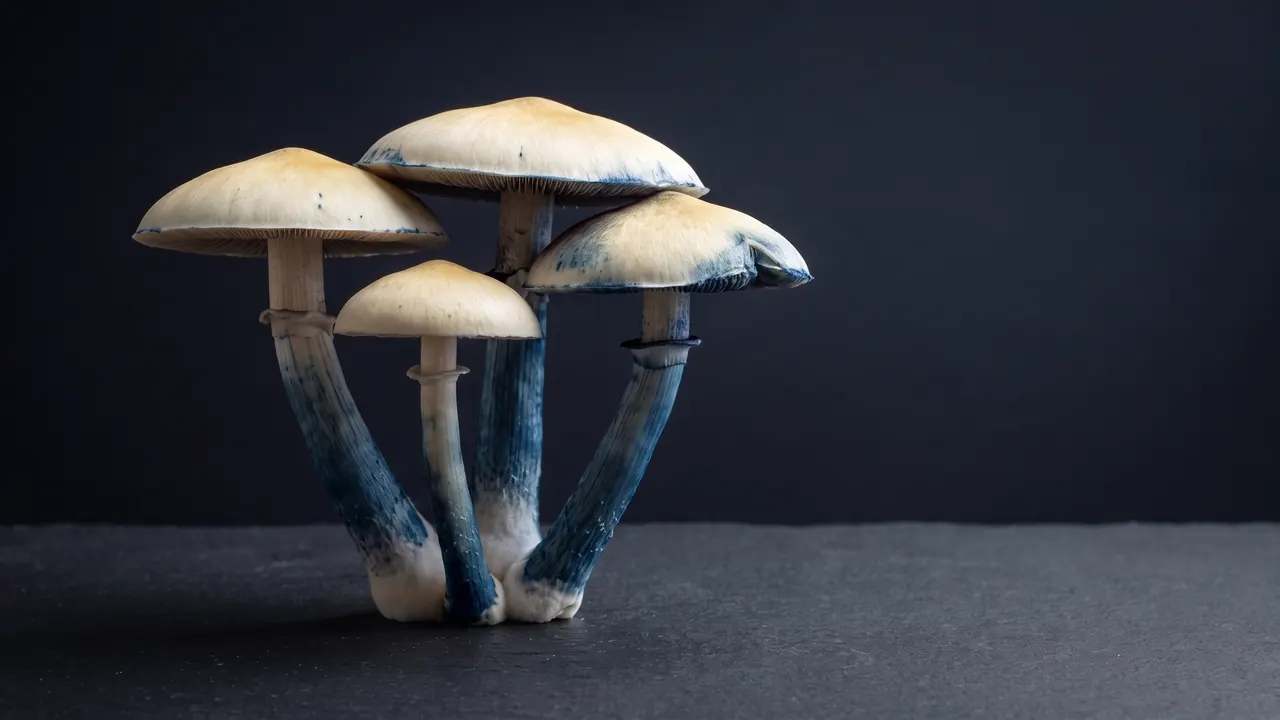
Albino Penis Envy: no pigment, so why is it blue?
Albino Penis Envy is a pale Psilocybe cubensis cultivar whose creator wanted it pure white, yet its caps kept turning blue. We follow it from a December 2007 forum post and a disputed origin story to the 2020 discovery of the enzymes behind the blue, then check what genome and lab studies do and don’t show about white mushrooms.
Key claims are labelled on screen by their evidence: documented, limited evidence, anecdotal, disputed or unknown.
It’s an educational film. It isn’t about our products, and there’s no growing, sourcing or dosing advice in it. Some scenes are AI-generated illustrations, and the narration is a synthetic voice.
FULL TRANSCRIPT
Cold open: a post in December 2007
December 2007. A post goes up on a mushroom-growing forum. This is an educational documentary. Psilocybin is a controlled substance in most countries, and nothing here is advice. Its author, a breeder named John Workman, is posting what he calls, for now, the best version of a mushroom he began breeding in the mid-2000s. He wanted it white. Pure white. But the caps kept turning blue.
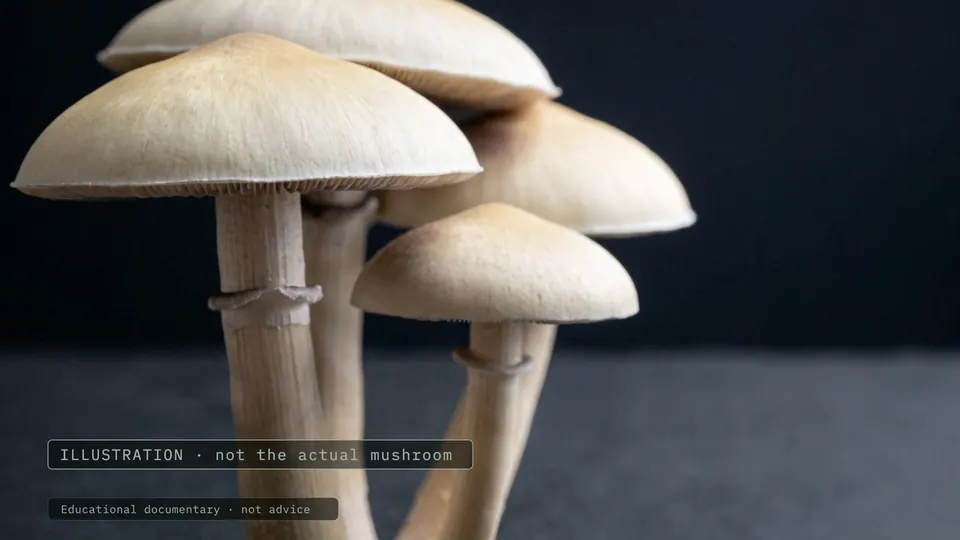
"I was hoping for pure white mushrooms," he wrote. His mushroom became known as Albino Penis Envy. So here's the puzzle. If a mushroom has almost no pigment, why does it still turn blue?
I · Two kinds of colour
Start with the word "albino". In a mushroom, colour lives in two places. The cap and stem. And the spores, which fall from the gills as a fine dust. Growers sort pale cubensis into two groups. Leucistic: a white or off-white mushroom that still drops pigmented spores. Albino: white all the way through, with clear, colourless spores. These are trade terms.
We couldn't find a formal scientific definition for either. Albino Penis Envy is said to drop very few spores, in deposits so faint they're hard to see at all. Growers and sellers describe it the same way. We found no measurement of it. So on paper, this is a mushroom with very little to show. Pale cap. Pale spores. And yet the descriptions keep mentioning blue. We'll get to the blue. First, where this mushroom came from.
II · Two parents, one cross
Its story begins with another white mushroom. In the 1990s, a grower went by the name Psylocybe Fanaticus. PF, for short. He kept a cubensis line called PF Classic. Around the year 2000, a white form turned up in it. It became known as PF Albino. How it arose is disputed. One account blames ultraviolet lamps used near the cultures.
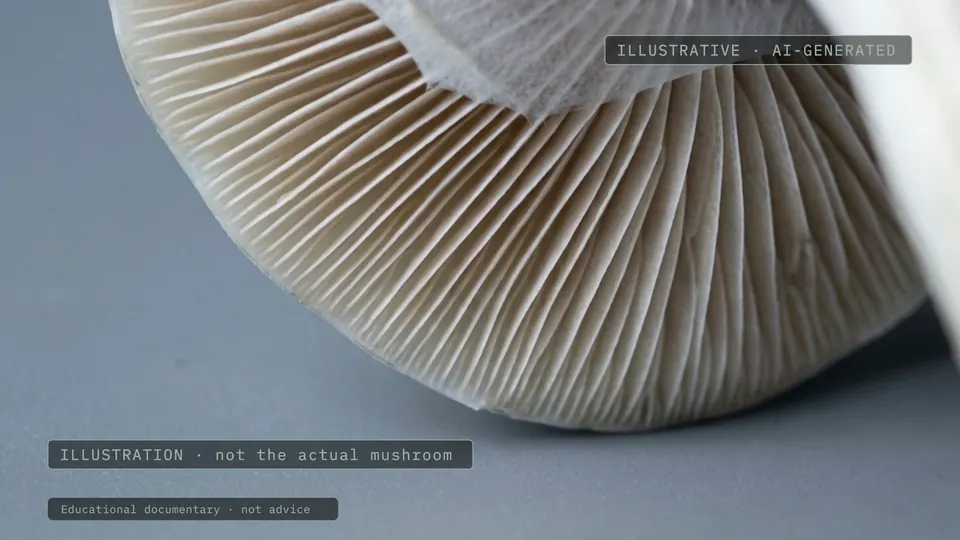
But even the man telling that story doubts it. He says the lamps were ordinary black lights, probably too weak to damage DNA. People assumed PF Albino made no spores at all. Then, by his own account, Workman looked at its gills under a microscope and found them. Colourless spores. Both white lines are real enough to photograph. A 2025 scientific review published pictures of PF Albino and of a line labelled Long Albino Penis Envy.
He crossed PF Albino with Penis Envy, the cultivar from our earlier film. He chose two parents that looked nothing alike, so a successful cross would be obvious. The first generation surprised him. The offspring looked like perfectly ordinary cubensis. Only in later generations did the white colour and the Penis Envy shape come back. His explanation: both traits are recessive.
They stay hidden unless a mushroom inherits them from both parents. It fits the pattern. But it's never been tested. Even the date is fuzzy. Accounts date it to 2006, or to a forum post at the end of 2007.
III · Clones and spores
There's a catch with recessive traits. Spores come from sexual reproduction. Each one carries a fresh shuffle of its parents' genes. So mushrooms grown from spores can drift. Two with the same name needn't be genetic twins. A clone avoids that. Copied living tissue carries the same genes as its source. One genome study notes that stable looks can be a sign of inbreeding.
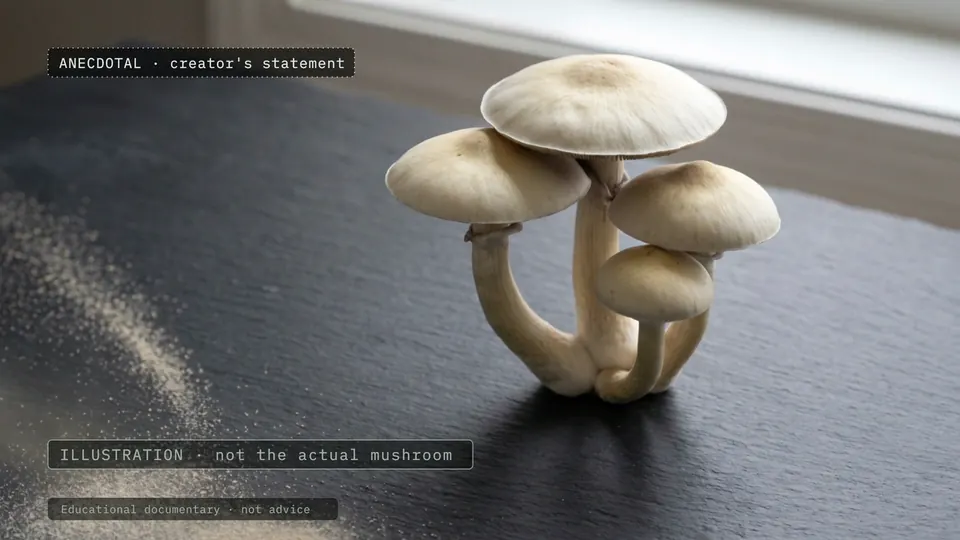
Its data suggest Penis Envy lines were cloned or self-crossed. For Albino Penis Envy, the paper trail is about spores. Its creator says enough spores can be gathered, and the line is still passed on through them. So the name may cover a family of siblings, not a single clone. That's an inference from basic genetics, not a measurement. How any particular line is kept going in practice isn't documented. That genetic shuffle may be one reason descriptions differ. Pale in one account. Tinged blue in another.
IV · Where the blue comes from
Now, the blue. For decades, chemists knew that injured Psilocybe mushrooms turn blue. They didn't know how. In 2020, researchers in Jena, Germany, worked out the reaction, using Psilocybe cubensis. The mushroom stores psilocybin, a molecule with a phosphate group attached. The researchers think that phosphate works like a reversible safety catch. When tissue is crushed or cut, an enzyme called PsiP strips the phosphate from psilocybin, leaving psilocin.
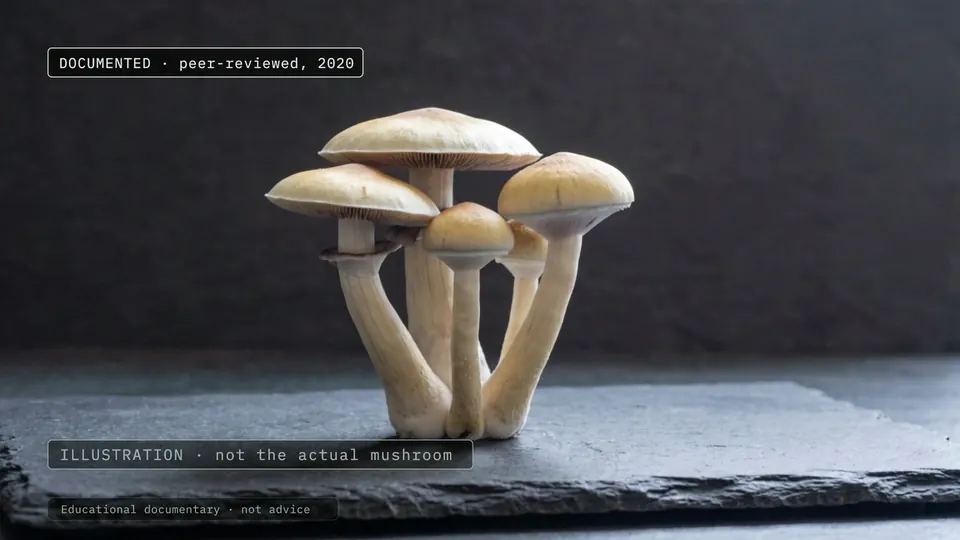
A second enzyme, PsiL, then oxidises the psilocin. The oxidised units link into chains, from about three to thirteen units long. Those chains are blue. The team watched it happen inside an NMR spectrometer, tracking the reaction carbon by carbon. There's no single blue molecule. It's a mixture. And specimens can turn blue on their own as they age. The genes for those two enzymes don't even sit with the psilocybin genes.
They're elsewhere in the genome. The blue machinery is a separate add-on. So here's the likely answer to our puzzle. The blue doesn't come from the cap's pigment. It's built on the spot, from psilocin. The blue material's infrared spectrum shows some similarities to eumelanin, a dark pigment. So a mushroom called albino can still make colour on demand. And the chemistry has one more turn.
In 2020, the team's evidence pointed to psilocin units joined at one particular position. The following year, the same lab built stable stand-ins for those molecules and tested them. The blue came from units joined at a different position. Scientists correcting themselves, in print. That's how it's supposed to work. It's how we try to work here at SHROOMVERSE. The legend first. Then the evidence. And a plain label on whatever can't be verified.
V · What’s inside the white
So a white mushroom can turn blue, as long as it still has psilocybin to break down. Does this one? In a 2026 study, researchers grew fourteen named cubensis strains under identical conditions. They confirmed every strain's species with DNA. Albino Penis Envy was one of them. Its sample contained psilocybin, and some psilocin too. Raw material for blue. But each strain was grown in a single chamber and measured from one pooled sample.
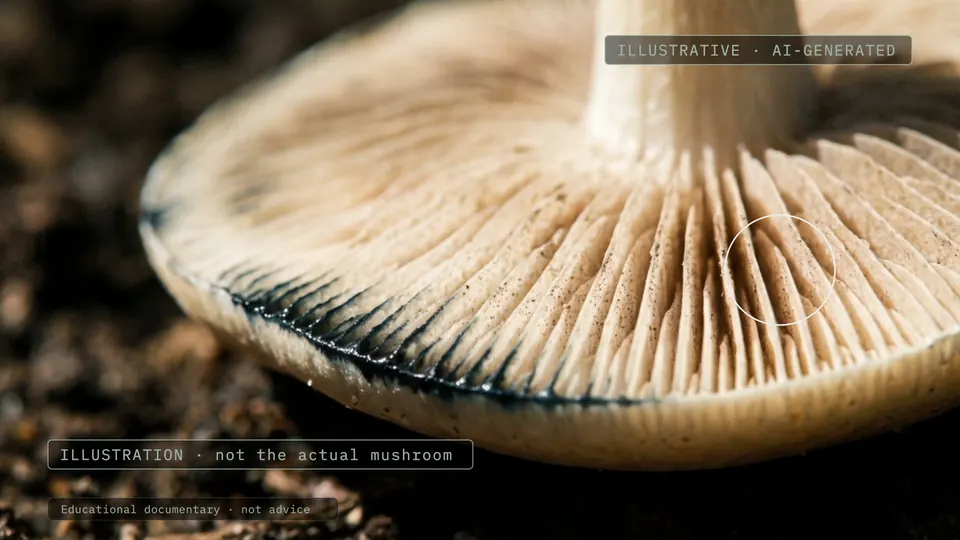
One batch is a data point, not a verdict on every mushroom with the name. And blue isn't a gauge. Blueing shows psilocin is present and breaking down. No study we found has measured whether a bluer mushroom contains more psilocybin.
VI · Is white one thing?
So what makes this mushroom white in the first place? Nobody knows yet. We found no study identifying the gene, or even the chemistry of the cubensis cap pigment. We found no published Albino Penis Envy genome. A 2021 genome atlas includes albino and leucistic samples from several sellers. None of them is labelled Albino Penis Envy. A 2023 study pooled those genomes with more, 124 in all.
Its albino and leucistic lines fell into two different populations, though related ones. White doesn't trace back to a single population. Those names came from sellers, so even that result carries an asterisk. The authors suggest traits like colour may have been fixed by self-crossing. Other mushrooms show how far this science can go. In the button mushroom, the white cap was the key trait chosen during domestication.
It's been linked to a specific gene. In one oyster mushroom, cap darkness tracks another gene. In enoki, the yellow comes from flavonoids, switched on or off mainly at one spot in the genome. For cubensis, that work hasn't been done.
Final thought
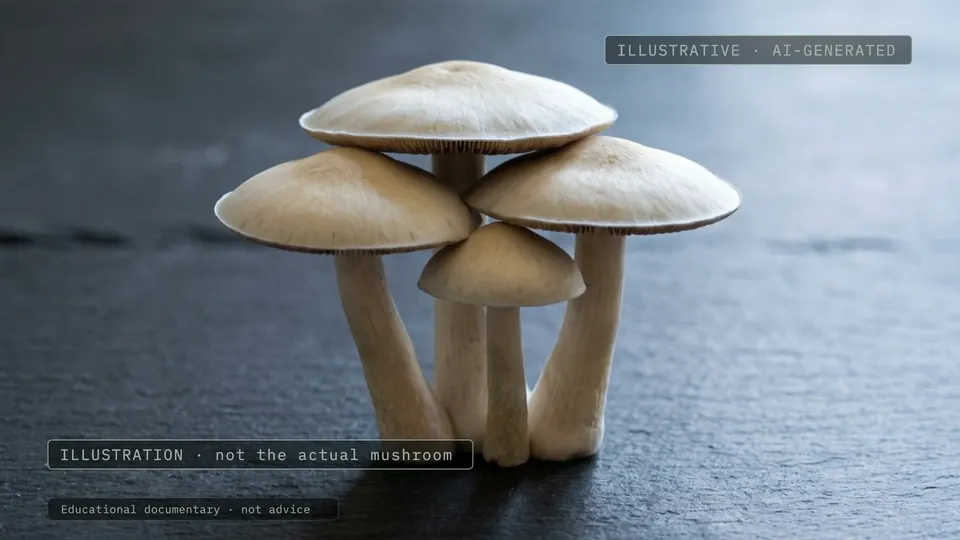
December 2007. A breeder hoping for pure white mushrooms, watching the caps turn blue. He'd bred the brown out. The blue, the chemistry suggests, was never stored pigment. It's built on demand, from psilocin, by enzymes with their own genes. And mushrooms labelled as white turn up in more than one genetic population. "Albino" tells you about pigment. It doesn't tell you how much psilocybin is inside, or which lineage a mushroom comes from.
Pigment is what a mushroom wears. Blue is something it does. Next: another name that promises a hometown. Texas Yellow. Is it really from Texas? We went looking for the paperwork.
SOURCES
- Lenz C et al. 2020, “Injury-Triggered Blueing Reactions of Psilocybe ‘Magic’ Mushrooms”, Angew. Chem. Int. Ed. 59(4):1450–1454
- Lenz C, Dörner S, Sherwood A, Hoffmeister D. 2021, “Structure Elucidation and Spectroscopic Analysis of Chromophores Produced by Oxidative Psilocin Dimerization”, Chem. Eur. J. 27(47):12166–12171
- Sharchaton A et al. 2026, “Surprising Variability in Tryptamine Profiles of Psilocybe cubensis Fruiting Bodies…”, J. Fungi 12(7):486
- McTaggart AR et al. 2023, “Domestication through clandestine cultivation constrained genetic diversity in magic mushrooms…”, Curr. Biol. 33(23):5147–5159.e7
- McKernan K et al. 2021, “A whole genome atlas of 81 Psilocybe genomes…”, F1000Research 10:961
- Kurzbaum E et al. 2025, “Exploring Psilocybe cubensis Strains…”, J. Fungi 11(2):99
- Bradshaw AJ et al. 2022, “DNA Authentication and Chemical Analysis of Psilocybe Mushrooms…”, Appl. Environ. Microbiol. 88(24):e01498-22
- Ling ZL et al. 2026, “Genomic signatures of evolution and domestication in the button mushroom Agaricus bisporus”, Curr. Biol. 36(2):506–521
- Zhang Y et al. 2022, “Fine Mapping and Functional Analysis of the Gene PcTYR…”, Appl. Environ. Microbiol. 88(7):e02173-21
- Lv ZW et al. 2026, “Dual genetic loci and flavonoid metabolism orchestrate fruiting body coloration in Flammulina filiformis”, J. Adv. Res. 87:309–322
- Busby M. 2024, “The Origins of Albino Penis Envy, According to the Man Who Created It”, DoubleBlind, 1 Aug 2024 (updated 7 Aug 2024)
- The creator’s own published account and his December 2007 forum post are anecdotal sources and are labelled that way in the film. They are not linked.
Keep exploring.
- All Shroomverse films
- DMT: The Molecule Beyond Reality: documentary and full transcript
- Tidal Wave: documentary and full transcript
- Penis Envy: The Mushroom Behind the Myth: documentary and full transcript
- Amazonian: what the name can and can’t tell us: documentary and full transcript
- Blue Meanie: one nickname, two mushrooms: documentary and full transcript
- Albino Penis Envy: why a nearly white mushroom still turns blue
- Penis Envy mushroom history: the true story behind the name
- Why do magic mushrooms turn blue? The chemistry of the bruise
- What are magic mushrooms? A plain-English guide
- Psychedelic Toronto: a history
- Toronto help lines