THE SHROOMVERSE JOURNAL ✳ 11 MIN READ
Magic mushroom safety: why a name or a photo can’t clear a mushroom, and who to call
Topic: Safety and risk
Published Updated
Listen: the 3-minute version
AI-narrated summary of this article
Short answer, checked 4 October 2026
A mushroom’s name, look or reputation cannot show that it is safe to eat. Health Canada says people can eat poisonous mushrooms by mistaking them for magic mushrooms, and the Ontario Poison Centre says only an expert can tell poisonous from non-poisonous ones and that illness can come many hours later. If someone may have eaten a wild mushroom, call a poison centre without waiting for symptoms: 1-844-POISON-X in most of Canada, 1-800-463-5060 in Quebec, 1-800-222-1222 in the United States. Call 911 if the person is unconscious, not breathing or having a seizure.
On this page 7 sections
Possible poisoning: get help now
If the person is unconscious, not breathing or having a seizure, call 911. For a possible poisoning, call a poison centre without waiting for symptoms. In Canada outside Quebec (in Nunavut, contact your local health centre): 1-844-POISON-X (1-844-764-7669). In Ontario you can also call 1-800-268-9017. In Quebec: 1-800-463-5060. In the United States: 1-800-222-1222. Numbers checked 4 October 2026.
Not medical advice
This is general information about what official sources say. It is not medical advice, it cannot assess your situation, and it does not replace a poison centre, a doctor or 911. Shroomverse is not an emergency or identification service. Questions about your own health, medicines or a mental-health condition belong with a qualified clinician.
Search “magic mushroom safety” and most results are about effects. This guide covers something narrower: the limits of what a name, a photograph or a lab number can tell you about a mushroom, and where to get real help. It does not teach anyone to identify wild mushrooms, and no page on this site can. For the wider safety picture, see the Shroomverse safety guide.
Who do I call after a possible mushroom poisoning?
Poison centres in Canada answer by phone around the clock. The Canadian Association for Poison Centres and Clinical Toxicology (CAPCC) says Canada has five regional poison centres open seven days a week, 24 hours a day, with telephone service from nurses and pharmacists trained in the effects of poisons (CAPCC centres page). The numbers we checked:
| Where | Number | Source |
|---|---|---|
| Anywhere: someone is unconscious, not breathing or having a seizure | 911 | CAPCC |
| Canada, provinces and territories other than Quebec and Nunavut | 1-844-POISON-X (1-844-764-7669) | CAPCC; Health Canada |
| Ontario (also served by this line) | 1-800-268-9017; (416) 813-5900 in the Greater Toronto Area | CAPCC; Ontario Poison Centre |
| Quebec | 1-800-463-5060 (Centre antipoison du Québec) | CAPCC; Health Canada |
| Nunavut | Contact your local health centre | CAPCC |
| United States only | 1-800-222-1222 | Poison Control (National Capital Poison Center) |
How these numbers fit together. Health Canada announced 1-844-POISON-X on 20 March 2023 as a toll-free number that routes callers to a local poison centre, and said Quebec would keep its own provincial number, 1-800-463-5060 (Health Canada, 2023). A 2024 ministerial message describes it as a 24/7 number that connects callers to poison centres across the country (Health Canada, 2024). The CAPCC lists the Ontario Poison Centre’s numbers as 1-844-POISON-X, 1-800-268-9017 and, for the Greater Toronto Area, (416) 813-5900; that centre also serves Manitoba and supports health-care professionals in Nunavut (CAPCC Ontario page). Other provinces list their own regional numbers beside 1-844-POISON-X on the CAPCC centres page.
The Ontario Poison Centre’s own page on mushrooms gives 1-800-268-9017 and says that if someone has eaten mushrooms growing wild, you should not wait until the person feels sick to call (Ontario Poison Centre). On when to use 911, the CAPCC site says: if the person is unconscious, not breathing or having a seizure, call 911 (CAPCC). The US service is a different matter: Poison Control says its number is for the US only, and that people elsewhere should use local procedures to reach a poison centre or an ambulance (Poison Control).
Someone in emotional distress is a different call. 9-8-8 is Canada’s suicide crisis helpline: call or text 9-8-8, 24 hours a day, every day of the year, with English and French options on the website (988.ca).
Why can’t a name, a photo or past experience show that a mushroom is safe?
Because identification is a specialist skill and the cost of an error is high. Health Canada’s page on magic mushrooms states that people can consume poisonous mushrooms, mistaking them for magic mushrooms (Health Canada). The Ontario Poison Centre says only a mushroom expert, called a mycologist, can tell the difference between poisonous and non-poisonous mushrooms. It also says that after eating a poisonous mushroom, you may not become ill for many hours, and that cooking wild mushrooms does not make them safe (Ontario Poison Centre).
The US Poison Control article agrees: look-alike mushrooms can fool you, symptoms can be delayed for many hours, and the article’s central advice is not to eat a wild mushroom unless a qualified expert has verified the species. If someone has eaten one, it says to call a poison centre right away (Poison Control).
Put together, these sources imply that an online match, a familiar-looking cap or confidence from earlier experience is not a substitute for an expert assessment. That last step is our reading of what the poison centres say, not a quotation. It also means this: if an exposure may have happened, do not delay the call while you search for a species name or compare images. Delay is what the poison centres warn against.
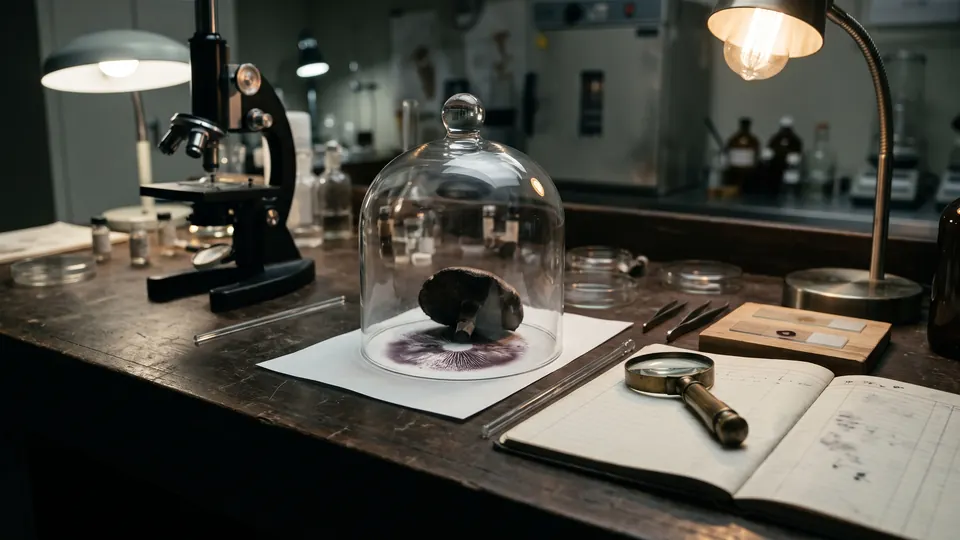
Experts themselves find some groups hard. A 2021 study of the genus Galerina, a group of small brown mushrooms, begins by noting that its roughly 300 species are notoriously difficult to identify by morphology. The authors found amatoxins in all 24 samples of one species complex among 70 samples collected in western British Columbia, and none in the other 46 (Landry et al., 2021). That is a result about one genus in one region. It is cited here only to show that deadly toxins exist in small, plain-looking mushrooms, not to help anyone sort them.
Can the same magic mushroom name mean different things?
Yes, and that is another reason names cannot clear anything. A scientific name, a community nickname and a commercial label carry different information, and a correctly spelled scientific name on a page does not authenticate material somewhere else. In a 2022 study that re-examined 94 Psilocybe fungarium specimens by DNA barcoding, the authors found that, apart from a few well-known species, the taxonomic accuracy of specimen names was largely unreliable, even at genus level (Bradshaw et al., 2022). If museum-held specimens are mislabelled that often, a label on a photo, a chart or a package is a weak guarantee.
Our explainer on the name “Blue Meanies” shows how one familiar name can point to more than one species in the sources. Any page that lists names, including ours, documents the existence of a name. It does not certify a mushroom, a product or a supplier.
Does blue bruising or a lab number prove a mushroom is safe?
No source we opened treats a colour change as a safety test. A colour change is a visible reaction, not an identification and not a measurement; our guide to why magic mushrooms turn blue covers what the chemistry does and does not show. Poison centres’ advice is built on expert identification, not colour.
A laboratory result is also narrower than it sounds. A test for specified compounds answers a specified analytical question about the sample that was tested. The same 2022 study also reported time- and taxon-dependent decay of psilocybin and psilocin, with some specimens showing no detectable amounts (Bradshaw et al., 2022). Our guide to mushroom potency claims explains why sample identity, the compounds measured and the method all matter. A chart comparing strain labels is an editorial claim unless it is tied to traceable analysis, and no label or chart tells you what someone actually has.
The same caution applies to pictures. A reference photograph illustrates one documented specimen; it does not confirm another specimen’s identity. Generated artwork can explain an idea but is not evidence of anything about a real mushroom.
What other risks do official sources describe?
Misidentification is not the only risk. Health Canada lists anxiety and panic attacks among the mental effects of magic mushrooms, and increased heart rate and blood pressure and nausea and vomiting among the physical ones. It says combining magic mushrooms with other substances elevates the risk of serious side effects, that people predisposed to or with existing psychiatric conditions may face an elevated risk of side effects, and that for people with heart disease the rise in heart rate and blood pressure could potentially be harmful (Health Canada, last modified 20 October 2026 when we read it).
The US National Center for Complementary and Integrative Health (NCCIH), writing about psilocybin in a research context, says experiences can be unpredictable and may vary with the amount taken and with a person’s personality, mood, expectations and surroundings. It lists adverse effects that can include increased blood pressure and heart rate, headache, nausea, dizziness, fatigue, poor sleep, anxiety, paranoia, persistent psychosis and hallucinations, and notes that health, the type of mushroom, previous experience and combined use with other drugs can also affect the experience (NCCIH, last updated May 2024).
This guide does not identify a safe amount, schedule or method, and no page here should be used as a reason to delay professional care. In Canada, the production, sale and possession of magic mushrooms are described by Health Canada’s page as illegal. Legal detail changes, so read the history in how magic mushrooms became illegal in Canada and check the official page itself. A film, a testimonial or a chemical comparison does not show that a mushroom treats any condition, and a commercial name is not a clinical protocol.
What does this guide leave out on purpose?
- Any feature, trait or test for telling wild mushrooms apart. The poison centres’ own position is that this needs an expert.
- Foraging, growing, preparing, dosing or “safer use” steps. For general safety information and Toronto help lines, see the Shroomverse safety guide.
- Whether any named mushroom, strain or product is safe, strong or documented. Names are discussed in our introduction to magic mushrooms and its linked explainers, and only as names.
Common questions
Can Shroomverse tell me whether a mushroom is safe from a photo?
No. The site is an educational reference, not an identification or emergency service. The Ontario Poison Centre says only a mushroom expert can tell poisonous from non-poisonous mushrooms. If someone may have eaten a wild mushroom, call a poison centre.
What number do I call in Canada if someone may have eaten a poisonous mushroom?
Poison centres: 1-844-POISON-X (1-844-764-7669) outside Quebec, 1-800-463-5060 in Quebec, and in Ontario also 1-800-268-9017. In Nunavut, contact your local health centre. Call 911 if the person is unconscious, not breathing or having a seizure. Numbers checked 4 October 2026.
Should I wait for symptoms after a possible poisoning?
No. The Ontario Poison Centre says not to wait until the person feels sick to call if wild mushrooms may have been eaten, and both it and US Poison Control say illness can be delayed for many hours.
Does cooking make a wild mushroom safe?
No. The Ontario Poison Centre says cooking outdoor mushrooms does not make them safe to eat.
Does blue bruising prove a mushroom is safe or strong?
No. A colour change is a visible reaction, not an identification or a measurement. Poison-centre advice rests on expert identification. See the guides to why mushrooms turn blue and to potency claims.
Is a lab test a safety certificate?
No. A test answers a specific question about the sample tested, for the compounds measured, by a given method. It does not certify another sample, a name or a supplier.
Does the US poison number work in Canada?
Poison Control says 1-800-222-1222 is for the US only and tells people elsewhere to use local procedures. In Canada, use 1-844-POISON-X (or 1-800-463-5060 in Quebec).
Where do I get help if I am in distress, not poisoned?
9-8-8, Canada’s suicide crisis helpline, offers call or text support 24 hours a day, every day of the year. In an emergency, call 911.
Shroomverse sells mushroom products. This article is general information about mushroom safety, misidentification and where to get help. It is not medical, legal or purchasing advice, and it does not encourage anyone to use drugs.
SOURCES
- Need immediate assistance, Poison Control (National Capital Poison Center). Accessed . US number 1-800-222-1222; US only, with a note that people elsewhere should use local procedures; guidance to call 911 for collapse, seizure, trouble breathing or inability to be awakened.
- Wild mushroom warning, Poison Control (National Capital Poison Center). Accessed . Look-alikes can fool you; symptoms can be delayed for many hours; do not eat a wild mushroom unless a qualified expert has verified it; call a poison center right away at 1-800-222-1222.
- Canadian Association for Poison Centres and Clinical Toxicology (home page), CAPCC. Accessed . 1-844-POISON-X and 1-844-764-7669; Quebec 1-800-463-5060; the instruction to call 911 if a person is unconscious, not breathing or having a seizure.
- Poison centres in Canada, CAPCC. Accessed . Five regional centres open 24 hours a day, seven days a week, staffed by nurses and pharmacists; Ontario, Quebec and Nunavut contact details; per-province numbers.
- Ontario Poison Centre, CAPCC. Accessed . Ontario Poison Centre numbers (1-844-POISON-X, 1-800-268-9017, (416) 813-5900 for the Greater Toronto Area), hours, and areas served.
- Canada launches new toll-free 1-844 POISON-X number for poison centres (20 March 2023), Health Canada. Accessed . 1-844-POISON-X launch; routes callers to their local poison centre; Quebec keeps 1-800-463-5060.
- Message from the Minister of Health: Poison Prevention Week (18 March 2024), Health Canada. Accessed . Describes 1-844 POISON-X (or 1-800-463-5060 in Quebec) as a 24/7 number connecting callers to poison centres nationwide.
- Ontario Poison Centre home page, Ontario Poison Centre, The Hospital for Sick Children (SickKids). Accessed . 1-800-268-9017 toll-free; open 24 hours a day, every day of the year; serves the public and health-care professionals in Ontario.
- Mushrooms (common poisons), Ontario Poison Centre, The Hospital for Sick Children (SickKids). Accessed . Only a mycologist can tell poisonous from non-poisonous mushrooms; illness may be delayed many hours; do not wait for symptoms to call after eating wild mushrooms; cooking does not make them safe.
- Psilocybin and psilocin (magic mushrooms), Health Canada. Accessed . People can eat poisonous mushrooms mistaking them for magic mushrooms; listed effects and risks; combined use raises risk; production, sale and possession described as illegal. Last modified 20 October 2026 when re-read on 24 October 2026.
- Psilocybin for mental health and addiction: what you need to know, National Center for Complementary and Integrative Health (NCCIH), US National Institutes of Health. Accessed . Unpredictable experiences; list of adverse effects; factors that affect the experience. Written about psilocybin in a research context. Last updated May 2024.
- 9-8-8: Suicide Crisis Helpline, 988.ca. Accessed . Call or text 9-8-8; 24 hours a day, every day of the year; website in English and French.
- Phylogenetic analysis of the distribution of deadly amatoxins among the little brown mushrooms of the genus Galerina (Landry et al.), PLoS One 16, 2021. Accessed . Abstract read via Europe PMC. Galerina species are described as notoriously difficult to identify by morphology; amatoxins found in 24 of 70 samples from western British Columbia, all within one species complex.
- DNA Authentication and Chemical Analysis of Psilocybe Mushrooms Reveal Widespread Misdeterminations in Fungaria and Inconsistencies in Metabolites (Bradshaw et al.), Applied and Environmental Microbiology 88, 2022. Accessed . Abstract read via Europe PMC. 94 specimens re-examined; specimen names largely unreliable apart from a few well-known species; taxon- and time-dependent decay of psilocybin and psilocin.
CHANGES
- : Published.
- : Added source links beside figures and legal statements.
- : Re-read Health Canada’s psilocybin page, updated on 20 October 2026, and corrected its date here. The statements this article cites from it are unchanged; the risk sentence now keeps the page’s own hedging (“may” for psychiatric conditions, “could potentially be harmful” for heart disease).



