THE SHROOMVERSE JOURNAL ✳ 24 MIN READ
How Magic Mushrooms Grow: From Spore to Mushroom
Learn how magic mushrooms grow, from spores to harvest: the psilocybin mushroom lifecycle, natural habitats, contamination risks, and safe storage.
On this page 12 sections
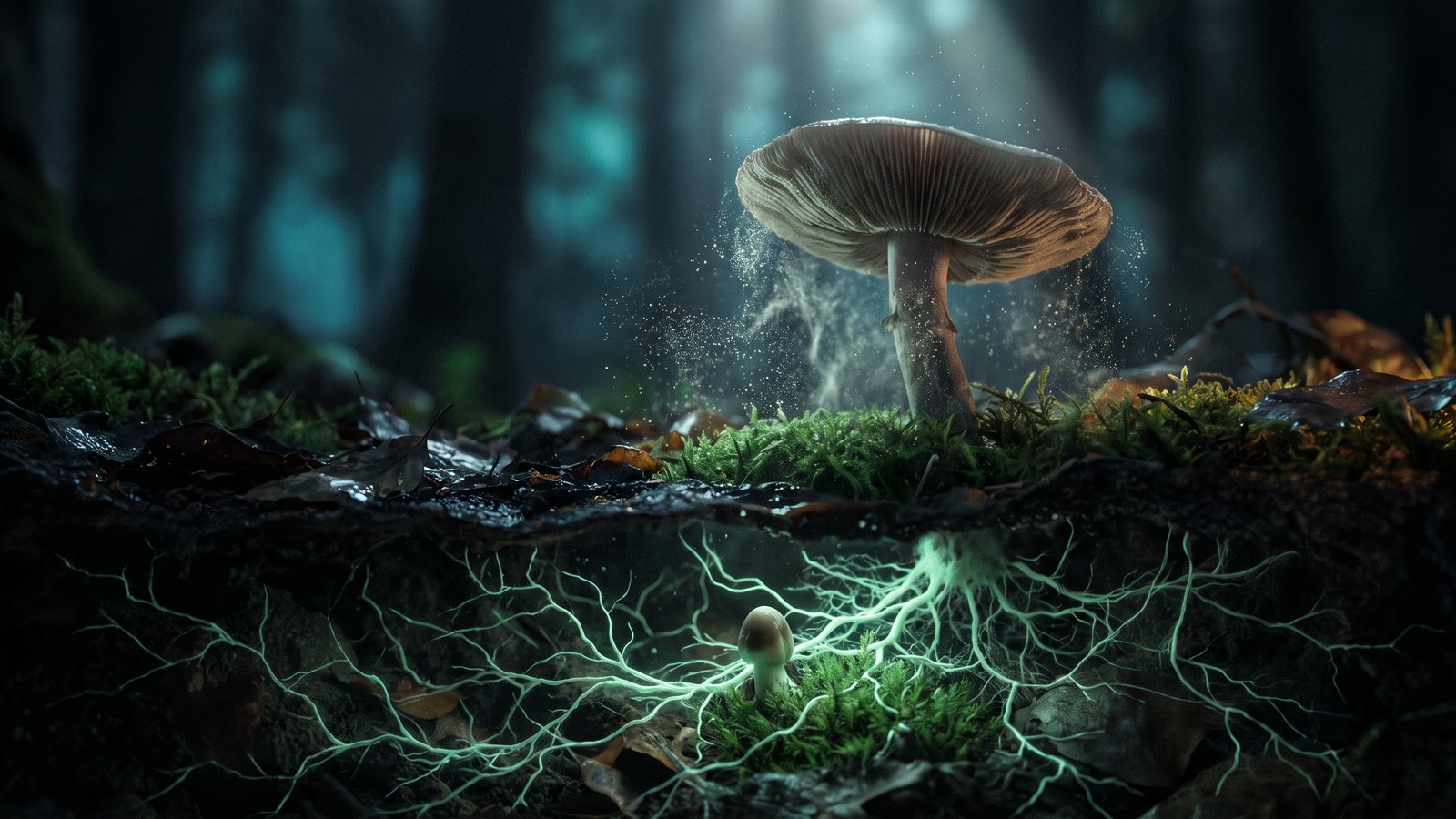
A mushroom can appear almost overnight after rain. That sudden arrival makes it easy to miss the much longer story underneath: a fungus has been growing through soil, wood, or another food source before you ever see a cap. Understanding how magic mushrooms grow starts with that hidden network, not with the mushroom itself, and that's true whether it's a wild species or a cultivated strain like Blue Meanie.
This is a biological review of psilocybin-producing fungi. You'll learn what spores, mycelium, and fruiting bodies do; why different species appear in different habitats; and what visible changes can, and can't, tell you about fungal health. The sections on indoor growing describe concepts rather than provide a cultivation recipe, since laws differ and contaminated or misidentified mushrooms can pose real risks. Likewise, descriptions of harvesting and storage are about understanding quality and safety, not instructions for producing or using psilocybin.
One distinction is worth keeping in mind throughout: "magic mushroom" isn't a single species. The familiar Psilocybe cubensis, the species behind strains like Golden Teacher, is only one example, and its habitat doesn't describe every psilocybin-containing fungus. Once you separate the species from the lifecycle, the whole subject gets easier to follow, no mushroom-growing experience required.
Key Takeaways
- Magic mushrooms are the fruiting bodies of certain psilocybin-producing fungi. Mycelium grows through a food source before a mushroom becomes visible.
- Spores, germinating hyphae, mycelium, young fruiting bodies, and mature mushrooms have different roles in the fungal lifecycle.
- Species differ in their relationships with decaying wood, dung, and other organic material; habitat alone cannot establish identity.
- Moisture, temperature, air movement, and other environmental conditions influence fruiting, but no single cue guarantees mushrooms will appear.
- Indoor-growth terminology describes biological stages and contamination risks, not proof that a culture is pure or a specimen is safe.
- Harvest appearance, drying, and storage cannot verify potency, remove toxins, or make an unidentified mushroom safe to consume.
What Are Magic Mushrooms (Psilocybin Mushrooms)?
"Magic mushrooms" is a common name for fungi that contain psilocybin, a compound the body converts to psilocin. These substances can alter perception, mood, and sense of time. Psilocybin-producing species occur in several fungal groups, although Psilocybe is the genus most people recognize.
You shouldn't assume that mushrooms sharing a nickname share the same appearance, ecology, or chemical content. A small brown cap, for example, is hardly a species-level identification. Many unrelated mushrooms look similar, and some are poisonous. Neither appearance nor a folk name makes a wild mushroom safe to eat.
In biological terms, a magic mushroom is a fruiting body: the visible reproductive structure made by a larger fungal organism. The organism's less visible growth, called mycelium, can occupy its food source long before a mushroom appears. That's why a patch that looks empty one week may look busy after a spell of wet weather.
Like other fungi, these organisms are neither plants nor animals. They do not obtain energy by photosynthesis. Instead, their growing filaments release enzymes into surrounding material and absorb nutrients. Every strain feeds this way, from common cultivars to high-potency ones like Penis Envy. That feeding process connects the appearance of mushrooms to what is happening inside a log, beneath leaf litter, or within another suitable food source.
There's a legal distinction, too. Rules concerning psilocybin, spores, possession, and cultivation vary by jurisdiction and can change. A medical research program or a locally permitted service does not automatically make home cultivation lawful. For this review, the useful question is not "Where can you find a shortcut?" but "What is the fungus doing at each stage?"
How Does a Mushroom Grow? The Fungal Lifecycle Explained
Picture a mushroom as an apple on a tree, except the "tree" is usually a fine, branching network tucked inside another material. The comparison isn't perfect, but it fixes a common misconception: the cap and stem aren't the whole organism.
Most of the lifecycle involves growth through a food source. When conditions support reproduction, some fungi form mushrooms that release spores. What happens between those events depends on the species and its surroundings; a spore landing somewhere does not guarantee a new mushroom patch.
The lifecycle is also less tidy than a diagram suggests. Spores may fail to germinate, early growth may be outcompeted, and an established mycelium may continue feeding without producing a visible mushroom. A fruiting event is one possible outcome of ongoing fungal growth, not the point at which the fungus first comes to life.
Spores vs. Mycelium vs. Fruiting Bodies (What Each Stage Does)
Spores are reproductive cells that can disperse by air, water, or animals. They're a means of reaching new places, not tiny fully formed mushrooms. If a spore finds a suitable environment and germinates, it produces threadlike growth called a hypha. Hyphae branch and interact, forming the network known as mycelium.
Mycelium obtains nutrients by releasing enzymes into its surroundings and absorbing the resulting smaller molecules. Depending on the species, its food might be decaying wood, plant debris, or dung. A fruiting body is a specialized structure produced by established mycelium. Its job is reproduction: it develops spore-bearing tissue and helps disperse the next generation.
These structures operate at different scales. A spore is a dispersal unit; hyphae are individual growing filaments; mycelium is the interconnected growth those filaments form. What people call a mushroom is a temporary, visible expression of that network. The network can persist after a cap collapses or disappears.
Colonization vs. Fruiting: What Changes Biologically and Environmentally
During colonization, the fungus spreads through an available food source. You're looking at resource acquisition: branching growth, nutrient absorption, and competition with other microorganisms. During fruiting, some of those resources support the formation of reproductive structures.
The shift is not a simple on/off switch controlled by one factor. Moisture, temperature, air movement, light, available nutrients, and species-specific biology can all matter. Outdoors, those signals arrive together as the weather and habitat change. A stretch of rainfall, for instance, may affect both the fungus and the microorganisms around it.
That's also why two neighboring patches can behave differently. One may hold moisture beneath leaves while the other dries in an afternoon. You might see mushrooms in the first patch and none in the second, even though mycelium is present in both. No visible mushroom doesn't necessarily mean no fungus.
Fruiting also changes what an observer can learn. A mushroom reveals that the organism reached a reproductive stage in that place and moment. It does not reveal the full extent of the mycelium, how long it has been present, or whether it will fruit again.
How Magic Mushrooms Grow in Nature (Where They're Found and Why)
In nature, psilocybin-producing fungi fill ecological roles rather than following a single "magic mushroom" playbook. Many help break down dead organic matter, returning nutrients to the surrounding ecosystem. Where you see a fruiting body reflects both the species' food source and the conditions at that particular moment.
Habitat descriptions are useful for understanding ecology. They are not a reliable way to identify a mushroom: poisonous and non-psilocybin species can share the same ground, season, and general appearance.
Common Habitats: Wood-Loving vs. Dung-Loving Species
Some species are associated with decaying wood or woody debris. Others are associated with dung or nutrient-rich grassland. Psilocybe cyanescens, for example, is often described as wood-associated, while Psilocybe cubensis is associated with dung in warm regions. Those examples show how different their ecological niches can be; neither is a field identification guide.
A mushroom's visible position can be misleading. A cap standing in grass may be connected to buried woody material, and a specimen near dung may be growing from something else entirely. Even the word "wood-loving" simplifies a messy setting populated by bacteria, insects, plants, and other fungi. Competition and decomposition are happening at the same time.
The food source matters because a fungus must obtain usable nutrients before it can invest in a fruiting body. It also shapes the surrounding microbial community. Decaying wood and dung differ not just in appearance but in how they retain water, break down, and host other organisms. A species' association with one habitat is therefore an ecological relationship, not a promise that it will appear wherever that material is found.
Seasonality and Climate: Temperature, Rainfall, and Microclimates
Fruitings often follow patterns of moisture and temperature, but there is no universal season for all psilocybin-containing species. Local climate matters more than a calendar date. A temperate coastal area, a warm pasture, and a sheltered urban garden can offer very different conditions.
Microclimates explain some of the surprises. Shade slows drying; leaf litter buffers temperature; exposed ground changes quickly after sun or wind. Rain may make mushrooms conspicuous for a short window, while dry weather leaves the underlying fungus out of sight. If you're studying fungi outdoors, notice those contrasts without treating them as clues that a particular wild mushroom is edible.
Weather can also change several conditions at once. Rain adds water, but it may also cool a surface or alter how quickly it dries afterward. Observing mushrooms after rain does not prove that rain alone caused them to form; the mycelium's development and the recent history of its habitat matter too.
For a closer look at how researchers classify fungi and their ecological roles, the U.S. Forest Service overview of fungi is a useful starting point.
How Magic Mushrooms Grow Indoors: Overview of the Cultivation Workflow
Indoors, the broad biology stays the same: a fungus must establish mycelium in a food source before it can produce fruiting bodies. Descriptions of cultivation commonly divide that process into preparing materials, introducing fungal material, observing mycelial growth, and observing fruiting. Those labels explain what happens, not how to carry it out.
An indoor setting also changes the ecological picture. Instead of encountering whatever competitors live in a patch of soil or wood, the fungus encounters microorganisms introduced through materials, surfaces, air, or handling. A container that looks controlled to you isn't necessarily free of microbial competition.
Control has limits for another reason: different parts of an enclosed space can have different conditions. The air outside a container, the air inside it, and the damp surface of its contents are not identical environments. Measuring one does not establish what the fungus experiences everywhere. This helps explain why indoor growth is discussed in terms of both the organism and its immediate surroundings.
Legal and Safety Note: Know Your Local Laws and Avoid Wild Misidentification
Before considering anything beyond biology, check current rules where you live. Psilocybin-related laws differ across countries, states, and cities, and rules for research, regulated services, possession, and home growing may not match. Don't infer permission from a product listing or a social-media post.
Wild identification is a separate safety issue. Photos, habitat, bruising, and online consensus can all fail as stand-alone identification methods. Some look-alike fungi are dangerous. If you're interested in learning field mycology, a local mycological society can help you practice observation without treating an uncertain specimen as food. If anyone may have eaten an unidentified mushroom, seek urgent medical advice; in the United States, Poison Control can help.
Supplies and Setup: Substrates, Spawn, and Sterile Technique
You'll encounter plenty of equipment lists when reading about indoor fungi. The underlying concepts are simpler: substrate means the material a fungus obtains nutrients from, while spawn generally means material already carrying growing mycelium. Clean handling aims to reduce unwanted organisms. None of those terms guarantees success, or safety.
Because equipment choices can become a cultivation recipe, this section compares their biological roles rather than giving a setup or operating instructions. If your interest is hands-on mycology, legally cultivated edible species offer a way to explore the same core lifecycle.
Substrate Options and When to Use Them (Grain, CVG, Manure-Based, Wood-Based)
Different fungi exploit different resources. Grain is nutrient-rich and frequently discussed as a carrier of mycelium. Wood-based materials resemble the food source of wood-decaying fungi. Manure-based materials reflect the ecology of species associated with dung. CVG is shorthand for coir, vermiculite, and gypsum; in hobby discussions, it refers to a material mix rather than a fungal species or lifecycle stage.
These categories aren't interchangeable merely because each can support some kind of fungal growth. Species, nutrient content, moisture retention, and microbial competition all affect what happens next. The useful takeaway is ecological: before you can make sense of a substrate claim, ask what the fungus normally decomposes and what else might grow on that material.
It's also worth separating food from structure. Components of a material may contribute nutrients, hold water, or change its physical texture. Calling a mix a substrate tells you that it surrounds and supports fungal growth; it does not tell you which component the fungus can digest or whether unwanted organisms can thrive there too.
Tools Checklist: Pressure Cooker, SAB/Glove Box, Tubs/Bags, Thermometer/Hygrometer
These names describe different jobs, not a shopping list you need to complete:
| Tool or container | General purpose | What it cannot tell you |
|---|---|---|
| Pressure cooker | Heat-processing certain materials | Whether a later culture is uncontaminated |
| Still-air box (SAB) or glove box | Limiting air movement during handling | Whether a surface or sample is sterile |
| Tubs or bags | Holding materials in an enclosed space | Whether growth is the intended fungus |
| Thermometer or hygrometer | Measuring temperature or relative humidity | Whether the fungus is healthy or safe |
A hygrometer reading may look reassuringly precise. It's still one measurement in a living system, and a clean-looking container is not proof of purity. Each tool addresses a limited question: heat processing concerns material before growth, an enclosure changes exposure during handling, and an instrument reports a physical condition rather than biological identity.
Sterilization vs. Pasteurization (What to Use for Which Materials)
Sterilization aims to eliminate viable microorganisms from a material. Pasteurization reduces microbial populations without necessarily eliminating them. Food safety uses the same distinction: pasteurized milk isn't sterile milk.
Which approach is appropriate depends on the material and the permitted application. Nutrient-dense materials and bulkier organic matter present different microbial challenges, so you shouldn't treat the words as interchangeable or assume that heating makes questionable growth safe. Even properly processed material can be contaminated afterward. Visible mold, unusual wet patches, or a strong off-odor deserve caution, not a taste test.
That distinction also explains why contamination can appear after an apparently clean beginning. Processing a material and protecting it from later exposure are different challenges. Neither a label describing the processing method nor a clean-looking exterior establishes what is growing throughout the material.
Step-by-Step: How Magic Mushrooms Grow (Stage-by-Stage)
The stages below are a map of fungal development, not a step-by-step growing procedure. That distinction matters: you can understand why mushrooms appear, and why they sometimes don't, without needing operating settings or an indoor recipe.
Think of the sequence as a relay. Reproductive material or an existing culture establishes growth; mycelium spreads through a food source; under suitable circumstances, it forms small fruiting structures; those structures mature and may release spores. At every handoff, competing microbes or unsuitable surroundings can change the outcome.
1) Inoculation: Spores vs. Liquid Culture vs. Agar (Pros/Cons and Contamination Risk)
Inoculation means introducing fungal material to a potential growth environment. Spores are reproductive cells and may vary genetically. Liquid culture refers to mycelium growing in liquid; agar is a gel used to observe and maintain cultures. Those differences matter because a mixed or contaminated starting sample can carry problems into later growth.
| Starting material | Biological advantage | Important limitation |
|---|---|---|
| Spores | Represent a dispersal and reproductive stage | Germination and resulting growth can vary |
| Liquid culture | Contains already-growing fungal tissue | Contamination may be difficult to judge by appearance |
| Agar culture | Allows growth to be observed on a surface | Appearance alone cannot establish safety or identity |
You don't need to memorize laboratory terminology to grasp the key point: the apparent source of growth is not necessarily the only thing growing. A culture's format affects what can be observed, but observation by eye has limits regardless of format.
2) Colonization: Ideal Temperature, Gas Exchange, and Timelines
As mycelium colonizes a material, hyphae extend through it, access nutrients, and interact with nearby microorganisms. Temperature and available oxygen influence fungal metabolism, but there is no single "ideal" value or dependable timeline for every psilocybin-producing species and material. Growth that seems slow may reflect biology, its surroundings, or competition.
You may see people equate faster growth with healthier growth. That's shaky logic. Some contaminants spread rapidly, while established mycelium can look different across species and food sources. A photo taken on one day can't settle what's happening inside an enclosed material.
Colonization is more than a change in color or surface coverage. The fungus must reach and use resources within the material, much of which may be hidden. Conversely, visible growth does not establish that every part of a material contains the same organism or has the same conditions.
3) Fruiting Conditions: Humidity, Fresh Air Exchange, Light, and Surface Conditions
Fruiting bodies need water to expand, and their development responds to the environment around them. Air movement affects gas concentrations and evaporation; light can serve as a cue in some fungi. The immediate surface, the boundary between mycelium and air, has its own moisture conditions, which may differ from a room-wide humidity reading.
That explains a common beginner puzzle: "The room feels humid, so why does the surface look dry?" Those are different observations at different scales. More importantly, no single visible cue proves that a fungus is ready to fruit. Species and overall health remain part of the picture.
The mycelium must also have the capacity to produce fruiting bodies. Favorable-looking surroundings cannot compensate for an unsuitable species, exhausted resources, or serious microbial competition. Environmental cues influence development; they do not create a healthy organism where one is absent.
4) Pinning and Maturation: What Healthy Growth Looks Like and Common Stall Causes
Pins are young fruiting bodies. If development continues, they expand into recognizable mushrooms with spore-producing structures. Size and shape can vary naturally, so a small mushroom isn't automatically unhealthy, and a large one isn't automatically safe.
Stalled development can have several possible explanations: the mycelium may be stressed, the available resources may be limited, conditions may fluctuate, or competing organisms may be present. A cluster of changes is more informative than one imperfect-looking cap. If you see suspicious discoloration or slimy growth, resist the urge to "rescue" material that may be contaminated. Your health matters more than a specimen.
From an ecological perspective, a pin is an investment of the mycelium's resources, not a guarantee of a mature mushroom. Some young structures stop developing while others continue. That variation is another reason a single snapshot cannot reliably distinguish ordinary developmental change from a larger problem.
Common Problems and Contamination: Identification and Fixes
Fungi seldom grow alone. Bacteria, molds, and yeasts can share the same materials, sometimes thriving under conditions that also suit the intended fungus. That's why contamination is a safety concern, not merely a disappointing result.
A practical rule: don't rely on a single photograph, color, or smell to declare a questionable specimen safe. If growth looks abnormal, avoid breathing disturbed dust, tasting it, or assuming that removing the visible patch removes the underlying organism. For any suspected exposure or illness, get medical advice.
Most Common Contaminants (Trichoderma, Bacteria) and Early Warning Signs
Trichoderma is a genus of molds often discussed in fungal cultivation; some species can develop conspicuous green spores. Bacterial activity may be associated with wet-looking areas, altered texture, or an unpleasant odor. Those observations are warning signs, not dependable home diagnostics. Other molds can also be green, and bacteria may be present without an obvious smell.
A new white patch isn't automatically the intended mycelium, either. Early mold growth can be pale before spores become visible. The safest response to suspicious material is to leave it undisturbed and follow appropriate local guidance for handling moldy waste, rather than scraping or sniffing it for a closer look.
Visible contamination may also be only part of the picture. Microorganisms can grow beneath a surface or spread through material before their distinctive features appear. Removing a discolored area therefore cannot establish that the rest is free of contamination.
Troubleshooting: No Pins, Fuzzy Feet, Cracked Caps, Aborts, Low Yields
These hobbyist terms describe appearances, not diagnoses. No pins means no young fruiting bodies are visible. "Fuzzy feet" refers to extra growth near a stem's base; "cracked caps" describe split cap surfaces. Aborts are young fruiting bodies that stop developing, and low yields mean fewer mushrooms than someone expected.
Why the caution? The same appearance can have more than one cause. Dryness, changing air conditions, genetics, limited resources, and contamination can overlap. Rather than assigning a quick fix from a photo, first ask whether the specimen is securely identified, whether contamination is possible, and whether the activity is legal where you are. If safety is uncertain, don't consume it.
Expectations can be misleading as well. Comparing one species, food source, or fruiting event with another may make normal variation look like a failure. A careful description of what changed is more useful than treating every unusual shape or delay as evidence of one specific cause.
Harvesting: When to Pick and How to Maximize Flushes
A flush is a wave of fruiting bodies produced by a fungal network. Some species and food sources can support more than one wave; others may not, especially if resources are depleted or competing organisms take hold. More fruiting does not necessarily mean better quality, and visual abundance says little about chemical content.
Because harvest timing and methods would turn this biological review into a cultivation guide, the useful focus here is what maturation tells you. A mushroom changes quickly as it develops, while the underlying mycelium continues responding to its surroundings.
Best Harvest Window (Veil Cues) and Gentle Removal Methods
In some mushrooms, a thin tissue called a partial veil connects the cap's edge to the stem while the fruiting body is young. As the cap expands, that tissue may tear. It's a visible sign of development, not a universal measure of potency, safety, or identity. Veils vary by species and can be hard to see or absent in a damaged specimen.
Handling any unidentified mushroom gently limits damage to features that a qualified identifier might need to examine. It does not make wild mushrooms safe to consume. If identification matters, leave the specimen intact and seek knowledgeable, local guidance rather than relying on a harvest-window rule.
Cap shape, veil remnants, and other visible features can change as a fruiting body ages. That is useful when studying development, but it also explains why photographs of the same species at different stages may look unlike one another. No stage supplies a shortcut around careful identification.
Rehydration/Dunking and Preparing for the Next Flush
Fruiting bodies contain a great deal of water, and a food source's moisture changes as mushrooms develop. That's the biological reason growers discuss rehydration between flushes. But additional water cannot restore depleted nutrients or undo contamination; more isn't automatically better.
The second-wave question also reveals something about fungi in nature. After a rainy period, a patch may produce mushrooms, fall quiet, then fruit again when circumstances change. To an observer, it can look as though the mushrooms "came back." The mycelium may never have left. If material shows signs of mold or decay, though, don't interpret another flush as proof that it's safe.
Drying and Storage (Potency and Quality Basics)
Once a mushroom is separated from its food source, it begins changing. Water loss affects its texture, while moisture left behind can support spoilage. Chemical content may also vary across species and individual specimens; appearance cannot tell you a reliable dose.
This section explains the vocabulary you may encounter, not how to prepare psilocybin mushrooms for use. Where possession is illegal, storage can create legal risk. And where a mushroom's identity is uncertain, drying can make later identification harder by changing its color and shape.
Drying Methods: Fan-Dry vs. Dehydrator and "Cracker Dry" Standard
A fan moves air around a mushroom; a dehydrator combines airflow with controlled heat. In discussions of preserved mushrooms, "cracker dry" means brittle rather than bendy. It's an informal texture description, not a measurement of water content and certainly not evidence that a specimen is safe.
Neither drying approach removes poisonous compounds from a misidentified species or reliably remedies mold contamination. A dried mushroom can also lose features useful for identification. If you encounter an unknown specimen, preserving its identity information and avoiding consumption are more important than trying to judge it by texture.
Drying and chemical stability are separate questions. A change in texture tells you something about water loss, not how much psilocybin a specimen contained initially or what remains later. Species differences and uncertainty about identity still matter after a mushroom has been preserved.
Storage Best Practices: Airtight Containers, Desiccants, Cool/Dark Conditions
Airtight containers, desiccants, and cool, dark conditions are commonly discussed because moisture, air, and light can affect many dried biological materials. Yet none of those measures can verify species, prevent every chemical change, or make contaminated material safe. A container can preserve a mistake just as efficiently as anything else.
For research or educational collections, clear labeling of location, date, and who identified a specimen (along with its species, if established) has more value than a mystery jar on a shelf. Keep any biological specimens away from children and pets, and follow local law. If someone may have ingested an unknown mushroom, contact a poison center promptly rather than waiting for symptoms.
Conclusion
Spores disperse, mycelium establishes itself in a suitable food source, and fruiting bodies appear when the organism and its environment support reproduction. Species and habitat shape every stage. If you're new to fungi, start by observing that lifecycle in legally available edible mushrooms or with a local mycology group. You'll learn to notice the hidden network behind the sudden cap, and you won't have to gamble on a wild identification.
Frequently Asked Questions About How Magic Mushrooms Grow
What are the main stages in the growth of magic mushrooms?
Spores may disperse and germinate into hyphae. Those filaments can form mycelium that grows through a suitable food source. Established mycelium may then produce young fruiting bodies, which can mature into visible mushrooms and release spores. Not every spore or mycelial network reaches the fruiting stage.
How does the environment affect the growth of magic mushrooms?
Moisture, temperature, air movement, light, available food, and competing organisms can influence growth and fruiting. Rainfall may coincide with visible mushrooms, but species and local microclimates help determine what happens in any particular patch.
Why is mycelium important in the lifecycle of magic mushrooms?
Mycelium is the network of fungal filaments that grows through a food source, releases enzymes, and absorbs nutrients. It supports fruiting bodies and may remain present even when no mushrooms are visible.
Can you identify magic mushrooms just by their appearance or habitat?
No. Unrelated mushrooms can share a habitat and resemble one another, including poisonous look-alikes. A photograph, bruising pattern, or location alone cannot establish that a wild mushroom is safe.
What is the difference between spores, mycelium, and fruiting bodies in magic mushrooms?
Spores are dispersing reproductive cells. Mycelium is the growing network that obtains nutrients from surrounding material. Fruiting bodies are the visible structures that develop spore-bearing tissue.
How do indoor growing conditions differ from natural growth for magic mushrooms?
The biological stages are the same, but an indoor environment changes exposure to competing microorganisms and the conditions immediately surrounding the fungus. Enclosures and measurements do not guarantee a pure culture or a safe specimen, and local laws may restrict cultivation.



